Density meter
Measures the density or specific gravity of a liquid in about a minute, using a vibrating glass U-tube. It replaces the pycnometer for most routine work.
- Pharmaceutical
- Food & beverage
- Spirits & brewing
- Chemicals
- Petrochemicals
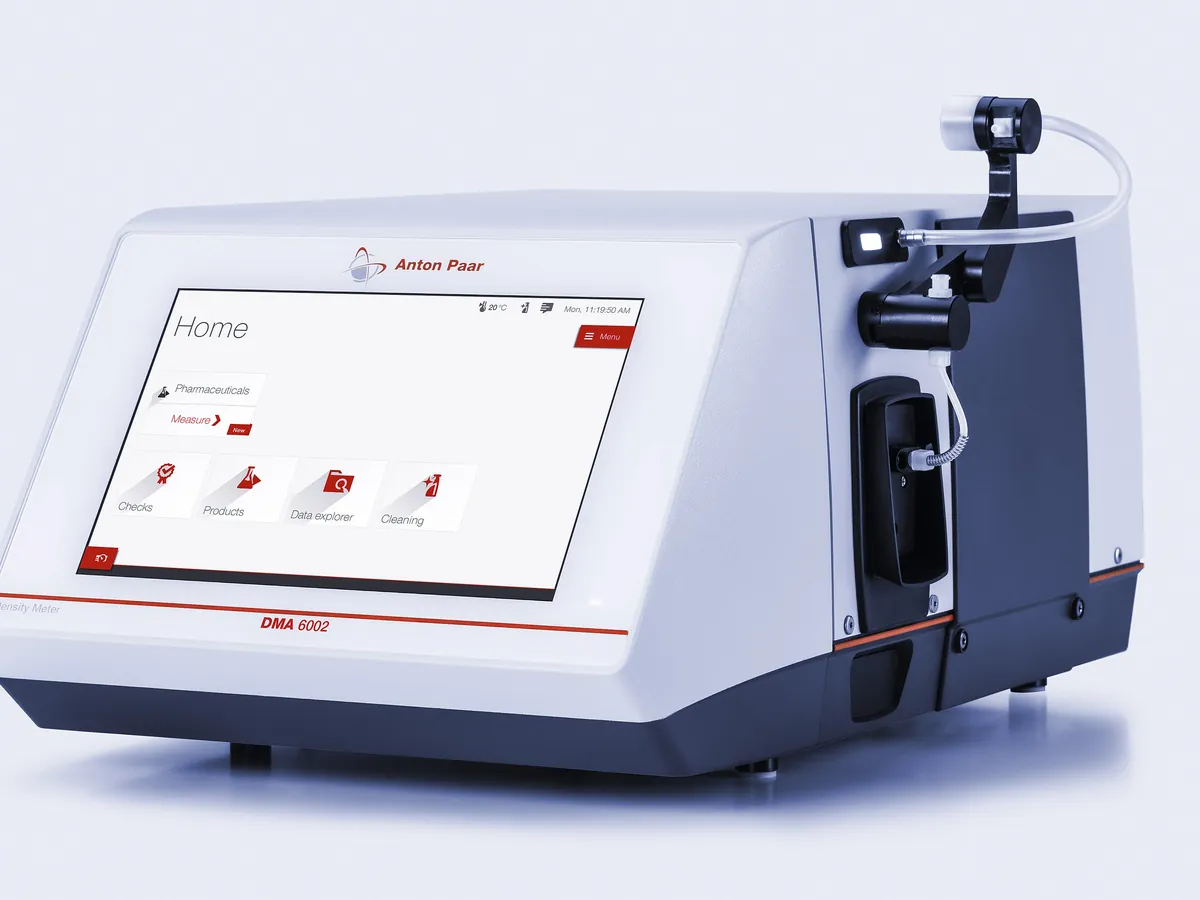
How Density meter works
A hollow glass U-tube is made to vibrate electronically. Its natural period of vibration depends on its total mass, which is the mass of the glass plus the mass of the sample filling the fixed volume. The density follows the relation ρ = A × τ² − B, where τ is the period and A and B are instrument constants found by adjusting with two substances of known density, usually air and water.
The path of a sample
- 01
Fill
About 1–2 mL of sample is injected by syringe or drawn by a pump into the U-tube, with no bubbles.
- 02
Thermostat
The Peltier block holds the tube at the set temperature, for example 20.00 °C.
- 03
Excite
A magnet and pick-up coil drive the tube to vibrate at its natural frequency.
- 04
Measure period
The instrument measures the period of oscillation very precisely.
- 05
Calculate
Density is calculated from the period using the adjustment constants, with automatic viscosity correction if fitted.
- 06
Report
Density, relative density or concentration is displayed with the temperature and sent to the LIMS.
Main parts and what they do
Oscillating U-tube
Borosilicate glass tube that holds the sample and vibrates.
Exciter and pick-up
Magnet and coil (or piezo) system that drives the vibration and measures its period.
Reference oscillator
Second oscillator in some models that compensates for temperature and ageing effects.
Peltier thermostat
Holds the tube at the measuring temperature, typically to ±0.03 °C or better.
Filling system
Syringe adapter, peristaltic pump or autosampler for filling, rinsing and drying.
Air pump / dryer
Blows dry air through the tube to clean and dry it between samples.
Camera / bubble detection
Shows the tube on the screen so the analyst can see bubbles or particles.
Display and software
Shows results, stores methods and adjustment data, and transfers results.
Terms every analyst should know
Density (ρ)
Mass per unit volume, in g/cm³ or kg/m³. Water at 20 °C is about 0.99820 g/cm³.
Relative density / specific gravity
Density of the sample divided by the density of water, at stated temperatures, for example d 20/20. It has no unit.
Oscillation period
The time for one vibration of the U-tube. A denser sample makes the period longer.
Air and water adjustment
The two constants A and B are found by measuring two known densities: dry air and pure water.
Viscosity correction
Viscous samples damp the vibration and make the density read slightly high. Modern meters measure the damping and correct for it.
Keep every Density meter in control: usage logs, calibration and maintenance schedules, and automatic blocking of overdue instruments.