Density meter · Calibration procedure
Air and water check
Measures dry air and pure water in the U-tube at the measuring temperature and compares each reading with its known density.
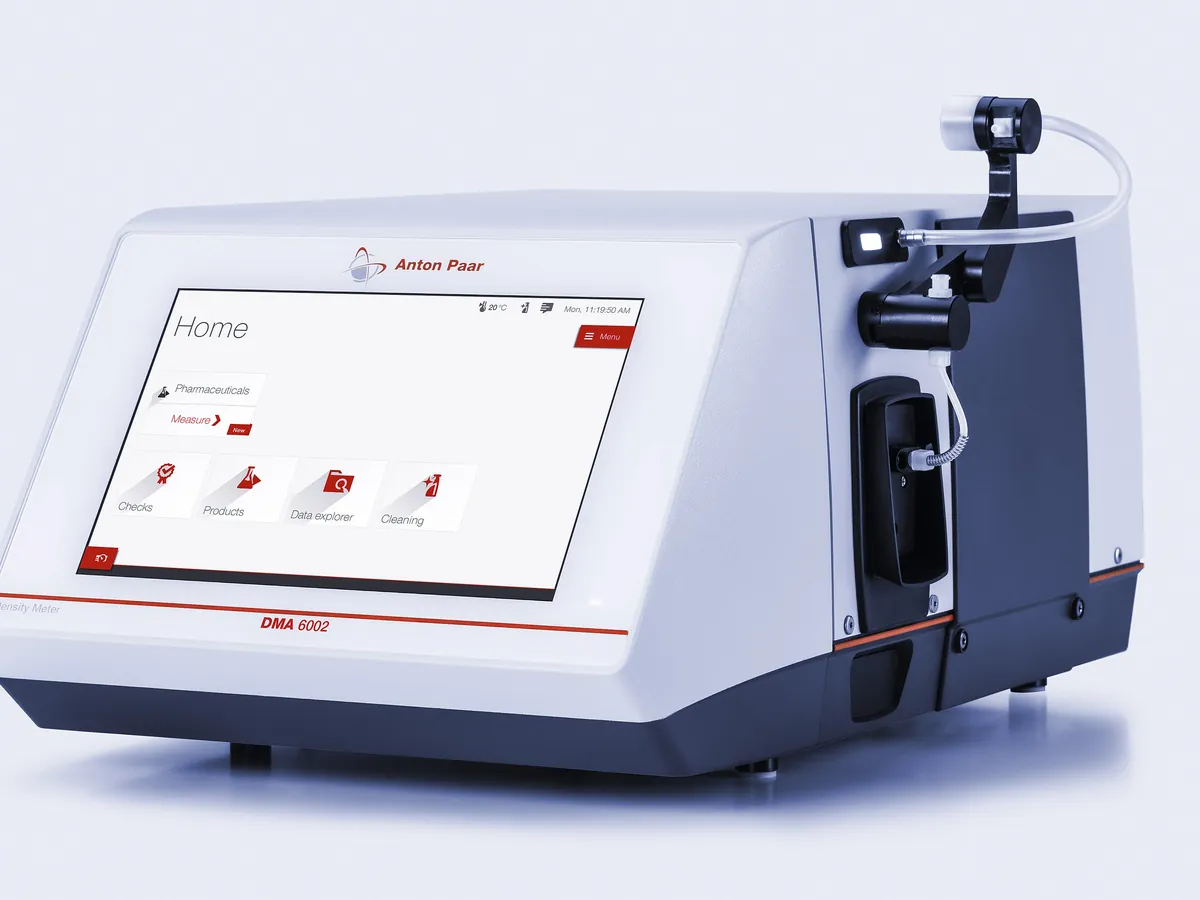
PURPOSE
Why this is checked
The density meter calculates density from two constants found with air and water. Checking both shows whether the tube is clean, dry and still correctly adjusted.
Frequency
Typically daily or before use, and after cleaning or maintenance, as defined in your SOP. A full calibration with certified standards is usually done every 6 or 12 months.
Learn how the Density meter worksYOU WILL NEED
Standards & tools
- Dry air (density calculated by the instrument from the barometric pressure and temperature, about 0.00120 g/cm³ at 20 °C and 1013 hPa)
- Freshly boiled and cooled purified water (0.99820 g/cm³ at 20 °C)
BEFORE YOU START
Prerequisites
- Tube cleaned and dried
- Temperature set to 20.00 °C and stable
- Barometric pressure entered or measured by the instrument
PROCEDURE
Step by step
- 1With the tube dry, start the air check. Record the reading and the expected air density.
- 2Fill the tube slowly with degassed purified water, checking for bubbles.
- 3Start the water check and record the reading.
- 4Compare each reading with the expected value.
- 5Rinse and dry the tube.
RECORD
Example observation table
| Standard | Expected (g/cm³ at 20 °C) | Observed (g/cm³) | Difference (g/cm³) | Result |
|---|---|---|---|---|
| Dry air (1013 hPa) | 0.00120 | 0.00121 | +0.00001 | Pass |
| Purified water | 0.99820 | 0.99822 | +0.00002 | Pass |
CALCULATION
How to calculate the result
Difference = Observed − Expected
- Air density at 20 °C and 101.325 kPa = p ÷ (R × T) = 101325 ÷ (287.05 × 293.15) = 1.204 kg/m³ = 0.00120 g/cm³
- Air: 0.00121 − 0.00120 = +0.00001 g/cm³
- Water: 0.99822 − 0.99820 = +0.00002 g/cm³
ACCEPTANCE CRITERIA
Pass if
- Water within the limit in your SOP, commonly ±0.0001 g/cm³ for a 4-decimal instrument (tighter for higher-resolution models).
- Air within the limit set by the manufacturer or your SOP.
IF IT FAILS
What to do
- Clean the tube thoroughly, dry it and repeat with fresh degassed water.
- If it still fails, perform an air and water adjustment as the manufacturer describes and check again with a certified density standard.
- If it fails after adjustment, call service and assess results since the last pass.
In LimsPulse · Calibration Management
LimsPulse schedules this calibration, records the result against limits, and blocks the instrument everywhere if it fails or goes overdue.