Colorimeter / colour spectrophotometer
Measures the colour of a surface or liquid as numbers in a standard colour space such as CIE L*a*b*, and the colour difference (ΔE*) from a standard. Used for batch-to-batch colour matching of paints, plastics, chemicals and cosmetics.
- Paints & coatings
- Polymers & plastics
- Chemicals
- Oils & fats
- Textiles
- Cosmetics
- Food
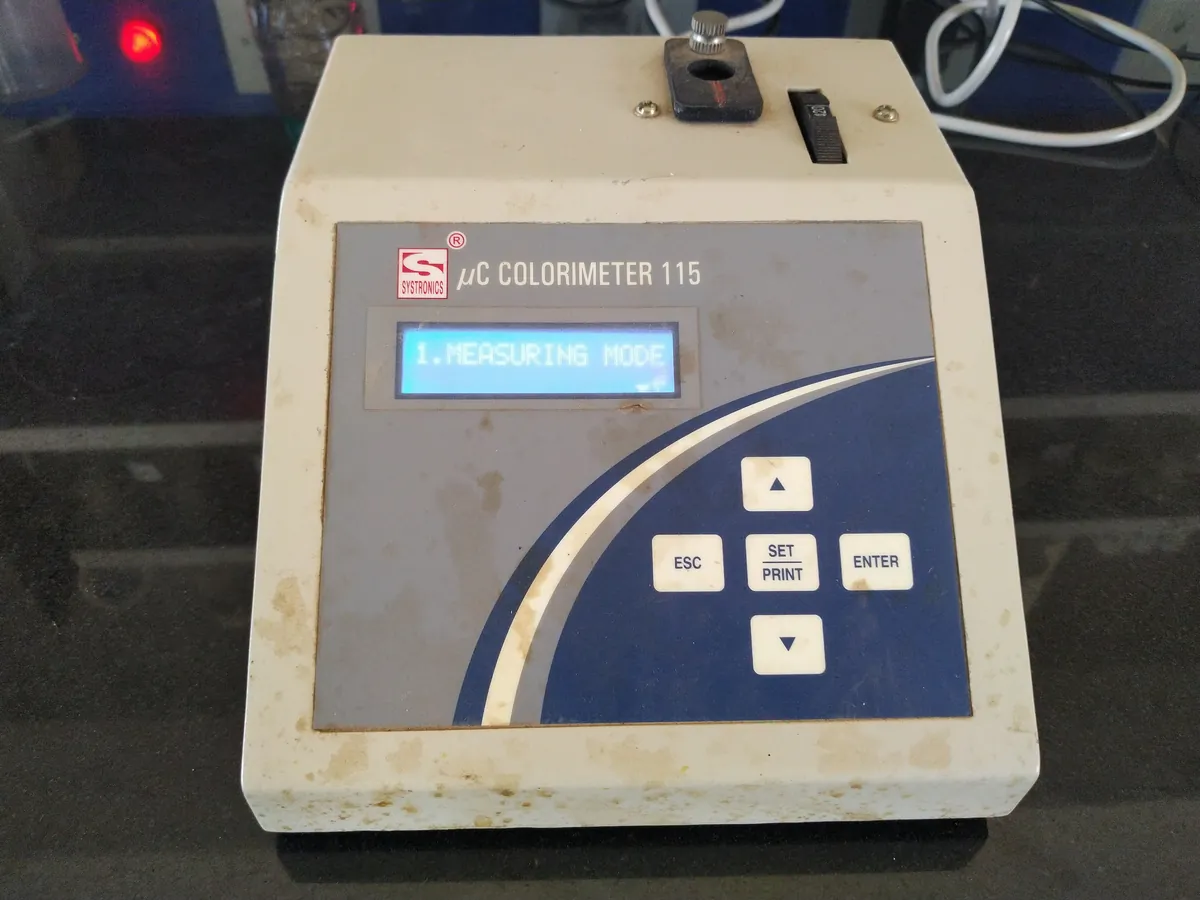
What is Colorimeter?
The eye judges colour differently from person to person and under different lights. A colorimeter replaces this with numbers. It illuminates the sample, measures the reflected (or transmitted) light, and calculates colour coordinates using standard CIE illuminants and observers. The most used coordinates are CIE L*a*b*: L* for lightness (0 black to 100 white), a* for red–green and b* for yellow–blue.
There are two broad types. A tristimulus colorimeter uses three filtered detectors that mimic the eye's response; it is simple and good for comparing similar samples. A colour spectrophotometer measures reflectance at many wavelengths (often every 10 nm from 400 to 700 nm) and calculates colour for any illuminant and observer; it can also detect metamerism. Benchtop spectrophotometers can measure liquids in cells for transmission colour, such as Pt-Co (APHA) colour or Gardner colour.
In QC the key result is the colour difference ΔE* between a batch and its standard, usually with limits on ΔL*, Δa* and Δb* too. Calibration on a white tile and a black trap or tile is done before every session, because the whole scale depends on it.
Used for
- Colour matching of paints, inks, plastics and masterbatches against a master standard
- Whiteness and yellowness index of plastics, paper and powders
- Transmission colour of liquids: Pt-Co/APHA, Gardner and Saybolt-type scales on suitable instruments
- Colour of oils, fats and resins
- Colour stability in weathering and ageing studies
- Colour of cosmetic products, food ingredients and pigments
How it works
- 01
Calibrate
Zero on the black trap or black tile and set 100% on the white calibration tile with certified values.
- 02
Illuminate
The sample is lit using a defined geometry, for example diffuse illumination with 8° viewing (d/8°) or 45°/0°.
- 03
Measure spectrum
The detector array measures reflectance at each wavelength from about 400 to 700 nm.
- 04
Calculate XYZ
Reflectance is weighted by the illuminant and observer functions to give X, Y and Z.
- 05
Convert to CIELAB
XYZ is converted to L*, a*, b* (and C*, h).
- 06
Compare
ΔL*, Δa*, Δb* and ΔE* against the standard are compared with the tolerance.
Advantages
- Objective numbers that can be written into specifications
- Spectrophotometers calculate colour under different illuminants and reveal metamerism
- One instrument can measure reflectance (solids) and transmittance (liquids)
- Fast and non-destructive
Limitations
- Results depend on geometry, illuminant, observer and specular setting, so these must be fixed in the method
- Texture, gloss, translucency and sample presentation affect readings
- A small ΔE* number does not always match how acceptable a colour looks; tolerances must be agreed
- Fluorescent samples need instruments with controlled UV content
1 calibration procedure
Methods that use Colorimeter
Keep every Colorimeter in control: usage logs, calibration and maintenance schedules, and automatic blocking of overdue instruments.