Colorimeter / colour spectrophotometer
Measures the colour of a surface or liquid as numbers in a standard colour space such as CIE L*a*b*, and the colour difference (ΔE*) from a standard. Used for batch-to-batch colour matching of paints, plastics, chemicals and cosmetics.
- Paints & coatings
- Polymers & plastics
- Chemicals
- Oils & fats
- Textiles
- Cosmetics
- Food
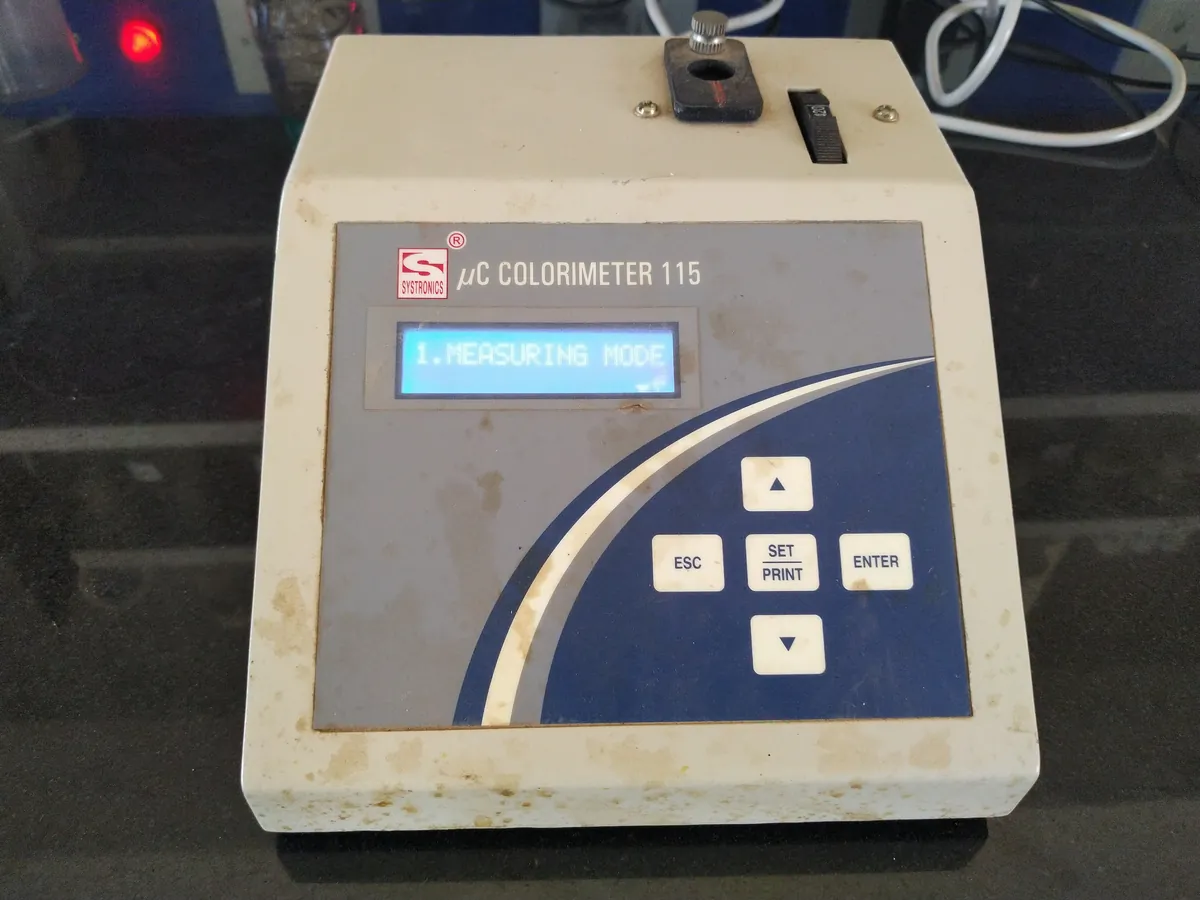
How Colorimeter works
Light from a known source falls on the sample. The reflected or transmitted light is measured across the visible spectrum. Reflectance values are combined with the spectral power of a standard illuminant (such as D65) and the colour-matching functions of a standard observer (2° or 10°) to give tristimulus values X, Y and Z. These are converted into L*, a* and b*, and differences from the standard are expressed as ΔE*.
The path of a sample
- 01
Calibrate
Zero on the black trap or black tile and set 100% on the white calibration tile with certified values.
- 02
Illuminate
The sample is lit using a defined geometry, for example diffuse illumination with 8° viewing (d/8°) or 45°/0°.
- 03
Measure spectrum
The detector array measures reflectance at each wavelength from about 400 to 700 nm.
- 04
Calculate XYZ
Reflectance is weighted by the illuminant and observer functions to give X, Y and Z.
- 05
Convert to CIELAB
XYZ is converted to L*, a*, b* (and C*, h).
- 06
Compare
ΔL*, Δa*, Δb* and ΔE* against the standard are compared with the tolerance.
Main parts and what they do
Light source
Pulsed xenon lamp or LEDs giving known, stable illumination, sometimes with UV control.
Integrating sphere or 45°/0° optics
Defines how the sample is lit and viewed.
Measuring port and aperture
Sets the measured area, for example large (25 mm) or small (8 mm) area view.
Spectral analyser
Grating and diode array (spectrophotometer) or three filtered detectors (tristimulus colorimeter).
Calibration tiles
White ceramic tile with certified values, black trap or black tile, and optional green or coloured check tiles.
Transmission compartment (benchtop)
Holds glass or quartz cells for liquid colour measurement.
Software
Stores standards and tolerances, calculates colour values, indices and pass/fail.
Terms every analyst should know
CIE L*a*b*
A colour space designed so that equal distances look roughly equally different. L* is lightness, a* red (+) to green (−), b* yellow (+) to blue (−).
ΔE*ab
Total colour difference = √(ΔL*² + Δa*² + Δb*²). Newer formulas such as ΔE00 (CIEDE2000) match visual judgement better.
Illuminant and observer
D65 (average daylight) with the 10° observer is common. Always state them, for example D65/10°.
Geometry and SCI/SCE
Diffuse/8° sphere instruments can include (SCI) or exclude (SCE) the specular gloss component. 45°/0° instruments see colour roughly as the eye does.
Metamerism
Two samples that match under one light but not another. Spectrophotometers can detect it by comparing illuminants.
Black and white calibration
Setting the 0% and 100% points of the reflectance scale. All later readings are relative to these, so tile care matters.
Keep every Colorimeter in control: usage logs, calibration and maintenance schedules, and automatic blocking of overdue instruments.