Burette & Volumetric Glassware
Glass apparatus made to contain or deliver accurately known volumes: burettes, volumetric flasks, bulb pipettes and graduated pipettes. The backbone of titrations, standard preparation and dilutions.
- Pharmaceutical
- Chemicals
- Universities
- Food & beverage
- Environmental
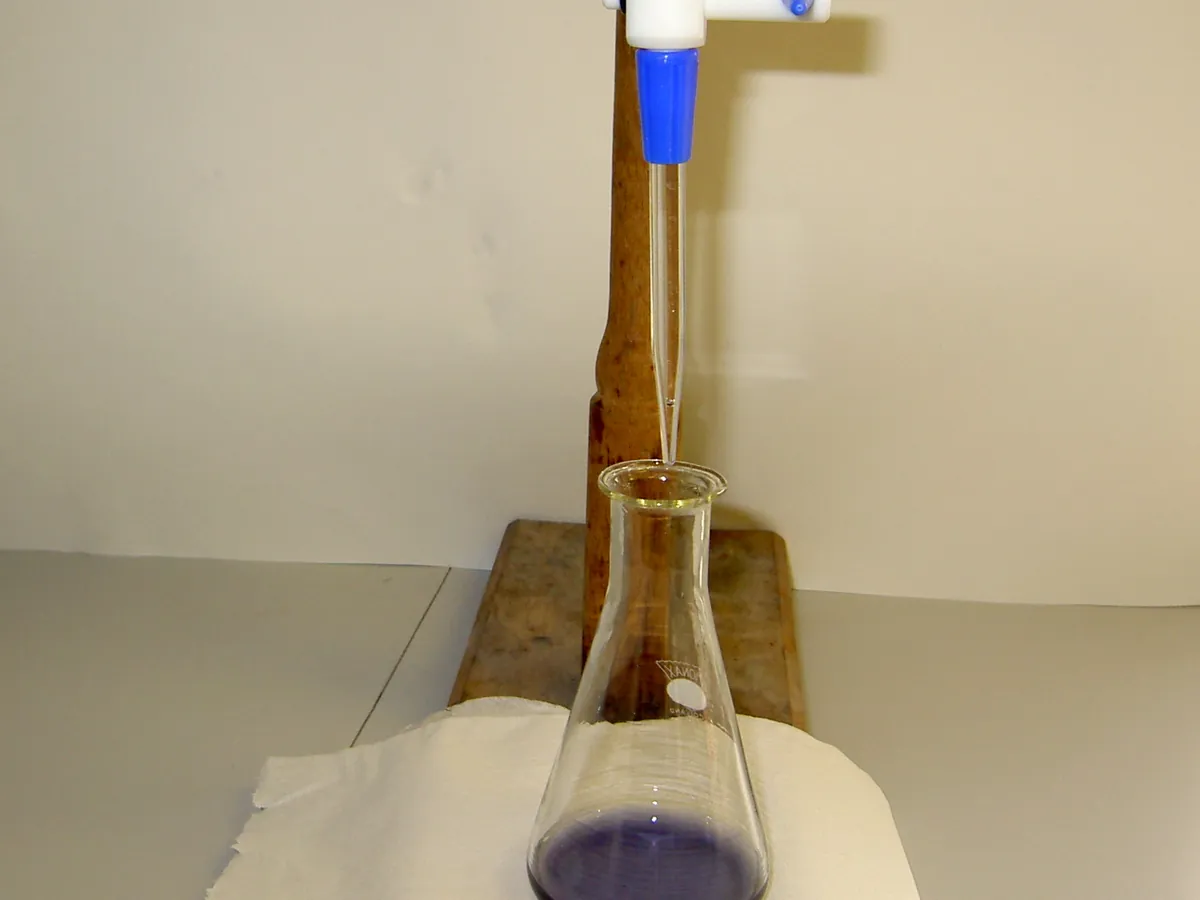
How Burette & glassware works
Each item is calibrated by the manufacturer so that the mark or graduation corresponds to a known volume at the reference temperature. The user reproduces the conditions of calibration: clean glass, correct meniscus reading, correct delivery and waiting times. Users verify volumes gravimetrically by weighing water and converting mass to volume with a Z factor.
The path of a sample
- 01
Clean
Glass must drain evenly with no droplets on the walls.
- 02
Rinse
Rinse with the solution to be measured (burettes, pipettes).
- 03
Fill
Fill above the zero mark and remove air bubbles from the tip.
- 04
Set zero
Bring the bottom of the meniscus to the mark at eye level.
- 05
Deliver and read
Deliver at the correct rate, wait the stated time and read the meniscus.
Main parts and what they do
Burette tube
Graduated glass tube, commonly 10, 25 or 50 mL.
Stopcock (PTFE or glass)
Controls the flow of titrant.
Burette tip (jet)
Delivers small drops; must be free of chips and bubbles.
Volumetric flask
Single-mark flask calibrated to contain a set volume.
Bulb (volumetric) pipette
Single-mark pipette calibrated to deliver a set volume.
Graduated pipette and cylinder
Measure variable volumes with lower accuracy.
Calibration certificate / marking
Shows class, volume, tolerance, reference temperature and batch or serial number.
Terms every analyst should know
To contain (TC / In) and to deliver (TD / Ex)
Flasks hold the stated volume. Pipettes and burettes deliver it; the liquid film left behind is allowed for.
Class A and Class B
Class A has the tightest tolerance. For example, a 50 mL Class A burette is commonly ±0.05 mL and a 100 mL Class A flask ±0.10 mL; Class B tolerances are about twice these.
Meniscus and parallax
Read clear liquids at the bottom of the meniscus with the eye level with the mark. Viewing from above or below gives a parallax error.
Reference temperature
Glassware is calibrated at 20 °C. Small temperature differences matter mainly for the liquid's expansion, not the glass.
Gravimetric check
Weigh the water delivered or contained and convert to volume with a Z factor (mL/g), which allows for water density and air buoyancy.
Keep every Burette & glassware in control: usage logs, calibration and maintenance schedules, and automatic blocking of overdue instruments.