Sieve Analysis of Aggregates (Grading and Fineness Modulus)
An oven-dried aggregate sample is shaken through a nest of standard sieves. The mass retained on each sieve gives the grading curve, the fineness modulus and, for sand, the IS 383 grading zone.
- Construction materials
- Dry sieving through a nest of standard test sieves
- Sieve shaker
- Hot air oven
- Analytical balance
Reference: Typical method based on IS 2386 (Part 1) and ASTM C136; grading limits from IS 383. Always follow the current editions and your approved SOP.
Why this method works
Aggregates are a mix of particle sizes. Passing a known mass through sieves with square openings that get smaller from top to bottom separates the particles into size fractions. The mass on each sieve is turned into a percentage retained, a cumulative percentage retained and a percentage passing. The grading controls how well the particles pack, so it affects the workability, cement demand and strength of concrete. The fineness modulus (FM) is a single number that summarises the grading: it is the sum of the cumulative percentages retained on the standard sieves divided by 100. A higher FM means a coarser material.
Instruments used
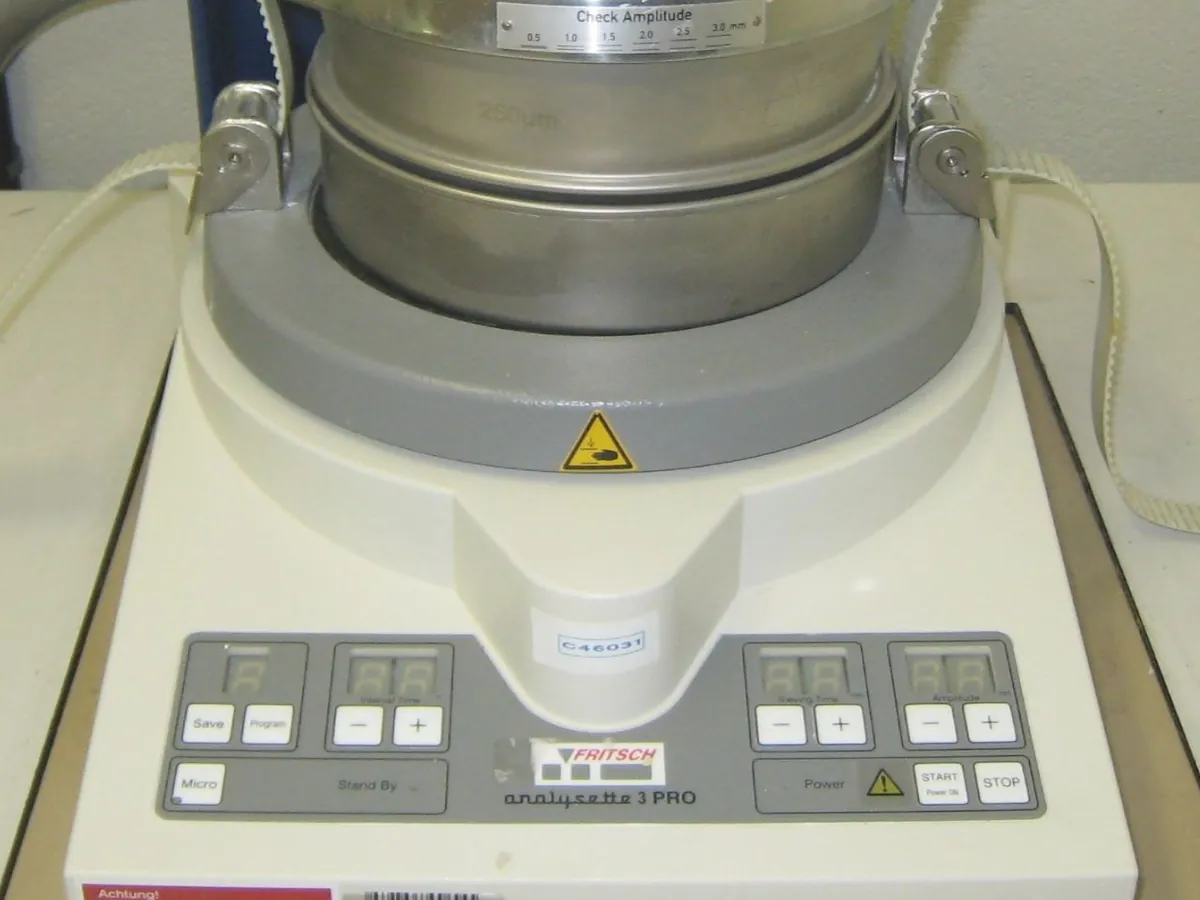
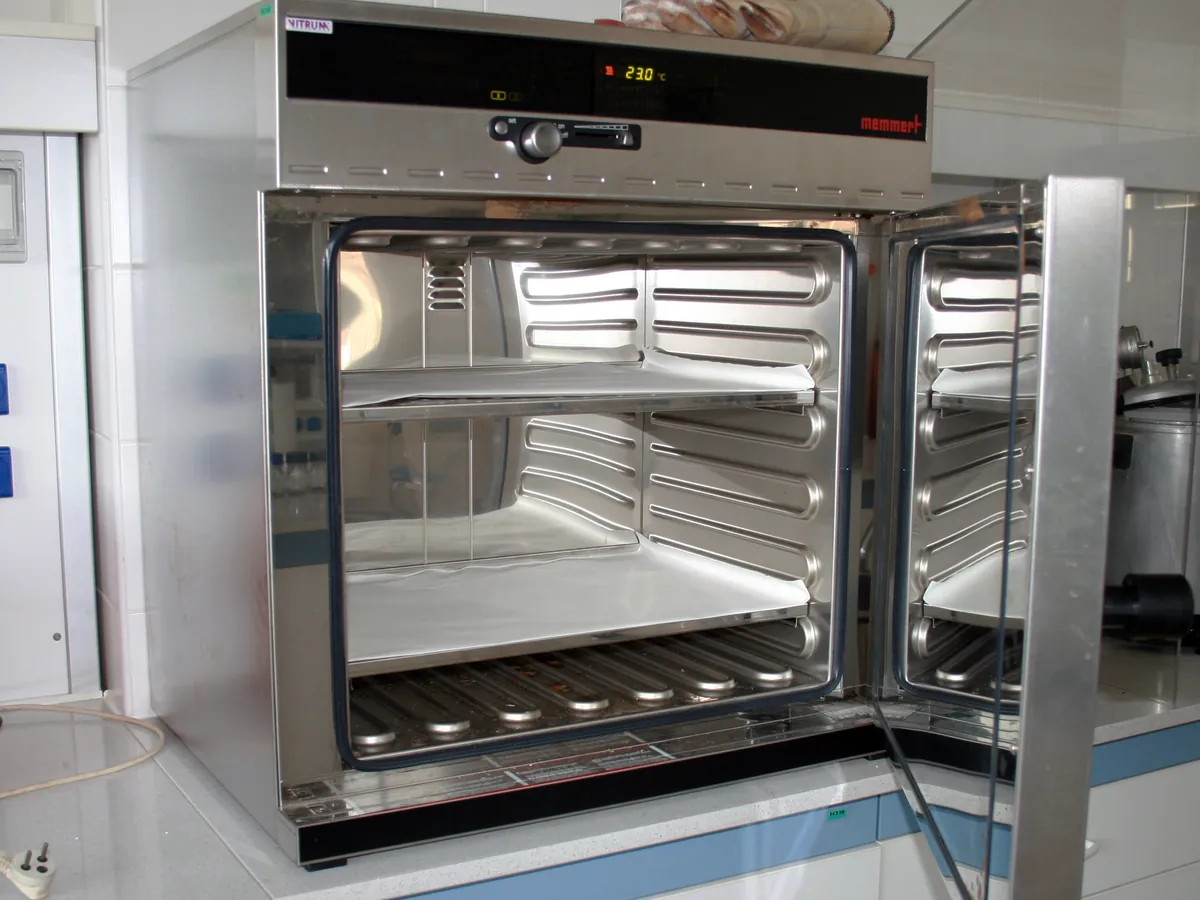
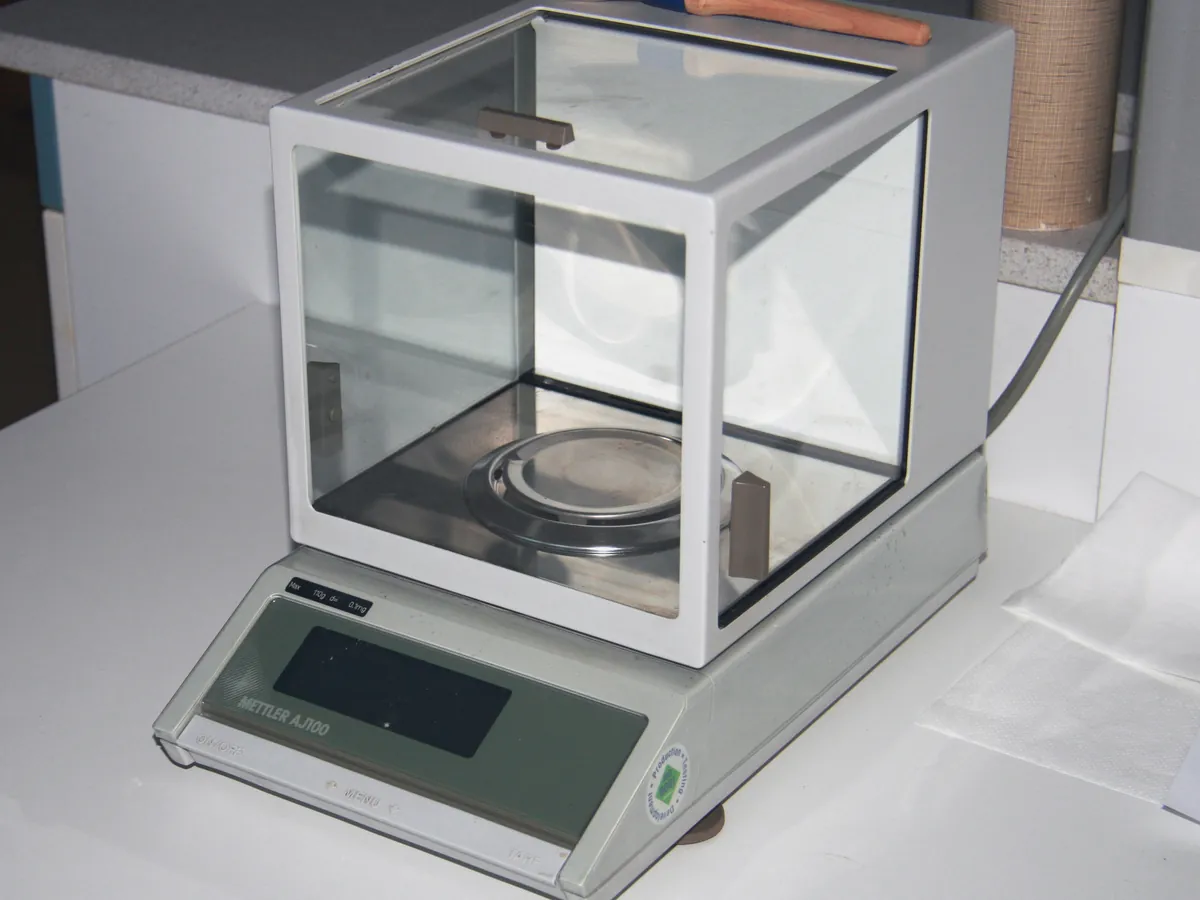
Reagents & standards
| Reagent | Grade / specification |
|---|---|
| Test sieves | IS sieves (or ISO / ASTM equivalent) with valid aperture verification, e.g. 80, 40, 20, 10, 4.75, 2.36, 1.18 mm, 600, 300 and 150 µm, with lid and pan |
| Sample divider | Riffle box or quartering equipment to reduce the field sample |
| Brushes | Soft brass or nylon brush for cleaning fine sieves |
Preparing the sample
- 01
Reduce
Riffle or quarter the field sample to the test mass.
- 02
Dry
Oven-dry at 100–110 °C to constant mass and cool.
- 03
Weigh
Weigh the dried test portion.
- 04
Sieve
Shake through the nest until little more passes.
- 05
Weigh fractions
Weigh the material on each sieve and the pan.
- 06
Calculate
Work out % passing, grading zone and FM.
Procedure
- 1Reduce the field sample by riffling or quartering to the minimum mass the standard gives for the largest particle size. A test portion of about 500 g is common for sand; coarse aggregate needs several kilograms (for example about 2 kg for 10 mm and 5 kg for 20 mm nominal size; see the current table in IS 2386 Part 1).
- 2Dry the test portion in the oven at 100–110 °C to constant mass, cool it and weigh it to 0.1% of its mass.
- 3If the material has clay or dust coatings, wash it over a 75 µm sieve first, dry it again and record the loss (material finer than 75 µm).
- 4Stack the clean, dry sieves in order with the largest opening at the top and the pan at the bottom. Pour in the sample and fit the lid.
- 5Shake on the sieve shaker for a set time (for example 10–15 minutes, or as your SOP states), then finish each sieve by hand until not more than about 0.1% of the mass passes in one minute.
- 6Do not overload any sieve. If a sieve is overloaded, split the material and sieve it in portions.
- 7Weigh the material retained on each sieve and in the pan. The total should agree with the starting mass within about 0.3% (or the limit in your SOP).
Standard preparation
- 1Use sieves whose apertures have been verified within the calibration interval; check for torn or bulging mesh before each use.
- 2Check the balance with a standard weight before the test.
Notes for analysts
- Only the standard sieve series counts towards the fineness modulus. Intermediate sieves such as 12.5 mm are reported but not added into FM.
- Always dry the sample first: damp fines stick to coarse particles and to the mesh, which makes the sand look coarser than it is.
- Plot % passing against sieve size on a log scale and draw the specification envelope; it shows at once where a sample is out of grading.
- Do not force particles through the mesh by hand. It damages the sieve and changes the result.
Method parameters (typical)
| Drying temperature | 100–110 °C to constant mass |
|---|---|
| Sieves for fine aggregate | 10 mm, 4.75 mm, 2.36 mm, 1.18 mm, 600 µm, 300 µm, 150 µm and pan |
| Sieves for coarse aggregate | For example 40, 20, 16, 12.5, 10, 4.75 mm, chosen for the nominal size |
| Test portion (sand) | Typically about 500 g; see the current table for coarse aggregate |
| Shaking | Mechanical shaking for a set time, then hand finishing |
| Balance readability | 0.1% of the test mass or better |
| Mass balance check | Sum of fractions within about 0.3% of the starting mass |
System suitability & sequence
| Parameter | Limit |
|---|---|
| Sieve condition | No torn, stretched or blocked mesh; apertures verified |
| Mass recovery | Sum of retained masses close to the starting mass (e.g. within 0.3%) |
Typical sequence
- 1Reduce and dry the sample
- 2Weigh the test portion
- 3Wash over 75 µm if required, dry and re-weigh
- 4Sieve through the nest
- 5Weigh each fraction and check the mass balance
- 6Calculate and plot the grading curve
Calculation with a worked example
Where
- Mᵢ
- Mass retained on sieve i (g)
- M
- Total oven-dry mass of the test portion (g)
- CRᵢ
- Cumulative % retained on sieve i
- FM
- Fineness modulus (no unit)
Given
- Total dry mass of sand
- 500 g
- Retained on 4.75 mm
- 10 g
- Retained on 2.36 mm
- 40 g
- Retained on 1.18 mm
- 80 g
- Retained on 600 µm
- 120 g
- Retained on 300 µm
- 140 g
- Retained on 150 µm
- 85 g
- Pan
- 25 g (total 500 g)
Working
- 1
Cumulative mass retained: 10, 50, 130, 250, 390 and 475 g
- 2Cumulative % retained = cumulative mass ÷ 500 × 100: 2, 10, 26, 50, 78 and 95%
- 3
% passing = 100 − cumulative % retained: 98, 90, 74, 50, 22 and 5%
- 4
Sum of cumulative % retained = 2 + 10 + 26 + 50 + 78 + 95 = 261
- 5FM = 261 ÷ 100 = 2.61
- 6
Passing 600 µm = 50%, which falls in the band IS 383 uses for a medium sand (commonly Zone II)
Fineness modulus = 2.61; 50% passes the 600 µm sieve, so the sand is a medium sand (typically IS 383 Zone II).
What result passes
- Percentage passing each sieve within the grading limits in IS 383 (current edition) or the project specification for that nominal size.
- Fine aggregate is placed in a grading zone (I to IV, coarse to fine) mainly by the percentage passing the 600 µm sieve; check the full zone table in the current edition.
- Fineness modulus within the range stated in the mix design or specification. As a rough guide, fine sands are about 2.2–2.6, medium sands about 2.6–2.9 and coarse sands about 2.9–3.2.
- Material finer than 75 µm within the limit in IS 383 or the specification (different limits apply to natural, crushed and manufactured sand).
Validation parameters (ICH Q2(R2))
| Parameter | Typical requirement |
|---|---|
| Approach | Standard method; laboratories show competence by repeat tests and proficiency testing |
| Repeatability | Duplicate tests on split samples should give FM values that agree closely (e.g. within about 0.1) |
| Equipment control | Sieve aperture verification and balance calibration within their due dates |
Run this method in LimsPulse: specifications and STPs under version control, results calculated and checked against limits, and a signed Certificate of Analysis.