Multiparameter Water Quality Meter
A portable or benchtop meter, often with a submersible sonde, that measures several water quality parameters at once, such as pH, conductivity, dissolved oxygen, temperature, turbidity and ORP.
- Environmental monitoring agencies
- Water and wastewater utilities
- Aquaculture
- Mining and industrial effluent
- Research and education
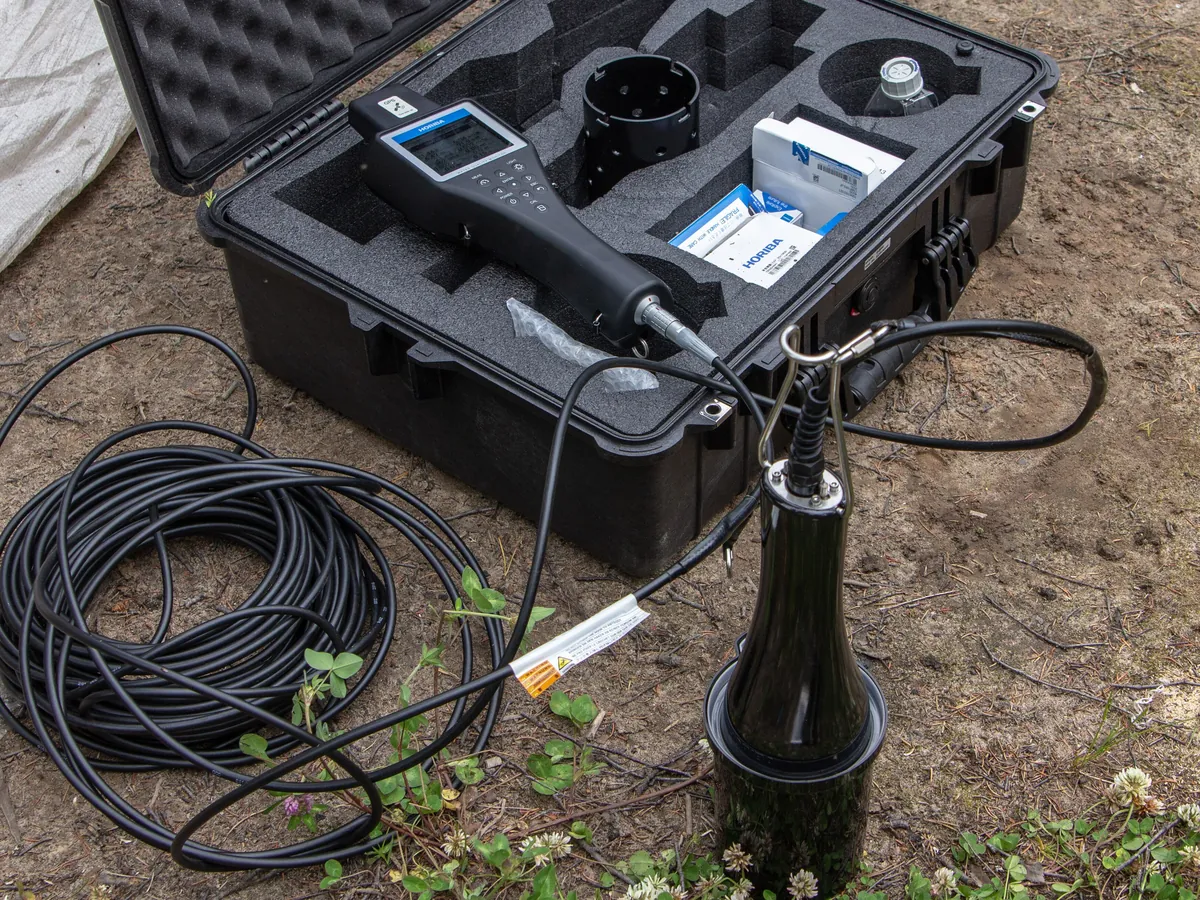
How Multiparameter meter works
Each sensor converts a property of the water into an electrical signal: potential for pH and ORP, resistance for conductivity, luminescence lifetime or current for dissolved oxygen, scattered light for turbidity and resistance for temperature. The meter turns each signal into a value using its calibration and corrects for temperature.
The path of a sample
- 01
Calibrate
Each sensor is calibrated with fresh standards (buffers, conductivity standard, air-saturated water, turbidity standards).
- 02
Deploy
The sonde is placed in the water, or a sample is taken in a clean container.
- 03
Equilibrate
Readings are allowed to stabilise, with gentle movement for DO sensors that need flow.
- 04
Read and log
Values are recorded with temperature, time and location.
- 05
Post-check
A standard is re-measured at the end of the day to confirm the sensors have not drifted.
Main parts and what they do
Handheld or benchtop meter
Display, keypad, calibration software and data logger.
Sonde or probe body
Waterproof housing that holds several sensors and the cable.
pH / ORP sensor
Glass and platinum electrodes with a reference junction.
Conductivity / temperature sensor
Measures conductivity, salinity, TDS (calculated) and temperature.
Dissolved oxygen sensor
Optical (luminescent) or membrane-covered electrochemical sensor.
Turbidity sensor (optional)
Optical sensor measuring scattered light, often with a wiper.
Calibration cup and guard
Holds standards around the sensors during calibration and protects them in the field.
Terms every analyst should know
pH electrode
A glass membrane develops a potential that changes by about 59.16 mV per pH unit at 25 °C. The slope and offset are set by calibrating with buffers.
Conductivity and cell constant
Conductivity is measured across electrodes of known geometry (cell constant). Results are normally reported at 25 °C using a temperature coefficient of about 2% per °C for natural waters.
Luminescent DO
A dye in the sensor cap glows when excited by blue light; oxygen quenches the glow. The decay time is related to oxygen concentration and does not consume oxygen, so no stirring is needed.
Oxidation–reduction potential (ORP)
A platinum electrode measures the balance of oxidising and reducing species. It is checked against a standard such as Zobell solution.
Temperature compensation
pH, conductivity and DO readings all depend on temperature, so a built-in sensor corrects them automatically.
Keep every Multiparameter meter in control: usage logs, calibration and maintenance schedules, and automatic blocking of overdue instruments.