Tablet Hardness Tester (Breaking Force Tester)
Measures the force needed to break a tablet by squeezing it between two jaws. Used to control compression and to make sure tablets are strong enough to survive coating, packing and handling.
- Pharmaceutical
- Nutraceuticals
- Confectionery and food tablets
- Veterinary medicines
What is Hardness tester?
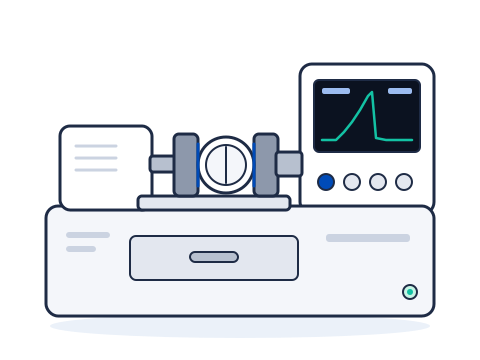
A hardness tester (more correctly called a breaking force or crushing strength tester) places a tablet between a fixed jaw and a moving jaw. The moving jaw pushes against the tablet until it breaks, and a load cell records the peak force.
Results are reported in newtons (N). Older units such as kiloponds (kP, equal to kilograms-force) and Strong-Cobb units are still seen on some instruments and in older documents. One kilopond is about 9.81 N.
Hardness is mainly an in-process control during compression. It is linked to friability, disintegration and dissolution: tablets that are too soft chip and break, and tablets that are too hard may disintegrate and dissolve slowly.
Used for
- In-process control during tablet compression
- Setting and monitoring compression force
- Finished-product testing where the specification includes breaking force
- Formulation and scale-up studies (hardness versus compression force profiles)
- Some testers also measure tablet thickness, diameter and weight in one cycle
How it works
- 01
Position
Place the tablet between the jaws in the orientation stated in the procedure (usually across the diameter, score line aligned as specified).
- 02
Load
The moving jaw advances at a controlled rate and the load cell measures force.
- 03
Break
The tablet fractures and the force drops sharply.
- 04
Record
The instrument records the peak force; repeat for the required number of tablets.
Advantages
- Fast, simple and cheap per test
- Gives a number that the compression operator can act on immediately
- Automatic multi-parameter testers reduce operator variability
Limitations
- Result depends on tablet shape, size and orientation in the jaws
- Breaking force is not a true material property; tensile strength is better for comparing shapes
- Manual testers depend on operator technique
- Destructive test
1 calibration procedure
Methods that use Hardness tester
Keep every Hardness tester in control: usage logs, calibration and maintenance schedules, and automatic blocking of overdue instruments.