Tablet Hardness Tester (Breaking Force Tester)
Measures the force needed to break a tablet by squeezing it between two jaws. Used to control compression and to make sure tablets are strong enough to survive coating, packing and handling.
- Pharmaceutical
- Nutraceuticals
- Confectionery and food tablets
- Veterinary medicines
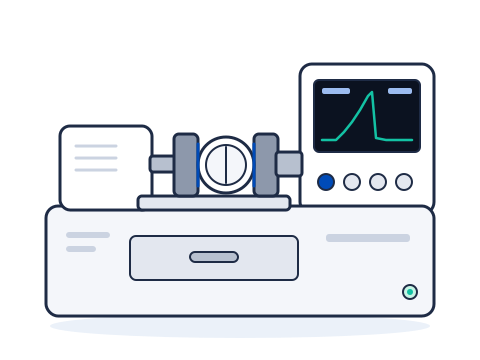
How Hardness tester works
The tablet is loaded diametrically between two flat, parallel platens. Force is increased at a constant rate or constant jaw speed until the tablet fractures. The peak force just before fracture is the breaking force.
The path of a sample
- 01
Position
Place the tablet between the jaws in the orientation stated in the procedure (usually across the diameter, score line aligned as specified).
- 02
Load
The moving jaw advances at a controlled rate and the load cell measures force.
- 03
Break
The tablet fractures and the force drops sharply.
- 04
Record
The instrument records the peak force; repeat for the required number of tablets.
Main parts and what they do
Fixed jaw (anvil)
Flat platen against which the tablet rests.
Moving jaw
Driven by a motor (or a manual screw in older designs) to apply force to the tablet.
Load cell
Converts the applied force to an electrical signal; this is what is calibrated.
Drive motor
Moves the jaw at a controlled speed or loading rate.
Display / printer / software
Shows and records the peak force, statistics and any other measured dimensions.
Tablet feeder (automatic models)
Feeds and orients tablets one at a time.
Terms every analyst should know
Breaking force
The force, in newtons, needed to cause a tablet to fail by fracture under diametral compression.
Units
1 kP = 1 kgf ≈ 9.81 N. Strong-Cobb units are an older arbitrary scale; convert only with the instrument maker's factor.
Tensile strength
Breaking force normalised for tablet diameter and thickness, which allows tablets of different sizes to be compared.
Constant rate of loading
Force or jaw displacement increases at a steady rate so results are comparable between runs and instruments.
Keep every Hardness tester in control: usage logs, calibration and maintenance schedules, and automatic blocking of overdue instruments.