Incubator / BOD incubator
A temperature-controlled chamber that holds culture plates and tubes at a fixed temperature so microorganisms can grow. BOD incubators can heat and cool, so they also hold temperatures below room temperature, such as 20–25 °C for fungi.
- Pharmaceutical
- Biotech
- Food & beverage
- Water testing
- Environmental
- Research laboratories
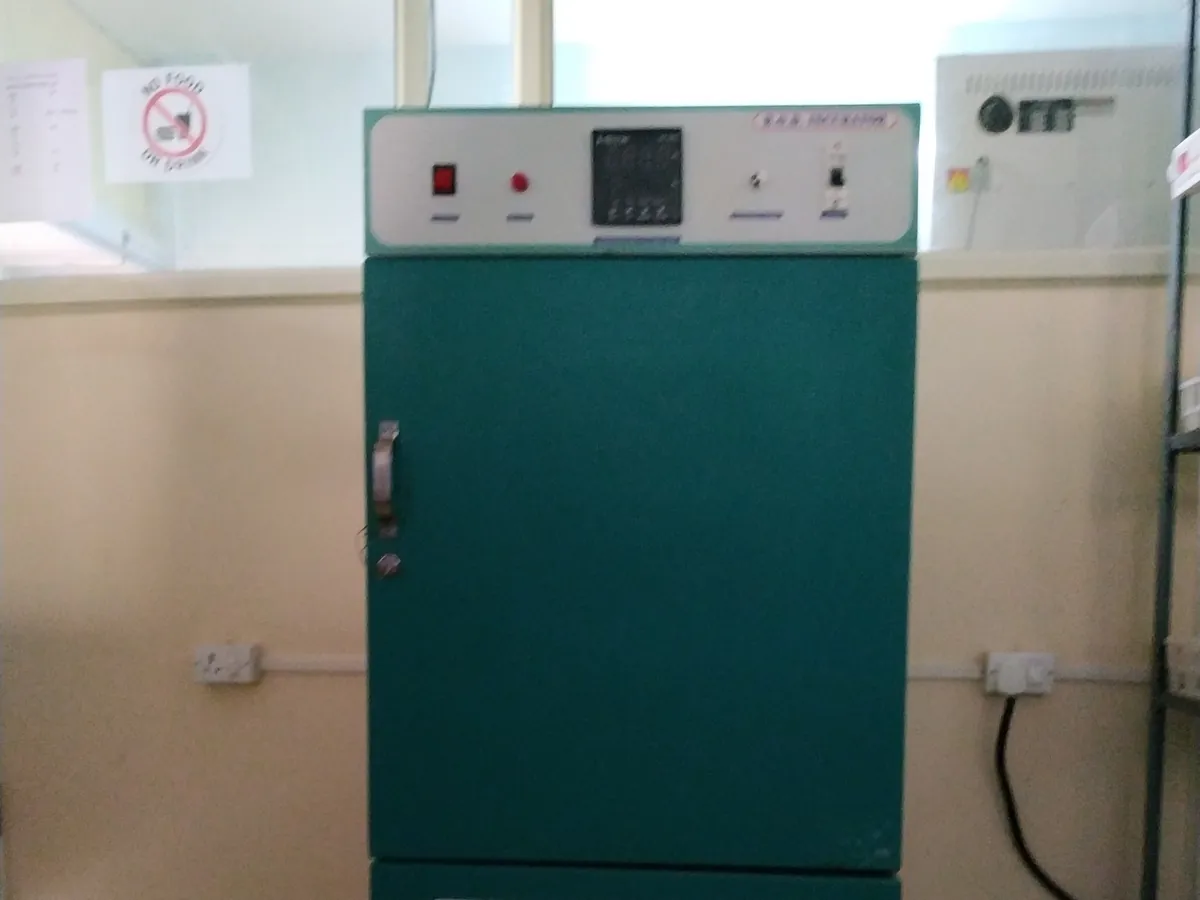
How Incubator works
A temperature sensor in the chamber feeds a controller that switches heating (and in a BOD incubator, cooling) to hold the set point. A fan circulates air so that all shelves are at nearly the same temperature. Microorganisms grow at their optimum temperature, so a stable, correct temperature gives reproducible colony counts within the incubation time stated in the method.
The path of a sample
- 01
Set point
The operator sets the temperature, e.g. 32.5 °C for a 30–35 °C requirement.
- 02
Sensing
A Pt100 or thermocouple sensor measures chamber air temperature.
- 03
Control
A PID controller switches the heater, and the compressor in BOD models, to correct deviations.
- 04
Circulation
A fan moves air around the chamber to keep shelves uniform.
- 05
Monitoring
An independent sensor or data logger records temperature and raises alarms on excursions.
Main parts and what they do
Insulated chamber
Stainless-steel interior with insulation that limits heat exchange with the room.
Inner glass door and outer door
The inner door lets the user view plates without losing too much heat; the outer door insulates.
Heater
Electrical element that raises the chamber temperature.
Refrigeration unit (BOD)
Compressor, condenser and evaporator that cool the chamber for set points near or below ambient.
Circulation fan
Moves air to give uniform temperature across shelves.
Temperature sensor and PID controller
Measures chamber temperature and controls heating and cooling to the set point.
Independent over-temperature cut-out
Switches heating off if the chamber overheats, protecting samples.
Perforated shelves
Hold plates while allowing air to circulate.
Data logger / monitoring system
Records temperature continuously and raises alarms for excursions.
Terms every analyst should know
Accuracy vs uniformity
Accuracy is how close the display is to the true temperature at the sensor. Uniformity is how much temperature varies between positions in the chamber.
Typical set points
30–35 °C for bacteria (TAMC, SCDA), 20–25 °C for yeasts and moulds (TYMC, SDA). Some sites use 2–8 °C storage chambers too, which are separate equipment.
Temperature mapping
A study with several calibrated probes placed across the chamber to find hot and cold spots and prove all usable positions are within the limits.
Recovery time
Time taken to return to the set range after the door has been opened. It is checked during qualification.
Heating-only vs BOD
Heating-only incubators cannot cool, so they cannot hold temperatures at or below room temperature. BOD incubators include a refrigeration system.
Keep every Incubator in control: usage logs, calibration and maintenance schedules, and automatic blocking of overdue instruments.