Total Hardness by EDTA Titration (Eriochrome Black T)
Calcium and magnesium ions are titrated together with EDTA at pH 10. The indicator Eriochrome Black T turns from wine-red to clear blue when all the metal ions have been complexed. The result is expressed as mg/L of calcium carbonate.
- Environmental & water
- Complexometric titration with 0.01 M disodium EDTA at pH 10, Eriochrome Black T indicator
- Burette & glassware
- pH meter
- Analytical balance
Reference: Typical method based on APHA Standard Methods 2340 C (EDTA titrimetric) and the IS 3025 part for total hardness. Follow your lab SOP.
Why this method works
EDTA forms stable 1 : 1 complexes with Ca²⁺ and Mg²⁺. At pH 10 (ammonia buffer), Eriochrome Black T (EBT) binds to magnesium to give a wine-red complex. As EDTA is added it takes up free Ca²⁺ and Mg²⁺ first, and finally pulls Mg²⁺ away from the indicator, releasing the free blue indicator. Because each mole of EDTA reacts with one mole of Ca²⁺ or Mg²⁺, hardness is reported as the equivalent mass of CaCO₃ (molar mass 100.09 g/mol).
Instruments used
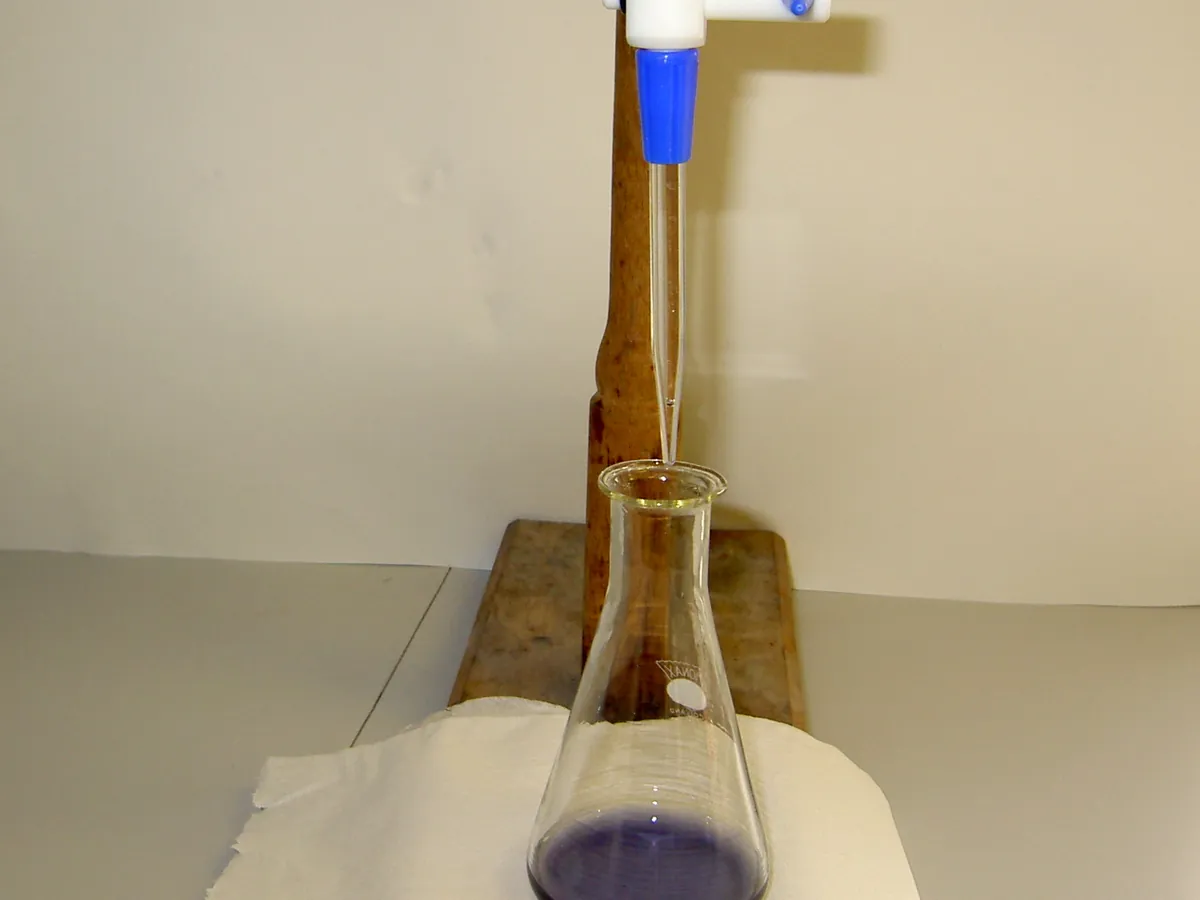
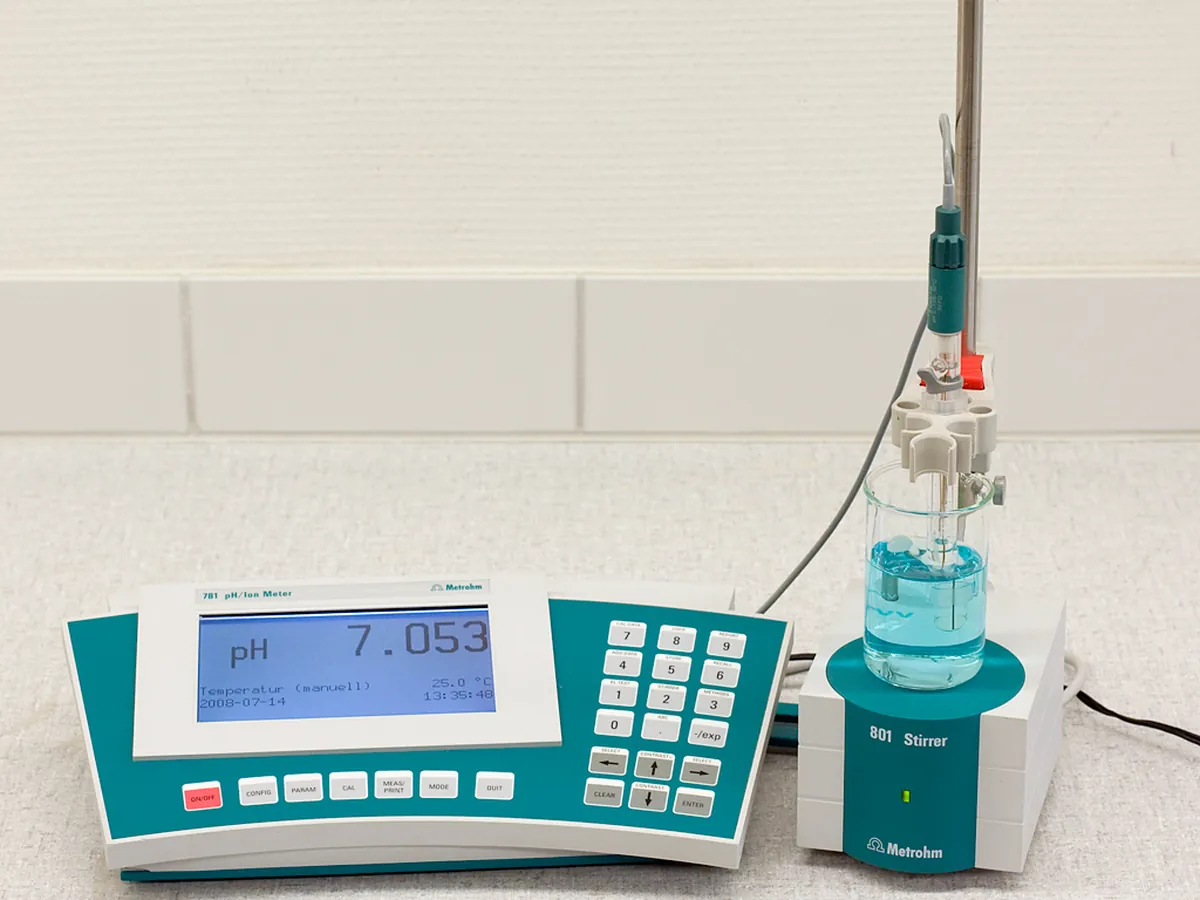
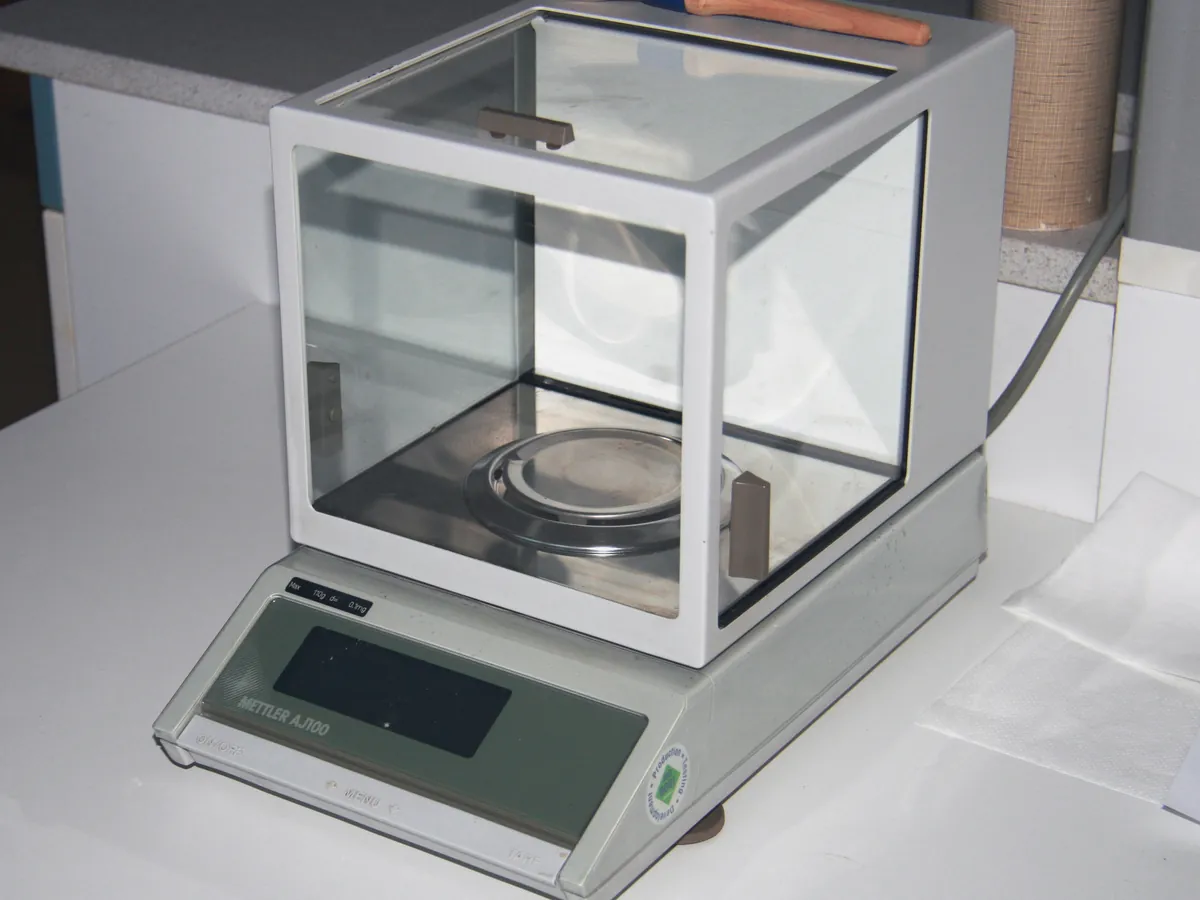
Reagents & standards
| Reagent | Grade / specification |
|---|---|
| Standard EDTA titrant | 0.01 M disodium EDTA dihydrate, standardised against a calcium carbonate standard |
| Ammonia buffer pH 10 | Ammonium chloride + ammonia solution, usually containing a little Mg-EDTA so a sharp endpoint is seen even in Mg-free samples |
| Indicator | Eriochrome Black T, as a dry powder mixture with NaCl or a fresh solution |
| Inhibitor (if needed) | Sodium cyanide or sodium sulphide inhibitors for interfering metals — only under strict safety controls, or as per SOP |
Preparing the sample
- 01
Measure sample
Pipette 50 mL into a conical flask.
- 02
Buffer
Add 1–2 mL buffer to reach pH 10.0 ± 0.1.
- 03
Indicator
Add EBT; solution turns wine-red.
- 04
Titrate
Titrate with 0.01 M EDTA to clear blue.
- 05
Blank
Titrate distilled water the same way.
Procedure
- 1Pipette 50.0 mL of sample (or a smaller volume diluted to 50 mL if hardness is high, so the titre stays below about 15 mL) into a 250 mL conical flask.
- 2Add 1–2 mL of pH 10 buffer and check that the pH is 10.0 ± 0.1.
- 3Add a small amount (about 0.1–0.2 g) of EBT indicator powder; the solution becomes wine-red.
- 4Titrate with standard 0.01 M EDTA, swirling continuously. Slow down near the end and add the last drops at 3–5 second intervals until the last reddish tinge disappears and the solution is pure blue.
- 5Finish the titration within about 5 minutes of adding the buffer, so that calcium carbonate does not precipitate.
- 6Run a blank on 50 mL of distilled water and subtract the blank titre.
Standard preparation
- 1Standard calcium solution: dissolve 1.000 g of dried CaCO₃ in a little dilute HCl, boil off CO₂, neutralise and make up to 1000 mL (1.00 mL = 1.00 mg CaCO₃).
- 2Titrate an aliquot of the calcium standard with the EDTA solution under the same conditions to establish its exact molarity.
Notes for analysts
- Calcium hardness alone can be found by titrating at pH 12–13 with murexide or a calcium indicator; magnesium hardness = total − calcium hardness.
- A dull, slow or purple endpoint usually means interfering metals, old indicator or wrong pH.
- Rough classification often used: below 75 mg/L soft, 75–150 moderately hard, 150–300 hard, above 300 very hard (as CaCO₃).
Method parameters (typical)
| Titrant | 0.01 M EDTA (1 mL ≈ 1.001 mg CaCO₃) |
|---|---|
| pH | 10.0 ± 0.1 (ammonia buffer) |
| Indicator | Eriochrome Black T |
| Endpoint | Wine-red → pure blue |
| Sample volume | 50 mL (smaller aliquot diluted to 50 mL for hard water) |
| Titration time | Complete within about 5 min of buffer addition |
System suitability & sequence
| Parameter | Limit |
|---|---|
| EDTA standardisation | Replicate titres agree within 0.05 mL (or %RSD as per SOP) |
| Check standard | Known CaCO₃ standard recovered within the SOP limit (e.g. 95–105%) |
| Duplicate samples | Agree within the SOP limit |
Typical sequence
- 1Standardise EDTA against calcium standard
- 2Blank
- 3Sample in duplicate
- 4Check standard
Calculation with a worked example
Where
- V_s
- EDTA titre for the sample (mL)
- V_b
- EDTA titre for the blank (mL)
- M
- Molarity of EDTA (mol/L)
- 100.09
- Molar mass of CaCO₃ (g/mol)
- V
- Volume of sample taken (mL)
Given
- V
- 50.0 mL
- V_s
- 8.40 mL
- V_b
- 0.10 mL
- M
- 0.0100 M
Working
- 1
Net titre = 8.40 − 0.10 = 8.30 mL
- 2Moles of EDTA = 8.30 × 0.0100 ÷ 1000 = 8.30 × 10⁻⁵ mol (= moles of Ca + Mg)
- 3
Mass as CaCO₃ = 8.30 × 10⁻⁵ × 100.09 g = 8.307 mg in 50 mL
- 4Hardness = 8.307 × 1000 ÷ 50 = 166.1 mg/L as CaCO₃
Total hardness = 166 mg/L as CaCO₃ (within the IS 10500 acceptable limit of 200 mg/L)
What result passes
- As per IS 10500:2012: acceptable limit 200 mg/L, permissible limit 600 mg/L as CaCO₃ in the absence of an alternative source; check the current edition.
- WHO has no health-based guideline for hardness; it is an acceptability (taste, scaling) parameter.
Validation parameters (ICH Q2(R2))
| Parameter | Typical requirement |
|---|---|
| Accuracy | Recovery of calcium standard spikes |
| Precision | Duplicate titrations on real samples |
| Interferences | Iron, manganese, copper, aluminium and others can block the indicator; assess and use inhibitors or ICP results where needed |
Run this method in LimsPulse: specifications and STPs under version control, results calculated and checked against limits, and a signed Certificate of Analysis.