Soil pH and Electrical Conductivity (1:2.5 Soil–Water Suspension)
Measures how acidic or alkaline a soil is, and how much soluble salt it contains, by shaking air-dried soil with water in a 1 : 2.5 ratio and reading the suspension with a calibrated pH meter and conductivity meter.
- Environmental & water
- Potentiometry (glass electrode) and conductometry on a soil–water suspension
- pH meter
- Conductivity meter
- Analytical balance
Reference: Typical soil-testing laboratory procedure (Jackson's Soil Chemical Analysis and national soil-testing manuals). ISO 10390 (pH) and ISO 11265 (EC) describe related procedures with different soil-to-liquid ratios. Always state the ratio used on the report.
Why this method works
When soil is mixed with water, hydrogen ions and soluble salts held in the soil move into the liquid until a near-equilibrium is reached. A glass electrode responds to the hydrogen-ion activity in the suspension and the meter converts the voltage to pH. A conductivity cell measures how easily the liquid carries an electric current; the more dissolved ions, the higher the conductivity. Because both readings depend on how much water is added, the soil-to-water ratio must be fixed and reported. A 1 : 2.5 ratio (for example 10 g soil + 25 mL water) is widely used for routine testing.
Instruments used
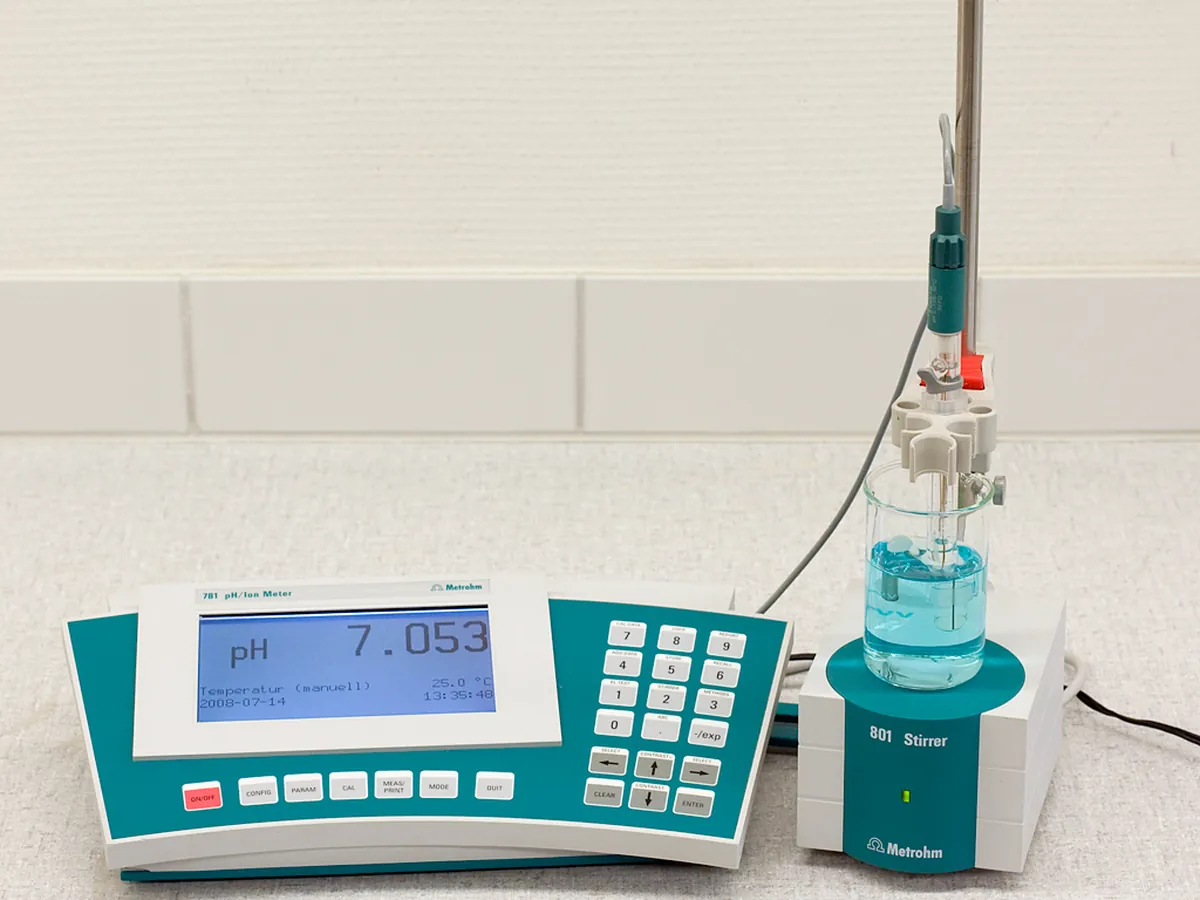
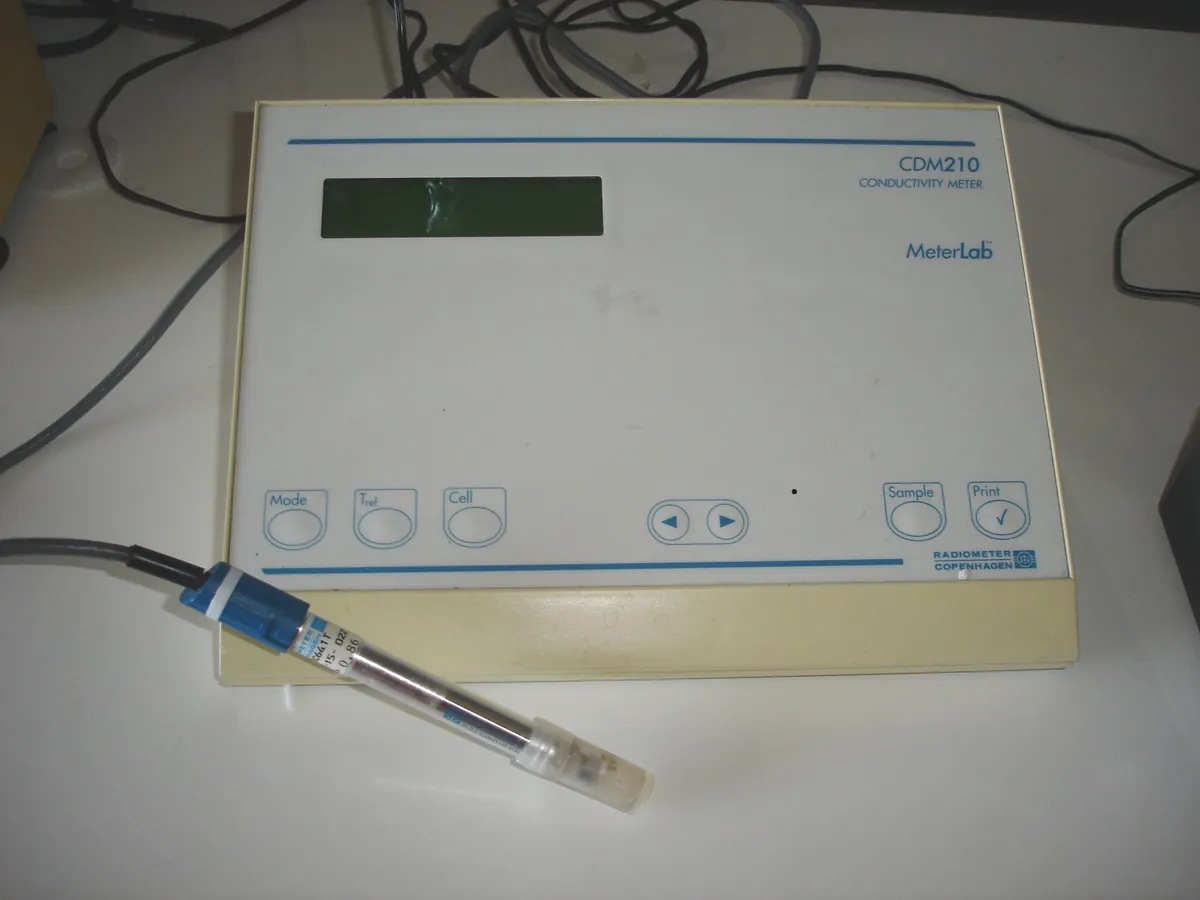

Reagents & standards
| Reagent | Grade / specification |
|---|---|
| Water | Distilled or deionised water, conductivity typically below about 2 µS/cm, CO₂-free if possible |
| pH buffers | pH 4.00, 7.00 and 9.20 (or 10.00) standard buffers |
| Conductivity standard | 0.01 M KCl (about 1413 µS/cm at 25 °C) or a certified standard near the expected range |
| Optional | 0.01 M CaCl₂ or 1 M KCl if pH in salt solution is also required (report separately) |
Preparing the sample
- 01
Dry
Air-dry the field sample in shade; break clods.
- 02
Sieve
Grind gently and pass through a 2 mm sieve.
- 03
Weigh
Weigh 10.0 g soil into a clean beaker or bottle.
- 04
Add water
Add 25 mL water (1 : 2.5).
- 05
Equilibrate
Stir or shake intermittently for about 30 minutes.
- 06
Read
Read pH in the stirred suspension; read EC in the settled supernatant.
Procedure
- 1Spread the field sample on a clean tray or paper, air-dry it in the shade (not in an oven at high temperature), remove stones and roots, and crush clods with a wooden roller or pestle.
- 2Pass the soil through a 2 mm sieve, mix well and store in a labelled, clean container.
- 3Weigh 10.0 g of the sieved soil into a 50 or 100 mL beaker or bottle.
- 4Add 25 mL of distilled water from a dispenser or measuring cylinder.
- 5Stir with a glass rod or shake on a mechanical shaker intermittently for about 30 minutes.
- 6Calibrate the pH meter with two or three buffers that bracket the expected range, and check the slope.
- 7Stir the suspension just before measurement, immerse the electrode, and record the pH once the reading is stable.
- 8Allow the suspension to settle (or filter it), then measure the conductivity of the clear supernatant with a calibrated, temperature-compensated conductivity meter. Rinse the cell with water between samples.
- 9Run a duplicate on every tenth sample and a laboratory control (reference) soil with each batch.
Standard preparation
- 1Use fresh pH buffers from sealed containers; discard buffer portions after use.
- 2Check the conductivity cell constant with 0.01 M KCl before the batch; the reading should agree with the certified value within the tolerance in your SOP.
Notes for analysts
- pH in water is usually a little higher than pH measured in 0.01 M CaCl₂ or 1 M KCl. Always state the medium.
- Do not oven-dry samples at high temperature; it can change pH and soluble salts.
- Clay particles can coat the electrode junction. Rinse well and clean the electrode as recommended by the maker.
- EC of a 1 : 2.5 extract is lower than the saturation-paste EC (ECe) for the same soil because the salts are diluted in more water.
Method parameters (typical)
| Soil : water ratio | 1 : 2.5 (w/v), for example 10 g + 25 mL |
|---|---|
| Particle size | < 2 mm, air-dried |
| Equilibration time | About 30 minutes with intermittent stirring |
| Temperature | Room temperature; meter with automatic temperature compensation; EC reported at 25 °C |
| pH reading | In the stirred suspension, to 0.01 unit, reported to 0.1 unit |
| EC reading | In the clear supernatant, reported in dS/m (1 dS/m = 1 mS/cm = 1000 µS/cm) |
System suitability & sequence
| Parameter | Limit |
|---|---|
| pH electrode slope | Typically 95–105% of the theoretical value |
| Buffer check | A check buffer reads within about ±0.05 pH of its value |
| Conductivity standard | Reads within the tolerance in your SOP (for example ±2–5%) |
| Reference soil | Within the control-chart limits established for that soil |
| Duplicates | pH within about 0.1–0.2 unit; EC within the agreed relative difference |
Typical sequence
- 1Calibrate pH meter and check conductivity cell
- 2Reagent (water) blank for EC
- 3Reference soil
- 4Samples 1–10
- 5Duplicate of one sample
- 6Check buffer / reference soil at the end of the batch
What result passes
- pH is reported as measured (for example 'pH (1 : 2.5 water) = 7.8'). It is interpreted rather than passed or failed.
- Typical interpretation: below about 6.5 acidic, 6.5–7.5 near neutral, above about 7.5 alkaline; values above about 8.5 suggest possible sodicity and justify further tests.
- EC is interpreted for salinity using the classes adopted by your soil-testing programme for the ratio used. Do not compare a 1 : 2.5 result directly with saturation-extract (ECe) limits.
Validation parameters (ICH Q2(R2))
| Parameter | Typical requirement |
|---|---|
| Precision | Repeatability from duplicates and a reference soil tracked on a control chart |
| Trueness | Proficiency-testing soils or certified reference soils where available |
| Robustness | Effect of equilibration time, ratio and settling time |
Run this method in LimsPulse: specifications and STPs under version control, results calculated and checked against limits, and a signed Certificate of Analysis.