Nitrate by UV Spectrophotometry (220 nm with 275 nm Correction)
Nitrate absorbs strongly in the far UV at 220 nm. Dissolved organic matter also absorbs at 220 nm, but nitrate does not absorb at 275 nm, so twice the 275 nm reading is subtracted as an organic correction. The corrected absorbance is read against a nitrate calibration curve.
- Environmental & water
- UV absorption at 220 nm, corrected for organic matter using absorbance at 275 nm
- UV-Vis
- Analytical balance
- Micropipette
Reference: Typical method based on APHA Standard Methods 4500-NO₃⁻ B (ultraviolet spectrophotometric screening method) and the IS 3025 part for nitrate. Suitable for low-organic waters; follow your lab SOP.
Why this method works
Nitrate ion has an absorption band near 220 nm that follows the Beer–Lambert law at low concentrations. Organic matter absorbs at both 220 and 275 nm; empirically, its contribution at 220 nm is about twice its absorbance at 275 nm. Corrected absorbance = A₂₂₀ − 2 × A₂₇₅. Acidifying with 1 N HCl prevents interference from hydroxide and carbonate. If 2 × A₂₇₅ is more than about 10% of A₂₂₀, the correction is unreliable and another method (for example ion chromatography or cadmium reduction) should be used.
Instruments used
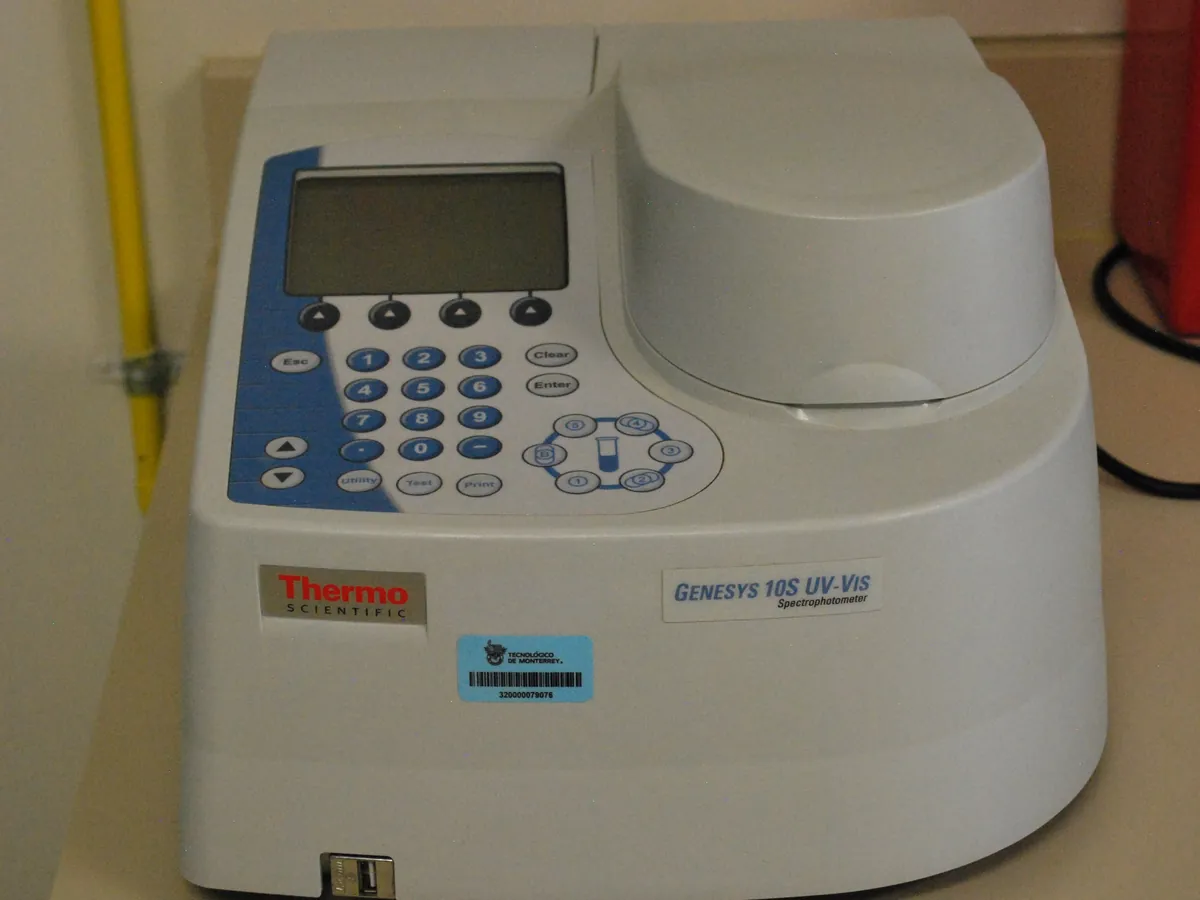

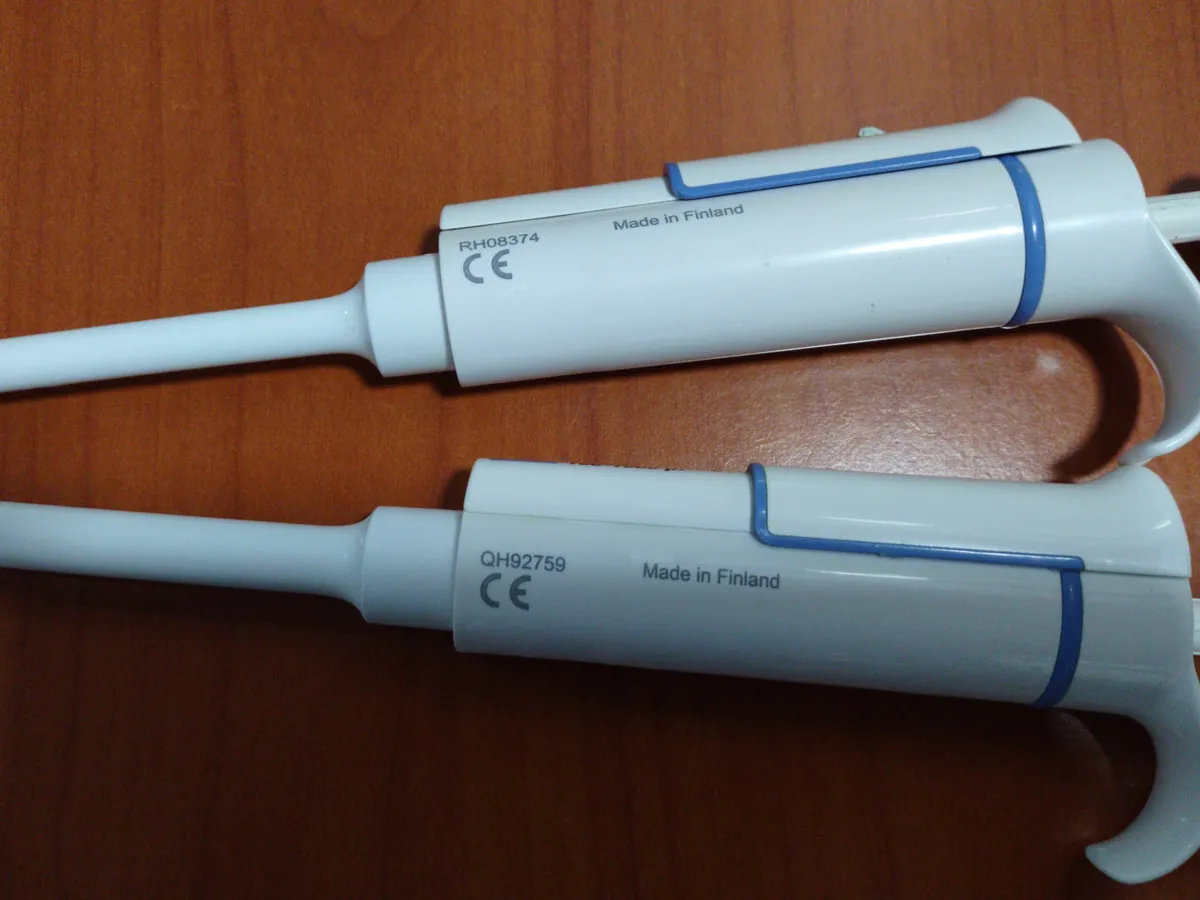
Reagents & standards
| Reagent | Grade / specification |
|---|---|
| Nitrate stock | Potassium nitrate (dried at 105 °C) in water, e.g. 100 mg/L NO₃⁻-N; preserve with a little chloroform |
| Working standards | Typically 0–7 mg/L NO₃⁻-N, prepared fresh |
| Hydrochloric acid | 1 N HCl, 1 mL per 50 mL of sample and standards |
| Nitrate-free water | High-purity lab water |
Preparing the sample
- 01
Collect
Analyse within 48 h; refrigerate at about 4 °C.
- 02
Filter
Filter turbid samples (0.45 µm).
- 03
Acidify
50 mL sample + 1 mL 1 N HCl.
- 04
Calibrate
Standards treated the same way.
- 05
Read
A₂₂₀ and A₂₇₅ in 1 cm quartz cells.
- 06
Correct
A = A₂₂₀ − 2 × A₂₇₅; read from curve.
Procedure
- 1Collect the sample in a clean bottle and analyse promptly (typically within 48 hours, refrigerated). Filter if turbid.
- 2Pipette 50 mL of clear sample into a flask and add 1 mL of 1 N HCl. Mix.
- 3Prepare calibration standards (for example 0, 0.5, 1, 2 and 5 mg/L NO₃⁻-N) in 50 mL volumes and add 1 mL of 1 N HCl to each.
- 4Zero the spectrophotometer with nitrate-free water (acidified) in matched quartz cells.
- 5Read the absorbance of standards and samples at 220 nm and at 275 nm.
- 6Calculate the corrected absorbance for each and read concentration from the calibration line. Dilute any sample above the top standard.
Standard preparation
- 1Stock: dissolve 0.7218 g of dried KNO₃ in water and dilute to 1000 mL (1.00 mL = 100 µg NO₃⁻-N).
- 2Working standards: dilute the stock with nitrate-free water to cover 0–7 mg/L NO₃⁻-N; acidify each 50 mL with 1 mL 1 N HCl.
Notes for analysts
- This is a screening method best suited to low-organic waters such as treated drinking water.
- Nitrite, hexavalent chromium, surfactants and high bromide also absorb near 220 nm and can bias results high.
- Plastic cells and glass absorb strongly at 220 nm; use quartz.
Method parameters (typical)
| Wavelengths | 220 nm (nitrate) and 275 nm (organic correction) |
|---|---|
| Cell | 1 cm silica (quartz) |
| Range | About 0–7 mg/L NO₃⁻-N (dilute samples above) |
| Acidification | 1 mL 1 N HCl per 50 mL |
| Conversion | NO₃⁻ (mg/L) = NO₃⁻-N (mg/L) × 4.427 |
System suitability & sequence
| Parameter | Limit |
|---|---|
| Calibration linearity | r typically ≥ 0.995 |
| Check standard | Independent standard within ±10% (or as per SOP) |
| Organic correction | 2 × A₂₇₅ not more than about 10% of A₂₂₀; otherwise use another method |
Typical sequence
- 1Reagent blank
- 2Calibration standards
- 3Check standard
- 4Samples (duplicate one in ten)
- 5Spiked sample
- 6Closing check standard
Calculation with a worked example
Where
- A₂₂₀, A₂₇₅
- Absorbance of the sample at 220 and 275 nm
- m
- Slope of the calibration line (absorbance per mg/L NO₃⁻-N)
- c
- Intercept of the calibration line
- 4.427
- Ratio of molar masses NO₃⁻ / N = 62.00 ÷ 14.01
Given
- Standards (mg/L NO₃⁻-N)
- 0, 0.5, 1, 2, 5
- Corrected absorbances
- 0.002, 0.103, 0.205, 0.408, 1.012
- Sample A₂₂₀
- 0.412
- Sample A₂₇₅
- 0.018
Working
- 1
Least-squares fit of the standards: m = 0.20199, c = 0.00261, r = 0.99999
- 2
Organic check: 2 × 0.018 = 0.036, which is 8.7% of 0.412 — correction acceptable
- 3
A_corr = 0.412 − 0.036 = 0.376
- 4NO₃⁻-N = (0.376 − 0.00261) ÷ 0.20199 = 1.85 mg/L
- 5
NO₃⁻ = 1.85 × 4.427 = 8.18 mg/L
Nitrate = 8.2 mg/L as NO₃⁻ (1.85 mg/L as NO₃⁻-N) — within the IS 10500 limit of 45 mg/L as NO₃⁻
Try it with your numbersWhat result passes
- As per IS 10500:2012: nitrate 45 mg/L as NO₃⁻ (no relaxation); check the current edition.
- WHO guideline value: 50 mg/L as nitrate, set to protect bottle-fed infants against methaemoglobinaemia.
- Always state whether a result is expressed as NO₃⁻ or as NO₃⁻-N — confusing the two gives a 4.4-fold error.
Validation parameters (ICH Q2(R2))
| Parameter | Typical requirement |
|---|---|
| Linearity | Calibration across 0–7 mg/L NO₃⁻-N |
| Accuracy | Spike recovery typically 90–110% |
| Specificity | Compare with ion chromatography on representative samples to confirm the organic correction works for your water |
Run this method in LimsPulse: specifications and STPs under version control, results calculated and checked against limits, and a signed Certificate of Analysis.