Chloride by Argentometric Titration (Mohr's Method)
Chloride is titrated with standard silver nitrate in a neutral or slightly alkaline solution. Silver chloride precipitates first; once all chloride is gone, the next drop of silver forms red-brown silver chromate with the indicator, marking the endpoint.
- Environmental & water
- Precipitation titration with 0.0141 N silver nitrate, potassium chromate indicator, pH 7–10
- Burette & glassware
- pH meter
- Analytical balance
Reference: Typical method based on APHA Standard Methods 4500-Cl⁻ B (argentometric method) and the IS 3025 part for chloride. Follow your lab SOP.
Why this method works
Silver chloride (AgCl) is much less soluble than silver chromate (Ag₂CrO₄). When AgNO₃ is added to a sample containing chloride and a little potassium chromate, white AgCl precipitates first. After practically all chloride has precipitated, excess Ag⁺ reacts with chromate to give a faint pinkish-yellow (red-brown) colour — the endpoint. With 0.0141 N AgNO₃, 1.00 mL is equivalent to about 0.500 mg Cl⁻.
Instruments used
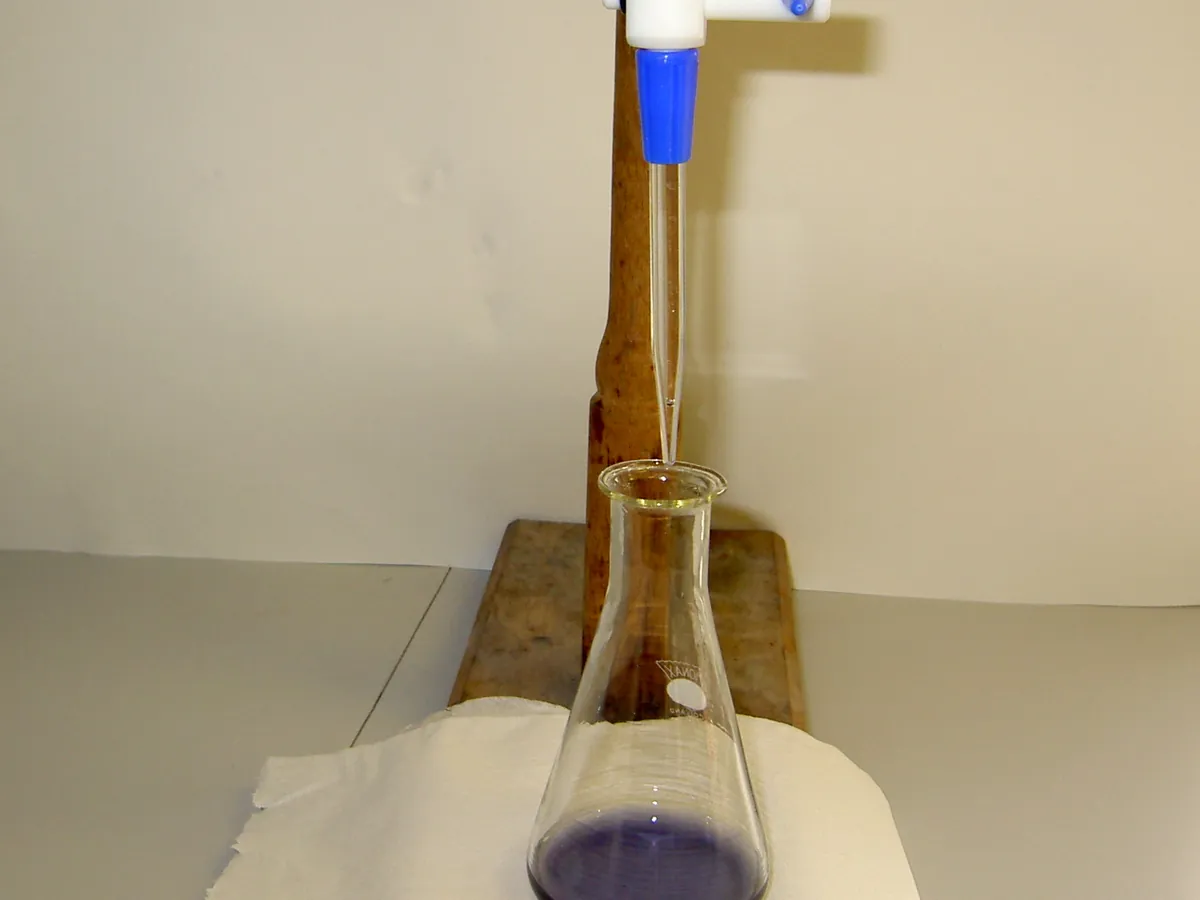
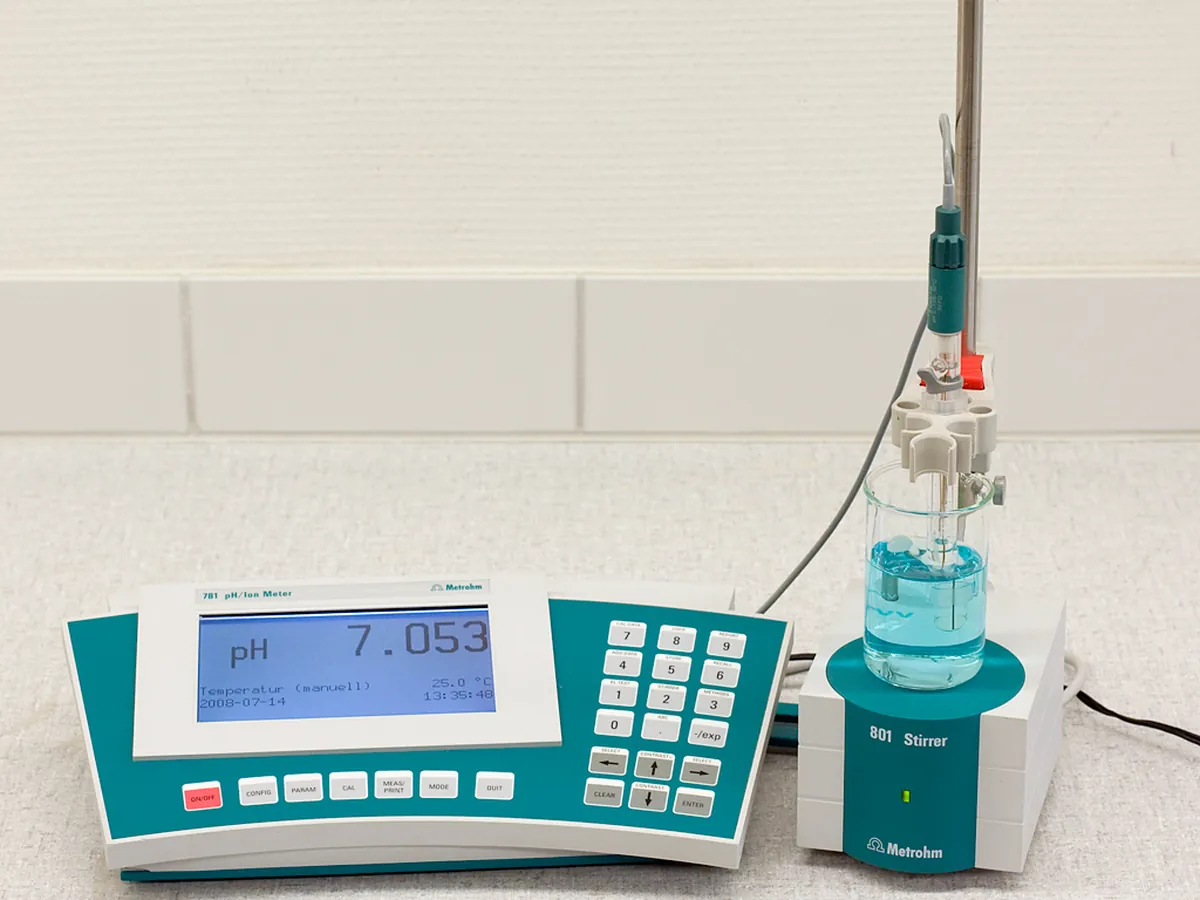
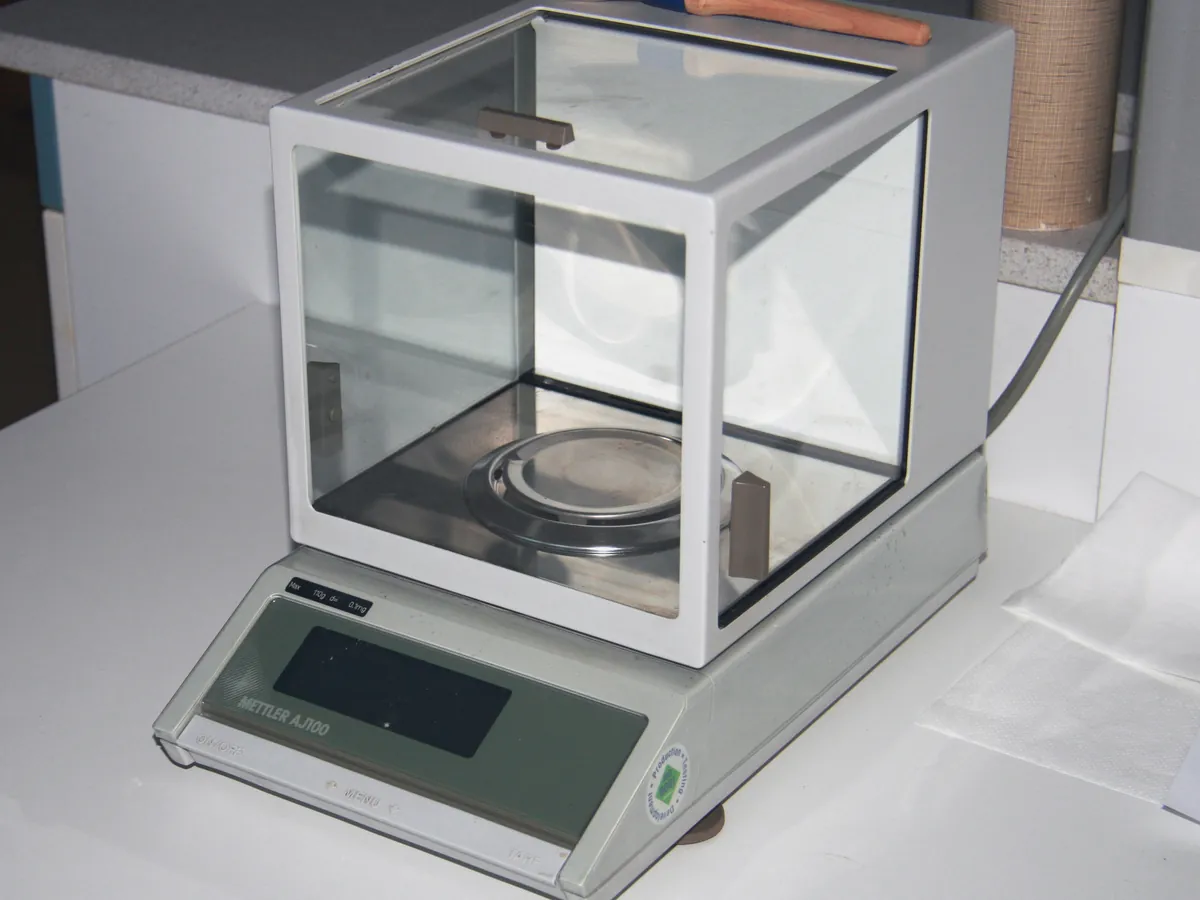
Reagents & standards
| Reagent | Grade / specification |
|---|---|
| Standard AgNO₃ | 0.0141 N (0.0141 M), standardised against NaCl; store in a brown bottle |
| Standard NaCl | 0.0141 N, from dried primary-standard sodium chloride |
| Potassium chromate indicator | About 5% K₂CrO₄ solution (toxic, carcinogenic — handle with care) |
| pH adjustment | Dilute NaOH or H₂SO₄ to bring pH to 7–10 |
| Aluminium hydroxide suspension | Optional, to clarify coloured samples |
Preparing the sample
- 01
Aliquot
100 mL sample (or diluted to 100 mL).
- 02
Adjust pH
Bring pH to 7–10.
- 03
Indicator
Add 1.0 mL K₂CrO₄ indicator.
- 04
Titrate
AgNO₃ until pinkish-yellow persists.
- 05
Blank
Titrate distilled water with indicator.
Procedure
- 1Pipette 100 mL of sample (or a smaller portion diluted to 100 mL if chloride is high) into a conical flask.
- 2Check the pH and, if necessary, adjust to between 7 and 10 with dilute NaOH or H₂SO₄. Below pH 7 chromate turns to dichromate and the endpoint is late; above pH 10 silver hydroxide/oxide precipitates.
- 3Add 1.0 mL of potassium chromate indicator.
- 4Titrate with 0.0141 N AgNO₃ against a white background, swirling constantly, to a faint but permanent pinkish-yellow endpoint.
- 5Titrate a blank of 100 mL distilled water with indicator in the same way (a blank of about 0.2–0.3 mL is usual) and subtract it.
- 6Be consistent in judging the endpoint colour; a comparison flask titrated just to the endpoint helps.
Standard preparation
- 1Standardise the AgNO₃ by titrating a known volume of 0.0141 N NaCl under the same conditions as samples.
Notes for analysts
- Potassium chromate is a hexavalent chromium compound. Collect titration waste for hazardous disposal; never pour it down the drain.
- Silver nitrate stains skin and is light-sensitive.
- For coloured or turbid samples, a potentiometric titration with a silver electrode gives a more objective endpoint.
Method parameters (typical)
| Titrant | 0.0141 N AgNO₃ (1 mL ≈ 0.500 mg Cl⁻) |
|---|---|
| Indicator | Potassium chromate, 1.0 mL |
| pH | 7–10 |
| Sample volume | 100 mL |
| Endpoint | First permanent pinkish-yellow (red-brown) tint |
System suitability & sequence
| Parameter | Limit |
|---|---|
| AgNO₃ standardisation | Replicate titres agree within the SOP limit |
| Blank | Typically about 0.2–0.3 mL; record and subtract |
| Check standard | NaCl standard recovered within the SOP limit (e.g. 95–105%) |
Typical sequence
- 1Standardise AgNO₃
- 2Blank
- 3Sample in duplicate
- 4Check standard
Calculation with a worked example
Where
- A
- AgNO₃ titre for the sample (mL)
- B
- AgNO₃ titre for the blank (mL)
- N
- Normality of AgNO₃
- 35 450
- Equivalent weight of chloride (35.45 g/eq) × 1000 mg/g
- V
- Sample volume (mL)
Given
- V
- 100 mL
- A
- 6.8 mL
- B
- 0.2 mL
- N
- 0.0141 N
Working
- 1
Net titre = 6.8 − 0.2 = 6.6 mL
- 2Chloride = 6.6 × 0.0141 × 35 450 ÷ 100
- 3= 0.09306 × 35 450 ÷ 100 = 3299 ÷ 100 = 32.99 mg/L
- 4
Cross-check: 1 mL of 0.0141 N AgNO₃ ≈ 0.500 mg Cl⁻, so 6.6 mL ≈ 3.30 mg in 100 mL = 33.0 mg/L
Chloride = 33.0 mg/L (well within the IS 10500 acceptable limit of 250 mg/L)
What result passes
- As per IS 10500:2012: acceptable limit 250 mg/L, permissible limit 1000 mg/L in the absence of an alternative source; check the current edition.
- WHO gives no health-based guideline for chloride; taste may be noticed above roughly 250 mg/L.
Validation parameters (ICH Q2(R2))
| Parameter | Typical requirement |
|---|---|
| Accuracy | Recovery of NaCl spikes |
| Range | Best for roughly 0.15–10 mg Cl⁻ in the titrated aliquot |
| Interferences | Bromide, iodide and cyanide titrate as chloride; sulphide, thiosulphate and sulphite interfere (remove with H₂O₂); orthophosphate above about 25 mg/L and iron above about 10 mg/L also interfere |
Run this method in LimsPulse: specifications and STPs under version control, results calculated and checked against limits, and a signed Certificate of Analysis.