Total soluble solids (°Brix) by refractometry
Measures the refractive index of a juice or drink at 20 °C and converts it to °Brix — the mass percentage of sucrose that would give the same refractive index. It is the quickest and most widely used check of sugar strength in beverages and fruit products.
- Food & beverage
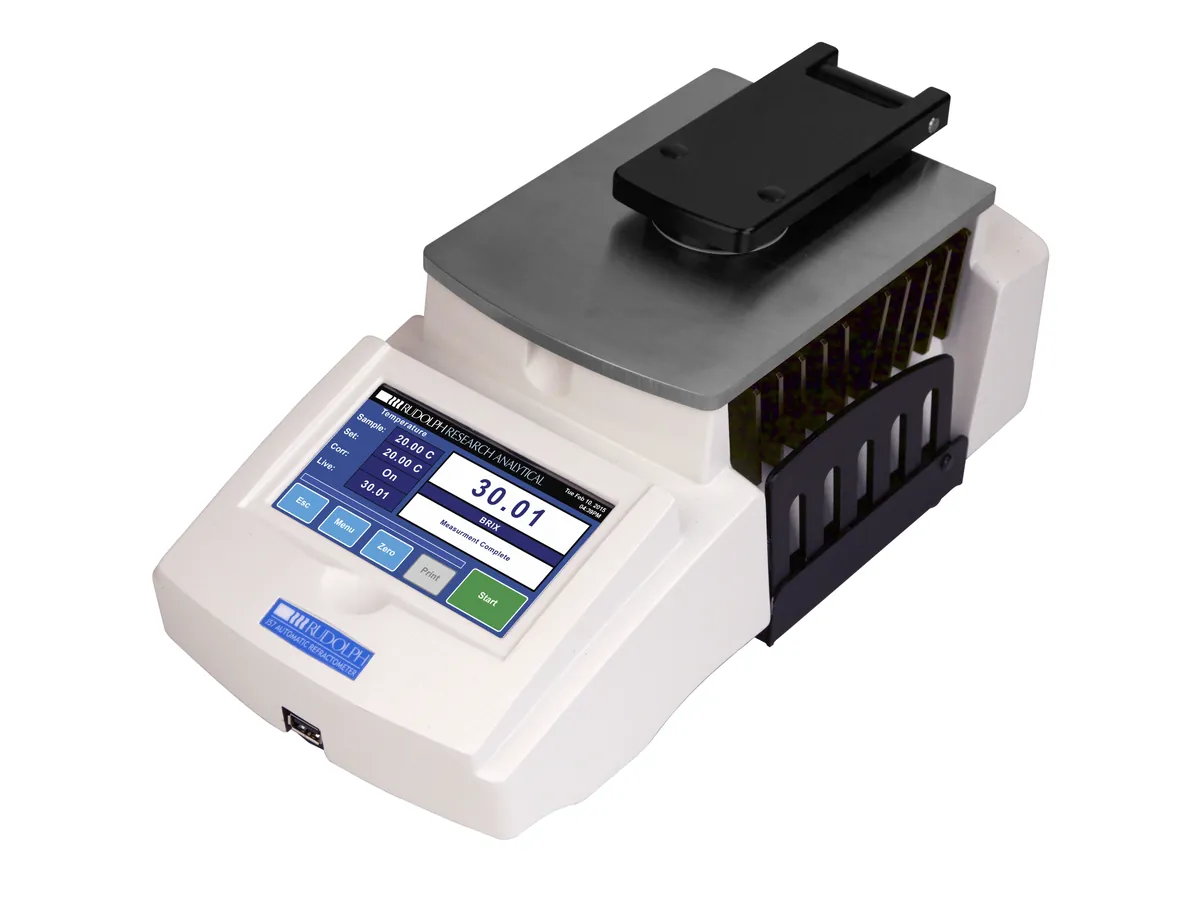
- Refractometry (digital Abbe or automatic refractometer)
- Refractometer
- Analytical balance
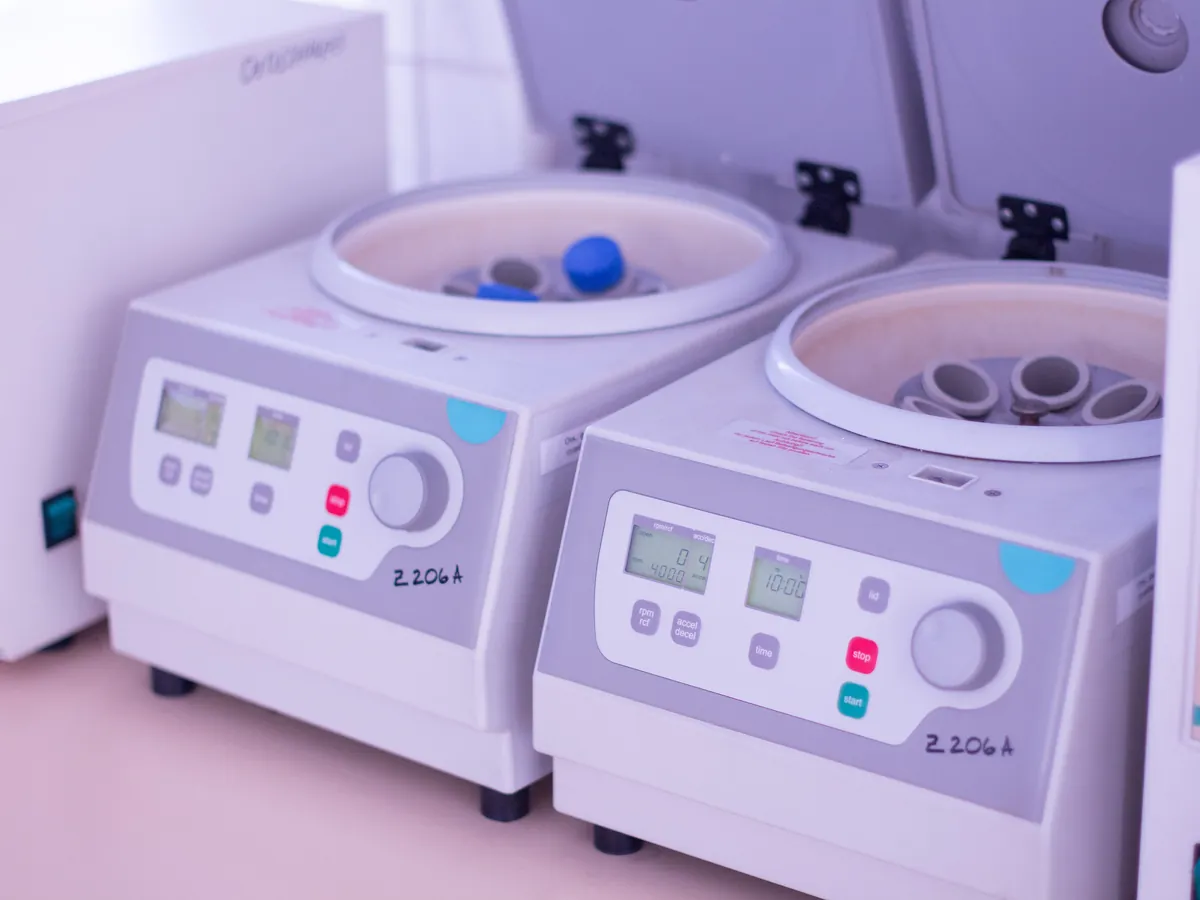
- Centrifuge
Reference: Typical method based on ISO 2173 and AOAC refractometric methods for soluble solids in fruit products. Follow your approved test method and product specification.
Why this method works
Dissolved sugars, acids and salts raise the refractive index of water. The refractometer measures the critical angle of total internal reflection at the prism–sample interface and converts the refractive index to °Brix using the international sucrose scale (ICUMSA tables). One °Brix is 1 g of sucrose in 100 g of solution. Because a juice contains other solutes, the result is reported as 'total soluble solids expressed as sucrose'. Refractive index falls as temperature rises, so readings are made at, or compensated to, 20 °C.
Instruments used

Reagents & standards
| Reagent | Grade / specification |
|---|---|
| Water | Distilled or purified water, for the zero check |
| Sucrose check standard | Certified sucrose solution (e.g. about 10% w/w) or a certified refractive index standard |
| Lint-free tissue | For cleaning the prism without scratching it |
Preparing the sample
- 01
Equilibrate
Bring the sample to about 20 °C.
- 02
Degas
Remove CO₂ from carbonated drinks by stirring or brief sonication.
- 03
Clarify
Filter or centrifuge cloudy juices and pulpy products.
- 04
Dilute if needed
Weigh and dilute thick concentrates with water by mass.
- 05
Read
Place on the clean prism and read at 20 °C.
Procedure
- 1Switch on the refractometer and let the prism reach 20.0 °C (Peltier control) or confirm that temperature compensation is active.
- 2Check the zero with distilled water: the reading should be 0.0 °Brix (or refractive index 1.3330 at 20 °C). Check a sucrose standard as required by your SOP.
- 3Mix the sample well. Degas carbonated drinks; filter or centrifuge cloudy or pulpy samples so that suspended solids do not blur the boundary line.
- 4For concentrates above the instrument range or too viscous to spread, weigh about 10 g into a beaker, add a weighed amount of water (for example to 40 g total), mix well and record both masses.
- 5Place a few drops of sample on the prism so it is fully covered with no air bubbles. Close the cover and wait for the temperature to stabilise.
- 6Record the reading to 0.1 °Brix (or 0.01 °Brix on high-resolution instruments). Clean the prism and repeat on a second portion.
- 7Report the mean of duplicates. Multiply by the dilution factor (by mass) if the sample was diluted.
Standard preparation
- 1Zero check: distilled water at 20 °C should read 0.0 ± 0.1 °Brix (or within the tolerance in your SOP).
- 2Span check: read a certified sucrose standard (for example 10% w/w) and confirm the result is within the stated tolerance before testing samples.
Notes for analysts
- Always dilute by mass, not volume. °Brix is a mass fraction, so a volumetric dilution gives a wrong answer for dense concentrates.
- Citrus juices contain a lot of citric acid. Some standards apply an acid correction (adding a small amount per % acid) to give 'corrected °Brix'; follow your product standard.
- The Brix-to-acid ratio (°Brix ÷ titratable acidity as citric acid) is a common maturity and taste index for juices.
- Never scratch the prism. Clean it with water and a soft tissue between samples; residual sugar gives a high bias.
Method parameters (typical)
| Measurement temperature | 20.0 °C (Peltier-controlled prism, or automatic temperature compensation to 20 °C) |
|---|---|
| Wavelength | Sodium D line, 589 nm (built into the instrument) |
| Scale | °Brix (ICUMSA sucrose scale) and refractive index nD20 |
| Resolution | Typically 0.1 °Brix (hand-held) to 0.01 °Brix (laboratory digital) |
| Replicates | Duplicate readings on separate portions |
System suitability & sequence
| Parameter | Limit |
|---|---|
| Water zero | 0.0 °Brix within the tolerance in your SOP (commonly ± 0.1 °Brix) |
| Sucrose standard | Within the certified value ± tolerance in your SOP |
| Duplicate agreement | Typically within 0.1–0.2 °Brix |
Typical sequence
- 1Water zero check
- 2Sucrose standard check
- 3Sample portion 1
- 4Sample portion 2
- 5Water check at end of series
Calculation with a worked example
Where
- R
- Refractometer reading of the diluted sample at 20 °C (°Brix)
- m₁
- Mass of concentrate taken (g)
- m₂
- Mass of water added (g)
Given
- Sample
- Orange juice concentrate
- m₁
- 10.00 g
- m₂
- 30.00 g (total 40.00 g)
- R (mean of duplicates)
- 16.2 °Brix
Working
- 1
Dilution factor by mass = (10.00 + 30.00) / 10.00 = 4.000
- 2
TSS = 16.2 × 4.000 = 64.8 °Brix
Total soluble solids of the concentrate = 64.8 °Brix (as sucrose)
What result passes
- Compare with the product specification or the applicable standard of identity. Typical ranges: orange juice about 10–13 °Brix, cola-type soft drinks about 10–11 °Brix, frozen juice concentrates about 60–66 °Brix.
- For reconstituted juices, many regulations set a minimum °Brix for the juice made from concentrate; check the current regulation in your market.
Validation parameters (ICH Q2(R2))
| Parameter | Typical requirement |
|---|---|
| Accuracy | Checked against certified sucrose standards across the working range |
| Precision | Repeatability of duplicates typically within 0.1 °Brix for clear liquids |
| Range | Instrument range, typically 0–85 °Brix; dilute by mass above this |
| Temperature effect | Verify temperature control or compensation at 20 °C |
Run this method in LimsPulse: specifications and STPs under version control, results calculated and checked against limits, and a signed Certificate of Analysis.