Karl Fischer Titrator (Coulometric)
Measures very small amounts of water by generating iodine electrically inside the cell and counting the charge needed to react with all the water. Suited to trace water, from ppm levels up to about 1–5%.
- Pharmaceutical
- Biotech
- Chemicals
- Petrochemicals
- Electronics / batteries
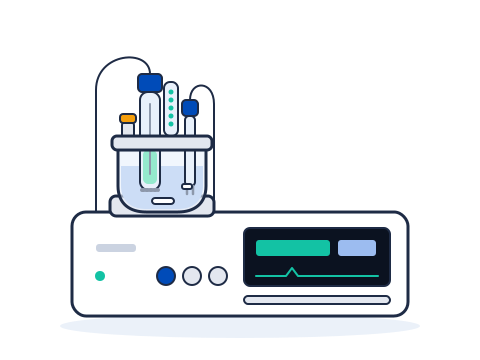
How KF titrator (coulometric) works
Iodide in the anolyte is oxidised to iodine at the generator anode. The iodine reacts at once with water in the sample. A double platinum indicator electrode detects when a small excess of iodine remains, which marks the endpoint. The charge passed is converted to water mass using Faraday's law: about 10.71 coulombs generate enough iodine for 1 mg of water.
The path of a sample
- 01
Conditioning
The instrument generates iodine until the anolyte is dry, then monitors the drift.
- 02
Sample injection
A weighed liquid sample is injected through the septum, or water from an oven is carried in by dry gas.
- 03
Iodine generation
Current passes through the generator electrode, producing iodine that reacts with the water.
- 04
Endpoint detection
The indicator electrode senses the first stable excess of iodine and generation stops.
- 05
Calculation
Total charge, corrected for drift, is converted to µg of water and then to ppm or %.
Main parts and what they do
Titration cell
Sealed glass vessel holding the anolyte, with a septum for injections and a drying tube.
Generator electrode
Produces iodine from iodide by electrolysis; with or without a diaphragm.
Double platinum indicator electrode
Detects the endpoint by bivoltametric indication.
Magnetic stirrer
Mixes sample and generated iodine quickly and evenly.
Drying tubes (molecular sieve)
Stop atmospheric moisture entering through vents.
Control unit and software
Controls the generator current, measures charge and drift, calculates results and keeps an audit trail.
KF oven (optional)
Heats sample vials and passes dry gas through them into the cell.
Terms every analyst should know
Faraday's law
The amount of substance produced at an electrode is proportional to the charge passed. Two electrons make one iodine molecule, which reacts with one water molecule, so 1 mg of water needs about 10.71 C (2 × 96 485 C/mol ÷ 18.015 g/mol).
Generator electrode
The electrode where iodine is made. Cells with a diaphragm separate the anode compartment (anolyte) from a small cathode compartment (catholyte). Diaphragm-free cells are simpler to clean but need suitable reagents.
Drift
Background moisture entering the cell, in µg/min. Because samples contain so little water, a stable low drift is even more important than in volumetric KF.
Working range
Typically from about 10 µg to 10 mg of water per determination, which suits samples from ppm levels up to roughly 1–5% water.
KF oven technique
The sample is heated in a sealed vial and a dry carrier gas sweeps the released water into the cell. Only water reaches the reagent, so insoluble or interfering samples can be analysed.
Keep every KF titrator (coulometric) in control: usage logs, calibration and maintenance schedules, and automatic blocking of overdue instruments.