FTIR · Calibration procedure
Wavenumber accuracy (polystyrene)
Checks that the FTIR reports absorption bands at the correct wavenumbers, by recording the spectrum of a certified polystyrene film and comparing band positions with reference values.
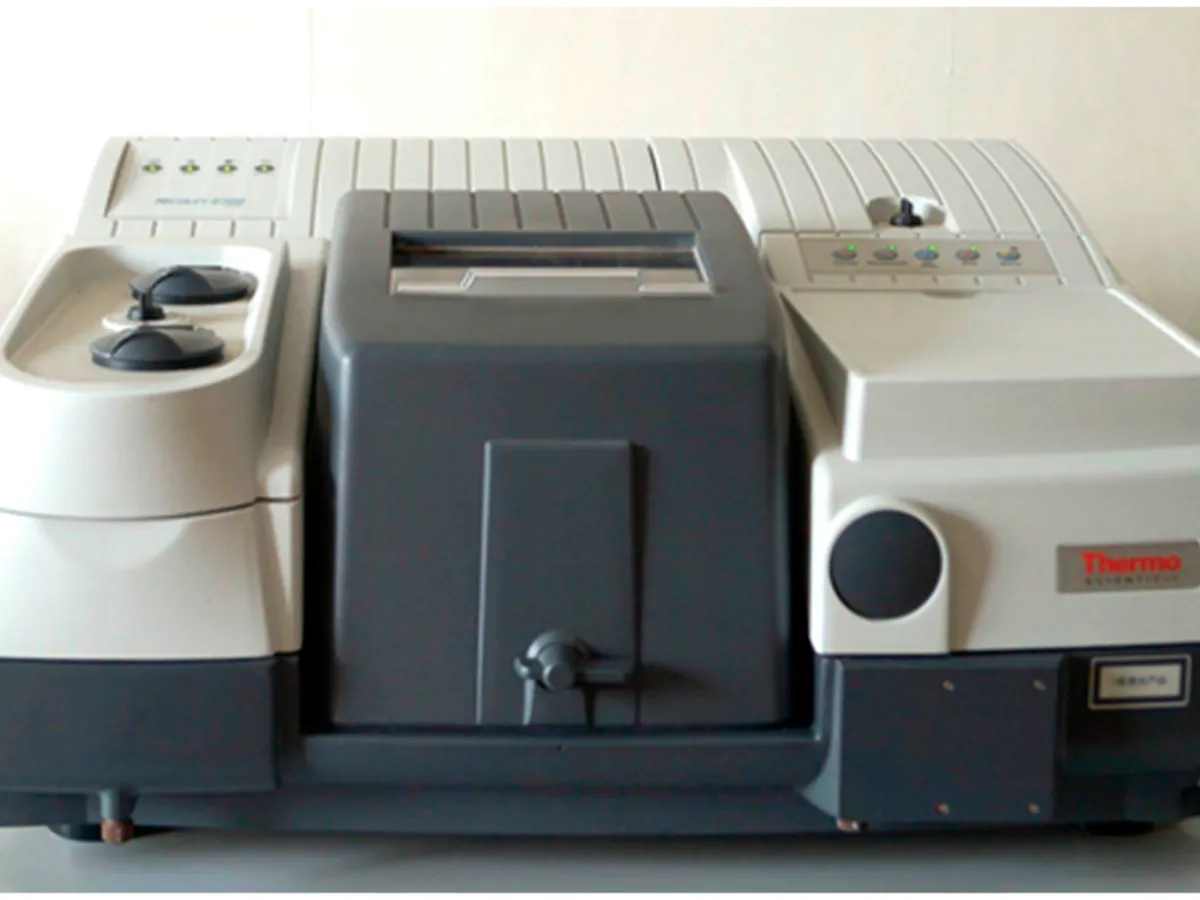
PURPOSE
Why this is checked
Identification compares the positions of bands in sample and reference spectra. A shifted wavenumber scale could make a correct material fail, or hide a real difference.
Frequency
Full calibration typically every 6 months or yearly; a quick polystyrene check is often done daily or before use, as defined in your SOP.
Learn how the FTIR worksYOU WILL NEED
Standards & tools
- Polystyrene film, about 35–50 µm thick, with a certificate of band positions traceable to a national standard
BEFORE YOU START
Prerequisites
- Instrument warmed up and humidity indicator acceptable
- Resolution and apodisation set as stated in your SOP or the film certificate (commonly 2 or 4 cm⁻¹)
- Sample compartment closed long enough for the atmosphere to settle
PROCEDURE
Step by step
- 1Collect a background spectrum with the beam path empty (transmission holder).
- 2Place the polystyrene film in the holder and record its spectrum over about 4000–400 cm⁻¹.
- 3Use the software's peak-pick to locate the band minima in %T (maxima in absorbance) at the certified positions.
- 4Compare each observed position with the certified value and calculate the difference.
- 5Do not use an ATR spectrum for this test unless your SOP and the certificate cover ATR, because ATR shifts some band positions slightly.
RECORD
Example observation table
| Typical reference band (cm⁻¹) | Observed (cm⁻¹) | Difference (cm⁻¹) | Typical tolerance (cm⁻¹) |
|---|---|---|---|
| 3060.0 | 3060.3 | +0.3 | ±1.5 |
| 2849.5 | 2849.9 | +0.4 | ±2.0 |
| 1942.9 | 1942.6 | −0.3 | ±1.5 |
| 1601.2 | 1601.4 | +0.2 | ±1.0 |
| 1583.0 | 1583.1 | +0.1 | ±1.0 |
| 1154.5 | 1154.4 | −0.1 | ±1.0 |
| 1028.3 | 1028.1 | −0.2 | ±1.0 |
CALCULATION
How to calculate the result
Difference = Observed wavenumber − Reference wavenumber
- Reference band 1601.2 cm⁻¹, observed 1601.4 cm⁻¹
- Difference = 1601.4 − 1601.2 = +0.2 cm⁻¹
- Within the typical ±1.0 cm⁻¹ tolerance, so the band passes
ACCEPTANCE CRITERIA
Pass if
- Each band within the tolerance in the current Ph. Eur. 2.2.24 / USP <854> table or the film certificate (typically ±1.0 cm⁻¹ for sharp bands in the fingerprint region, ±1.5 to ±2.0 cm⁻¹ for bands above 1900 cm⁻¹).
IF IT FAILS
What to do
- Check the film for damage and the method settings (resolution, apodisation); repeat once if an error is documented.
- Stop using the instrument and label it 'Out of calibration'.
- Arrange service to check the reference laser and alignment.
- Assess identification results since the last passing check.
MORE
Other FTIR calibrations
In LimsPulse · Calibration Management
LimsPulse schedules this calibration, records the result against limits, and blocks the instrument everywhere if it fails or goes overdue.