FTIR · Calibration procedure
Resolution
Checks that the FTIR can resolve close bands, by measuring the depth of the dips between neighbouring polystyrene bands near 2850 and 1583 cm⁻¹.
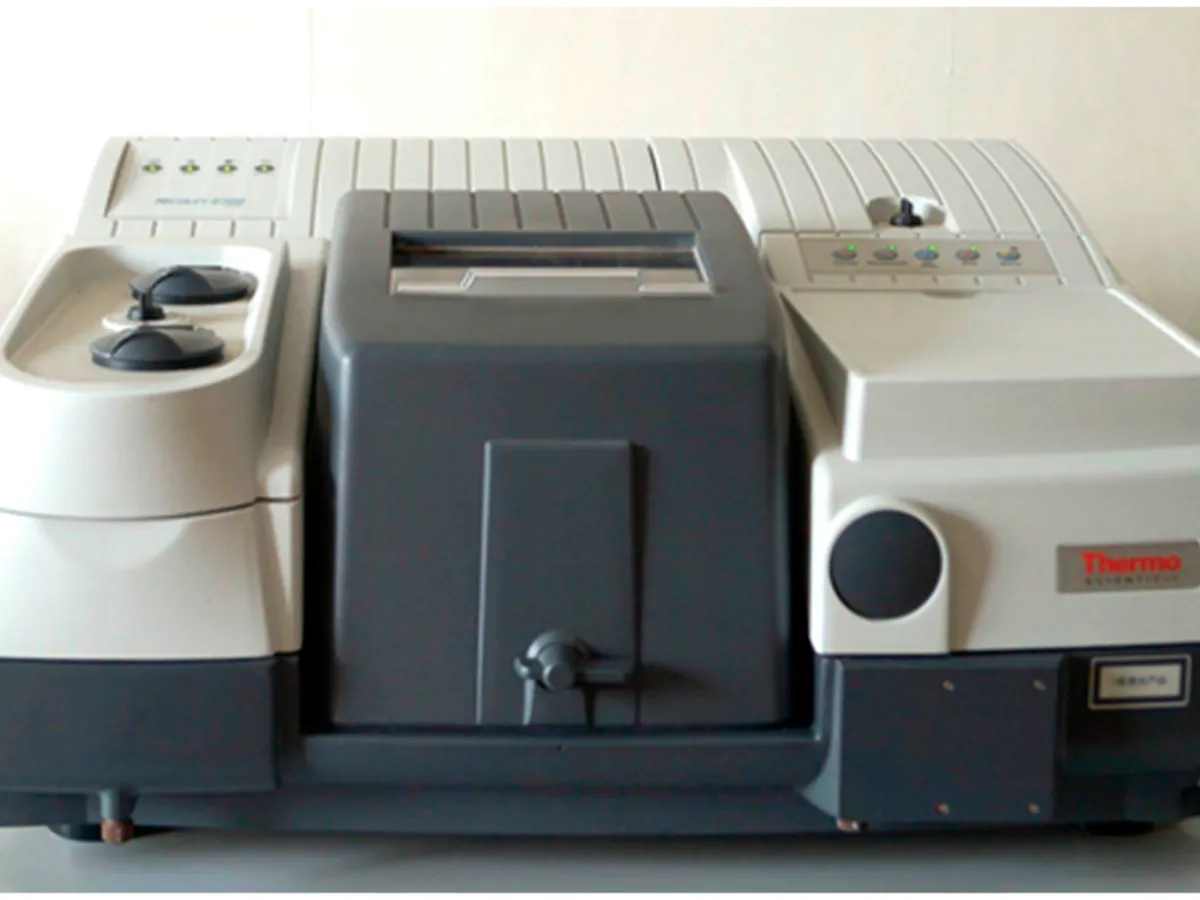
PURPOSE
Why this is checked
A poorly resolved spectrum merges close bands, which can hide differences between similar compounds. The resolution check confirms the instrument meets the level the identification methods assume.
Frequency
Full calibration typically every 6 months or yearly; a quick polystyrene check is often done daily or before use, as defined in your SOP.
Learn how the FTIR worksYOU WILL NEED
Standards & tools
- Certified polystyrene film, about 35 µm thick
BEFORE YOU START
Prerequisites
- Wavenumber accuracy already passed
- Resolution set to the value used for routine identification (commonly 2 or 4 cm⁻¹, or as the chapter specifies for this test)
PROCEDURE
Step by step
- 1Record the polystyrene spectrum in absorbance mode.
- 2Read the absorbance at the maximum near 2849.5 cm⁻¹ and at the minimum near 2870 cm⁻¹.
- 3Read the absorbance at the maximum near 1583 cm⁻¹ and at the minimum near 1589 cm⁻¹.
- 4Calculate each difference (maximum minus minimum).
RECORD
Example observation table
| Band pair | A at maximum | A at minimum | Difference | Typical limit |
|---|---|---|---|---|
| 2849.5 (max) / 2870 (min) cm⁻¹ | 0.812 | 0.402 | 0.410 | > 0.33 |
| 1583 (max) / 1589 (min) cm⁻¹ | 0.395 | 0.281 | 0.114 | > 0.08 |
CALCULATION
How to calculate the result
Difference = A(band maximum) − A(adjacent minimum)
- A at 2849.5 cm⁻¹ = 0.812; A at 2870 cm⁻¹ = 0.402
- Difference = 0.812 − 0.402 = 0.410
- 0.410 is greater than the typical limit of 0.33, so it passes
ACCEPTANCE CRITERIA
Pass if
- Typically: difference near 2870/2849.5 cm⁻¹ greater than 0.33, and near 1589/1583 cm⁻¹ greater than 0.08, for a film of about 35 µm. Some instruments instead verify resolution against the manufacturer's specification (e.g. using a water-vapour line width). Apply your SOP and the current chapter.
IF IT FAILS
What to do
- Check the resolution and apodisation settings and the film thickness.
- Repeat after collecting a fresh background.
- Arrange service (alignment, mirror drive) if it still fails.
MORE
Other FTIR calibrations
In LimsPulse · Calibration Management
LimsPulse schedules this calibration, records the result against limits, and blocks the instrument everywhere if it fails or goes overdue.