Autoclave · Calibration procedure
Biological indicator challenge
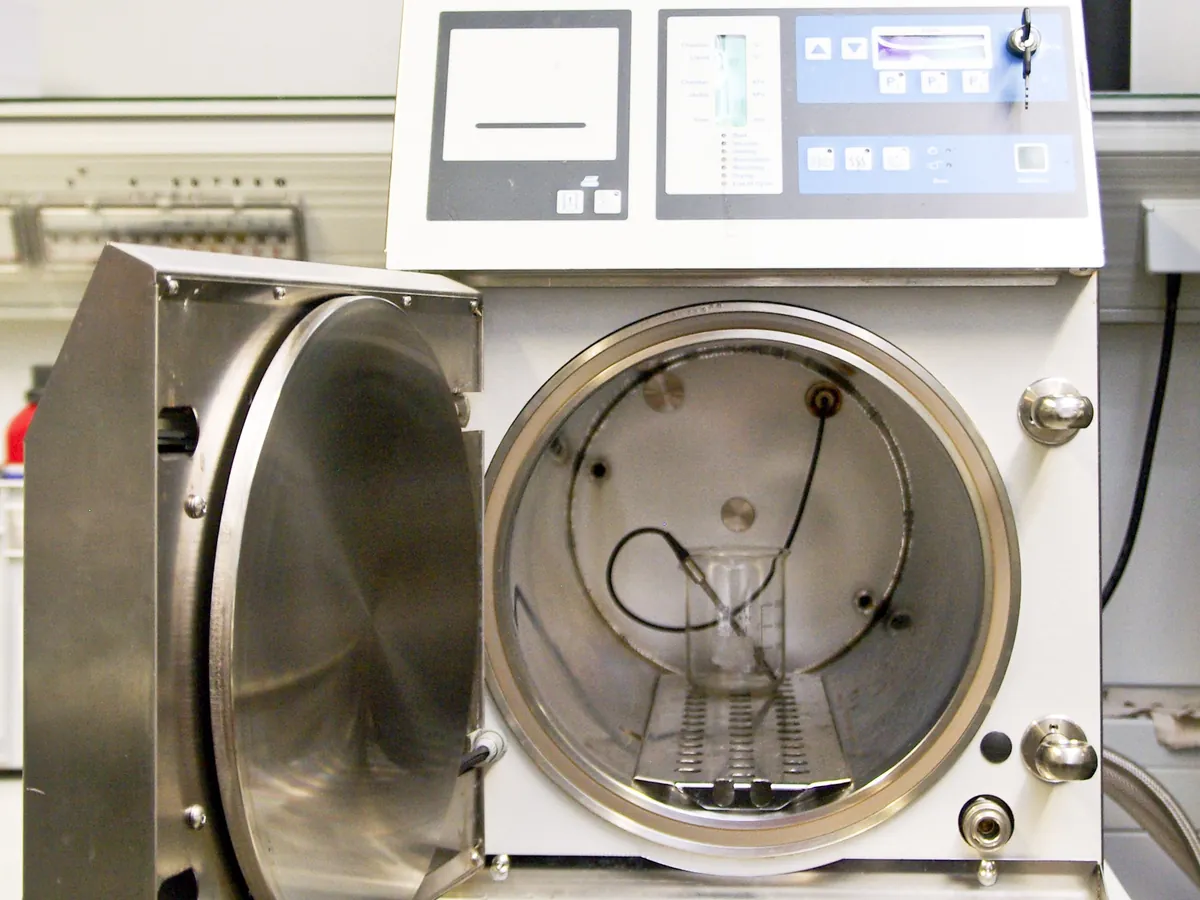
Places biological indicators containing at least 10^6 spores of Geobacillus stearothermophilus at the cold spots of the load, runs the cycle, and incubates them to show that no spores survive.
PURPOSE
Why this is checked
Temperature data show the physical conditions; biological indicators show the actual lethal effect on highly heat-resistant spores. Together they demonstrate that the cycle delivers the required sterility assurance at the worst-case locations.
Frequency
At initial PQ (three consecutive runs per load pattern), at periodic requalification (typically annually), and after major changes, as defined in your validation SOP.
Learn how the Autoclave worksYOU WILL NEED
Standards & tools
- Biological indicators of Geobacillus stearothermophilus with a population of ≥10^6 spores per carrier and a certified D121 value (typically about 1.5–2.5 minutes)
- Recovery medium (e.g. soybean-casein digest broth with indicator, often supplied in self-contained vials)
- Calibrated incubator at 55–60 °C
BEFORE YOU START
Prerequisites
- Temperature mapping completed and cold spots identified
- BI certificate of analysis checked (lot, population, D-value, expiry)
- Positive and negative controls planned
PROCEDURE
Step by step
- 1Place BIs at the cold spots found during mapping, next to the thermocouples, inside the slowest-heating items.
- 2Run the validated cycle with the routine load pattern.
- 3Retrieve the BIs aseptically, activate or transfer them into recovery medium, and incubate at 55–60 °C for the time stated by the supplier (often 24–48 hours for rapid types, up to 7 days for conventional).
- 4Incubate one unexposed BI from the same lot as a positive control.
- 5Read for growth (turbidity or colour change) and record each result.
RECORD
Example observation table
| BI no. | Location | Growth after incubation | Result |
|---|---|---|---|
| BI-1 | Drain | No growth | Pass |
| BI-2 | Chamber centre | No growth | Pass |
| BI-3 | Inside 1000 mL media bottle (cold spot) | No growth | Pass |
| BI-4 | Inside 500 mL media bottle | No growth | Pass |
| BI-5 | Top front, near door | No growth | Pass |
| Positive control | Not exposed | Growth | Valid |
CALCULATION
How to calculate the result
Log reduction = F0 ÷ D121; Expected survivors per BI = 10^(log10 N0 − F0 ÷ D121)
- BI population N0 = 2.1 × 10^6 spores, so log10 N0 = 6.32; certified D121 = 1.7 min
- Cold-spot F0 = 17.9 min, so log reduction = 17.9 ÷ 1.7 = 10.5 logs
- Expected survivors = 10^(6.32 − 10.53) = 10^−4.2 per BI
- The cycle inactivates the full spore population with a wide margin, consistent with no growth seen
ACCEPTANCE CRITERIA
Pass if
- No growth from any exposed biological indicator.
- Positive control shows growth; negative (uninoculated medium) control shows no growth.
- Physical data for the same run meet the temperature mapping acceptance criteria.
IF IT FAILS
What to do
- Treat the run as failed and do not release the cycle or load pattern.
- Check the BI controls, handling and incubation to rule out a test error; identify the organism if growth is atypical.
- Investigate the temperature data, air removal and load configuration at the failing location.
- Correct the cause and repeat the full challenge for three consecutive runs.
MORE
Other Autoclave calibrations
In LimsPulse · Calibration Management
LimsPulse schedules this calibration, records the result against limits, and blocks the instrument everywhere if it fails or goes overdue.