Viscosity of Creams and Lotions (Rotational Viscometer)
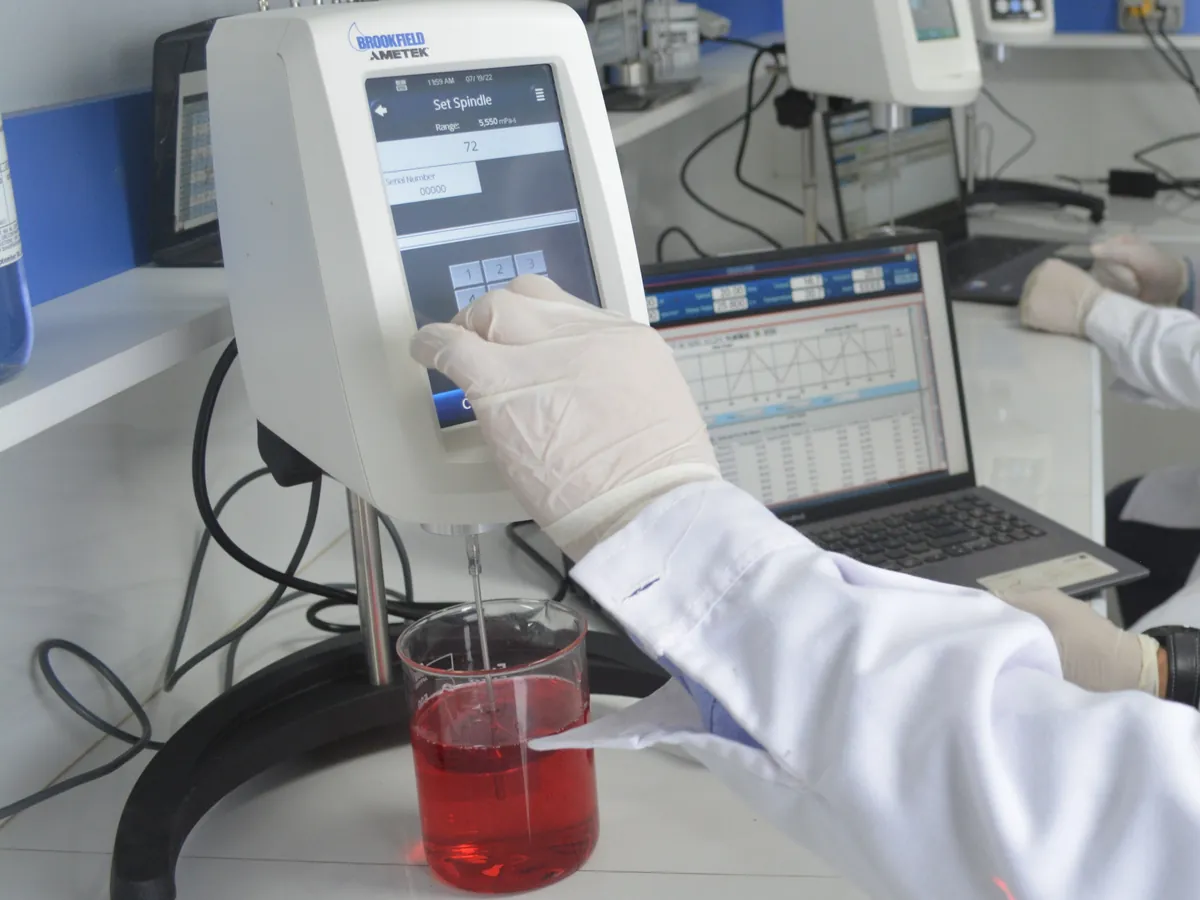
A spindle rotates in the product at a fixed speed and the instrument measures the torque needed to turn it. Torque is converted to apparent viscosity in mPa·s. For thick creams a T-bar spindle on a helipath stand moves slowly downward so it always cuts fresh product.
- Cosmetics & personal care
- Rotational viscometry (single-point apparent viscosity)
- Viscometer
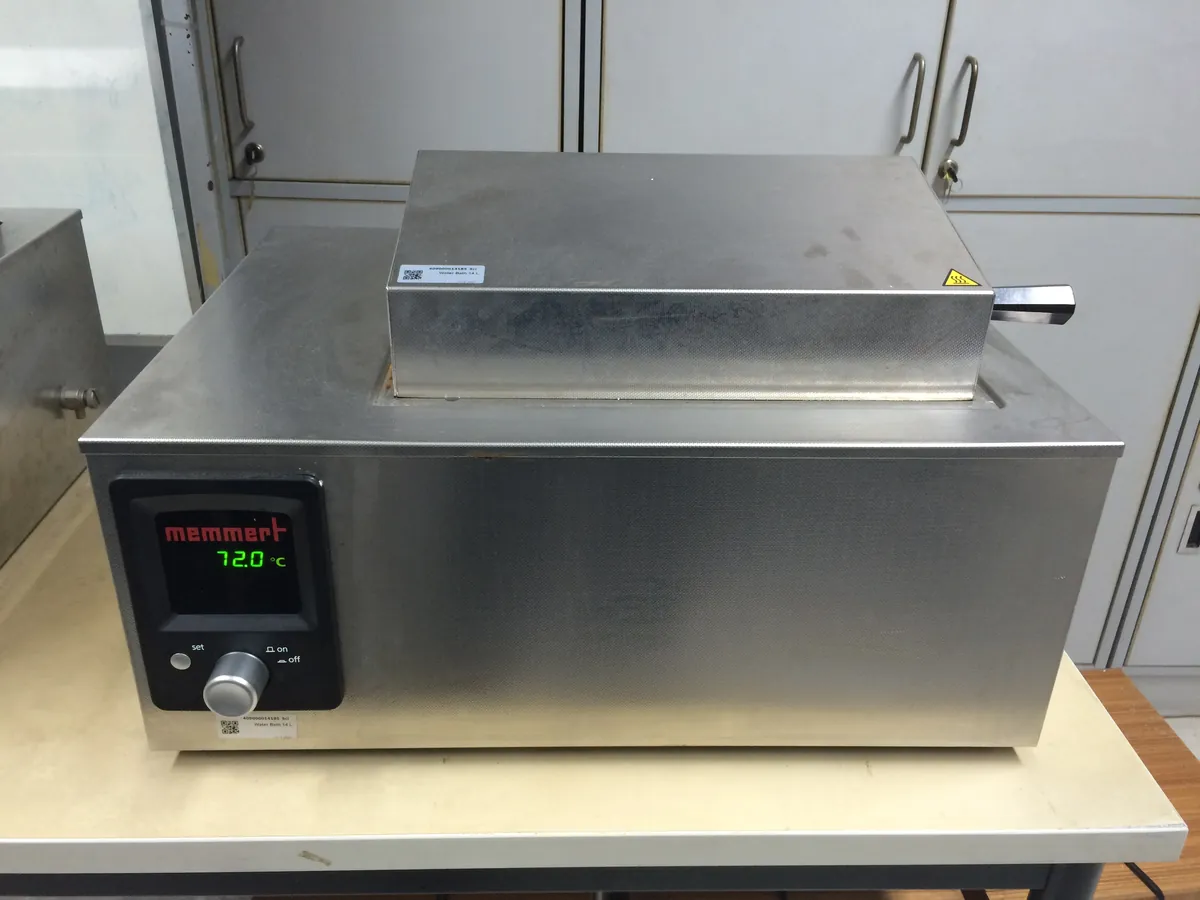
- Water bath
Reference: Typical in-house QC method using a rotational (Brookfield-type) viscometer. Spindle, speed, temperature and reading time are product-specific and fixed in the specification.
Why this method works
Viscosity is resistance to flow. A rotating spindle drags the surrounding product; the torque needed is proportional to viscosity for a given spindle and speed. Most creams and lotions are shear-thinning and often thixotropic, so the result depends on spindle, speed, temperature, time and how the sample was handled. The number is an apparent viscosity, valid only for those exact conditions. It is used for batch-to-batch control and for stability trending rather than as a fundamental property.
Instruments used
Reagents & standards
| Reagent | Grade / specification |
|---|---|
| Viscosity standard | Certified silicone oil standard in the range of use, for instrument checks |
Preparing the sample
- 01
Condition
Bring the sample to 25.0 ± 0.5 °C in a water bath.
- 02
Fill
Fill a standard container gently without stirring in air.
- 03
Select spindle
Choose spindle and speed so torque is 10–100%.
- 04
Measure
Run for a fixed time (for example 60 s) and read.
- 05
Record
Record viscosity, torque %, spindle, speed and temperature.
Procedure
- 1Level the viscometer and check auto-zero; verify with a viscosity standard at the frequency in your SOP.
- 2Fill the product into a 600 mL low-form beaker (or the container in the method) without whipping in air. Let it rest for the specified time to recover structure.
- 3Condition the beaker in a water bath at 25.0 ± 0.5 °C.
- 4Attach the specified spindle (disc spindle for lotions; T-bar spindle with helipath stand for thick creams). Immerse to the immersion mark, avoiding trapped air under the disc.
- 5Start rotation at the specified speed and read after a fixed time (for example 60 s) or as an average over the helipath travel.
- 6Check that torque is between about 10% and 100%; if not, change spindle or speed as allowed by the method.
- 7Measure in duplicate on separate fills and report the mean.
Standard preparation
- 1Verify the instrument with a certified viscosity standard at 25 °C using the spindle and speed recommended on its certificate.
Notes for analysts
- Viscosity of emulsions falls as temperature rises; a 1 °C change can shift results noticeably, so control temperature tightly.
- Results at different spindles or speeds cannot be compared because creams are shear-thinning.
- For full flow behaviour (yield stress, thixotropy), a rheometer with flow curves gives more information than a single-point reading.
Method parameters (typical)
| Instrument | Rotational viscometer (RV or HA/HB torque range for creams) |
|---|---|
| Spindle / speed | Product-specific, for example disc spindle at 20 rpm (lotion) or T-bar spindle at 5 rpm with helipath (cream) |
| Temperature | 25.0 ± 0.5 °C |
| Reading time | Fixed, for example 60 s |
| Torque range | 10–100% of full scale |
System suitability & sequence
| Parameter | Limit |
|---|---|
| Viscosity standard | Typically within ± 5% of the certified value (including standard and instrument tolerance) |
| Torque | Between 10% and 100% |
| Duplicates | Within the method precision, for example ≤ 5% difference |
Typical sequence
- 1Auto-zero
- 2Viscosity standard check
- 3Condition samples
- 4Measure duplicates
- 5Clean spindle between samples
Calculation with a worked example
Where
- Torque (%)
- Percentage of the instrument's full-scale torque
- Full-scale range
- Maximum viscosity measurable with that spindle and speed (from the instrument's range table)
Given
- Spindle / speed full-scale range
- 100 000 mPa·s
- Torque reading
- 45.6%
Working
- 1Viscosity = 45.6 ÷ 100 × 100 000 = 45 600 mPa·s
Apparent viscosity = 45 600 mPa·s (45.6 Pa·s) at 25 °C, stated spindle and speed. Most digital viscometers display this directly.
What result passes
- Within the product specification range (for example 30 000–60 000 mPa·s for a body cream), set from development and batch history.
Validation parameters (ICH Q2(R2))
| Parameter | Typical requirement |
|---|---|
| Precision | Repeatability and intermediate precision on a typical batch |
| Robustness | Effect of temperature, rest time, reading time and container size |
| Range | Torque kept within 10–100% across the specification |
Run this method in LimsPulse: specifications and STPs under version control, results calculated and checked against limits, and a signed Certificate of Analysis.