Total Acid Number (TAN) by Potentiometric Titration
The acid number measures the amount of acidic material in an oil. In new oils it reflects acidic additives. In service, a rising TAN shows that the oil is oxidising and forming organic acids, which corrode metal and thicken the oil — so TAN is a key 'change the oil' indicator.
- Petroleum, oil & gas
- Non-aqueous potentiometric titration with alcoholic potassium hydroxide
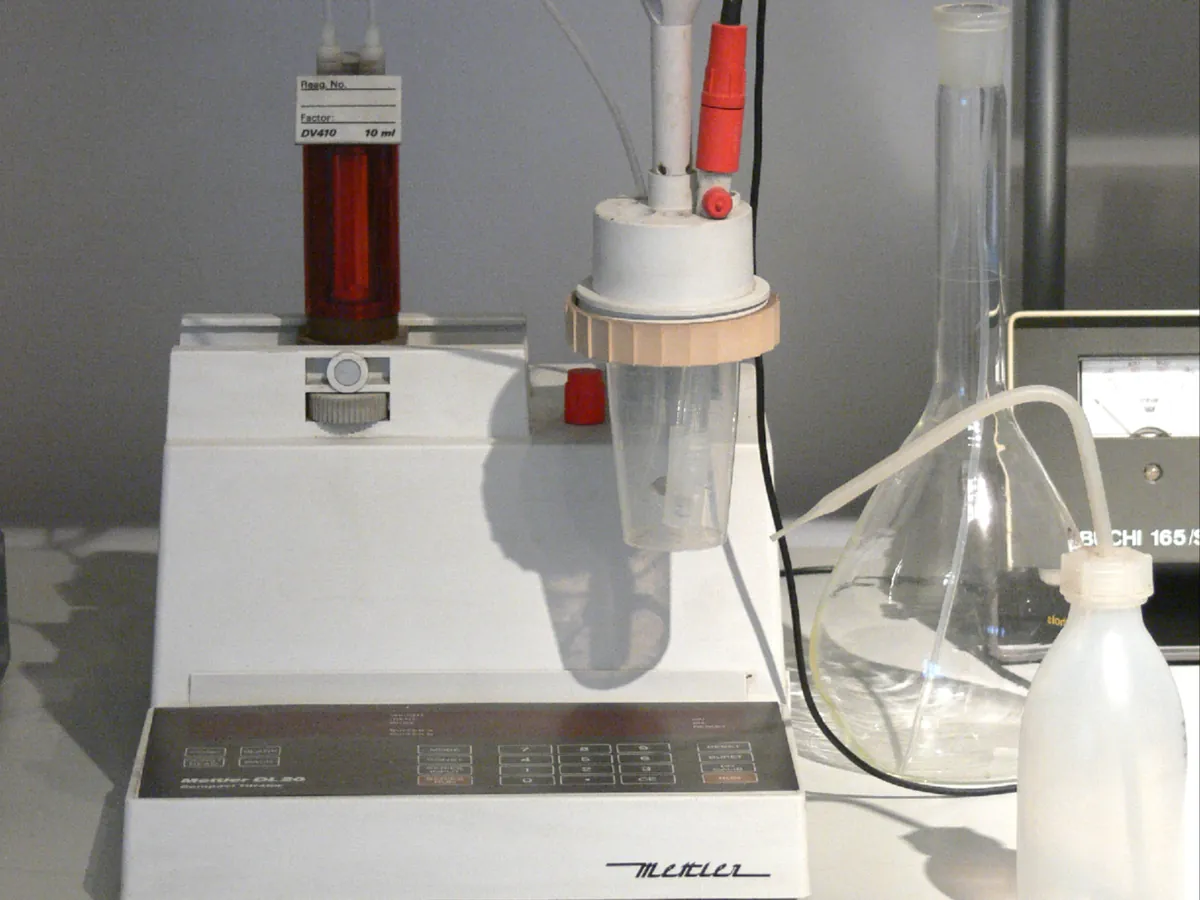
- Potentiometric titrator
- Analytical balance
Reference: Typical method based on ASTM D664 (acid number of petroleum products by potentiometric titration), with the corresponding IS 1448 part and IP method. The colour-indicator method ASTM D974 is an alternative for light-coloured oils. Follow your lab SOP and the current editions.
Why this method works
The oil is dissolved in a mixture of toluene and propan-2-ol containing a little water, and titrated with standard alcoholic potassium hydroxide (KOH). A combination glass electrode (with a non-aqueous reference electrolyte, for example lithium chloride in ethanol) follows the potential. The end point is the inflection of the titration curve; where no clear inflection appears, the method uses a buffer end point set from an aqueous basic buffer. The volume of KOH used, minus a solvent blank, gives the milligrams of KOH needed to neutralise the acids in 1 g of sample.
Instruments used

Reagents & standards
| Reagent | Grade / specification |
|---|---|
| Titrant | 0.1 mol/L potassium hydroxide in propan-2-ol, standardised against potassium hydrogen phthalate (KHP) |
| Titration solvent | Toluene + propan-2-ol + a small amount of water (proportions as given in the method, for example 500 + 495 + 5 mL) |
| Electrode | Combination glass electrode with a non-aqueous reference electrolyte (for example 1–3 mol/L LiCl in ethanol) |
| Buffers | Aqueous buffer(s) for electrode checks and buffer end points, as the method specifies |
Preparing the sample
- 01
Standardise
KOH titre against KHP.
- 02
Blank
Titrate the solvent alone.
- 03
Weigh
Sample mass chosen from the expected TAN.
- 04
Dissolve
Add 125 mL titration solvent; stir.
- 05
Titrate
Add KOH; record curve to inflection.
- 06
Calculate
(A − B) × M × 56.1 ÷ W.
Procedure
- 1Standardise the 0.1 mol/L alcoholic KOH against dried potassium hydrogen phthalate, as often as the SOP requires (for example weekly), and record the molarity.
- 2Condition the electrode as the method describes (soak in water, then rinse with solvent). Check the response with buffers; the electrode should give a sharp, fast response.
- 3Run a blank: titrate the same volume of titration solvent (for example 125 mL) and record the volume B to the same end point.
- 4Shake the sample well. Weigh the sample mass appropriate to the expected acid number into the titration beaker. As a guide, larger masses (about 20 g) are used for very low TAN oils and smaller masses (5 g or less) for higher TAN oils — follow the table in the current method.
- 5Add the titration solvent, stir until the sample dissolves, immerse the electrode and titrate with KOH. The titrator adds titrant in small increments and records millivolts against volume.
- 6Take the volume at the inflection point (or at the buffer end point if no inflection is seen) as A.
- 7Clean the electrode with solvent between samples and rinse with water every few titrations to keep the glass membrane hydrated.
Standard preparation
- 1KHP standardisation: weigh dried KHP accurately, dissolve in carbon-dioxide-free water and titrate potentiometrically with the KOH solution; M = mass of KHP (g) ÷ (0.20422 × V in mL), using 204.22 g/mol for KHP.
- 2Protect the KOH solution from carbon dioxide (soda-lime guard tube) and light.
Notes for analysts
- Inflection and buffer end points can give different results on the same oil; always report which was used.
- Base number (TBN) for engine oils is a different test (for example ASTM D2896 or D4739) using acid titrant.
- Electrode fouling with heavy or used oils is the most common cause of poor curves; clean and rehydrate the electrode regularly.
- Work with toluene in a fume hood; it is flammable and harmful by inhalation.
Method parameters (typical)
| Titrant | 0.1 mol/L alcoholic KOH |
|---|---|
| Solvent volume | Typically 125 mL per titration |
| End point | Inflection point; buffer end point if no inflection |
| Sample mass | From the method table according to expected TAN (for example about 20 g for TAN below 1) |
| Reporting | mg KOH/g, quoting the method and end-point type |
System suitability & sequence
| Parameter | Limit |
|---|---|
| Titrant standardisation | Replicate KHP titrations agree within the SOP limit (for example ≤ 0.2% RSD) |
| Blank | Small and consistent between runs |
| Control sample | TAN of a reference oil within its control limits |
| Electrode response | Clear inflection and stable readings; replace or recondition if sluggish |
Typical sequence
- 1Electrode check
- 2Blank (solvent)
- 3Control oil
- 4Samples (duplicates as per SOP)
- 5Control oil at end of batch
Calculation with a worked example
Where
- A
- Volume of KOH to the end point for the sample (mL)
- B
- Volume of KOH to the same end point for the solvent blank (mL)
- M
- Molarity of the alcoholic KOH (mol/L)
- 56.1
- Molar mass of KOH (g/mol), so mmol × 56.1 = mg KOH
- W
- Sample mass (g)
Given
- A
- 2.45 mL
- B
- 0.05 mL
- M
- 0.1000 mol/L
- W
- 5.012 g
Working
- 1
A − B = 2.45 − 0.05 = 2.40 mL
- 2
mg KOH = 2.40 × 0.1000 × 56.1 = 13.464 mg
- 3Acid number = 13.464 ÷ 5.012 = 2.686 mg KOH/g
TAN = 2.69 mg KOH/g
What result passes
- New oil: compare with the product specification or certificate of analysis.
- In-service oil: compare with the new-oil value and OEM limits. A common rule of thumb is to investigate when TAN rises by about 1–2 mg KOH/g above the new-oil value (or exceeds an absolute limit for turbine oils) — set the limits in your SOP.
Validation parameters (ICH Q2(R2))
| Parameter | Typical requirement |
|---|---|
| Accuracy | Reference oils of known acid number; recovery of a spiked acid such as benzoic acid |
| Precision | Repeatability within the method statement; control chart of a control oil |
| Robustness | Electrode condition and end-point mode (inflection versus buffer) documented |
Run this method in LimsPulse: specifications and STPs under version control, results calculated and checked against limits, and a signed Certificate of Analysis.