PM10 and PM2.5 in Ambient Air by Gravimetric Sampling
Measures the mass concentration of airborne particles in two size fractions. Air is drawn at a known, controlled flow through a size-selective inlet for 24 hours; the particles that pass the inlet collect on a pre-weighed filter. The filter is conditioned and re-weighed, and the mass gain divided by the volume of air sampled gives µg/m³.
- Environmental & water
- Size-selective inlet, controlled-flow sampling onto a filter, and weighing of conditioned filters
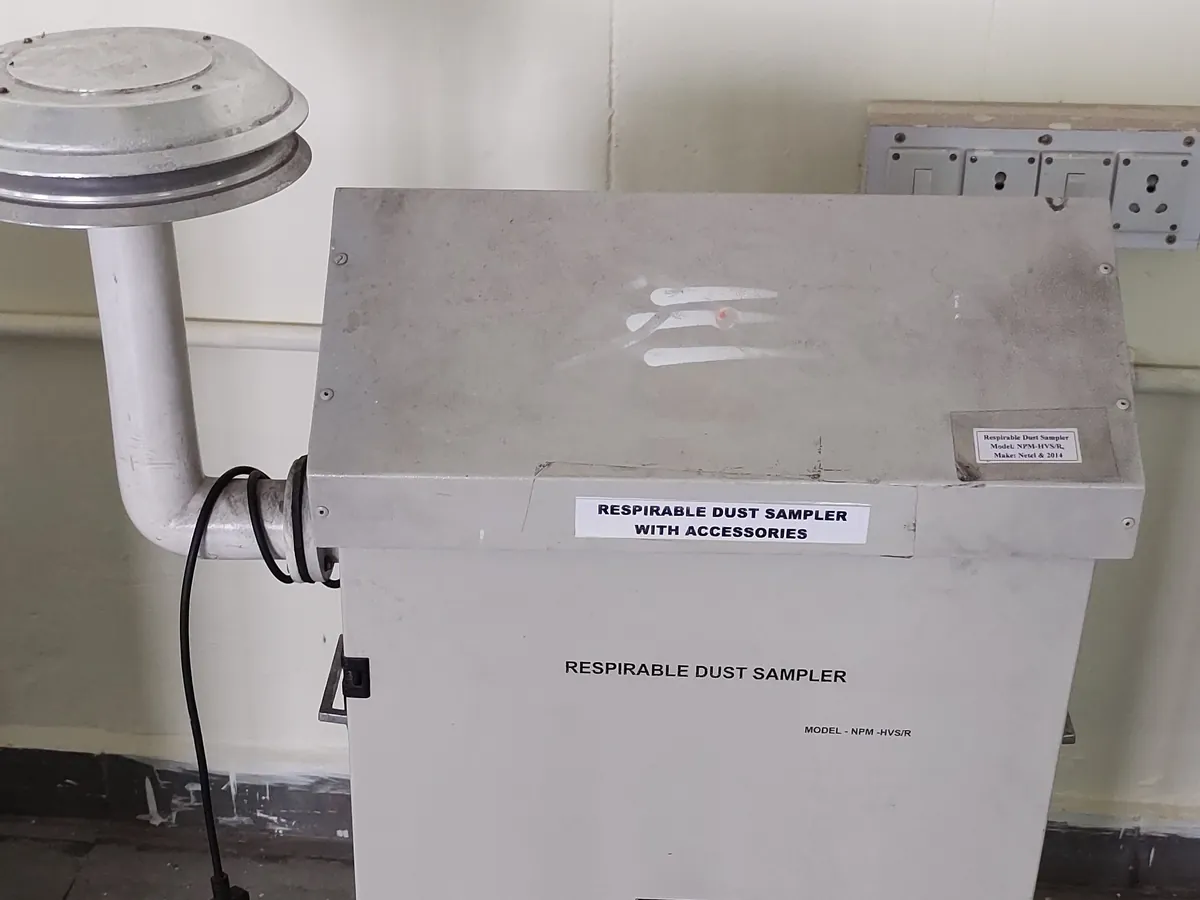
- PM sampler
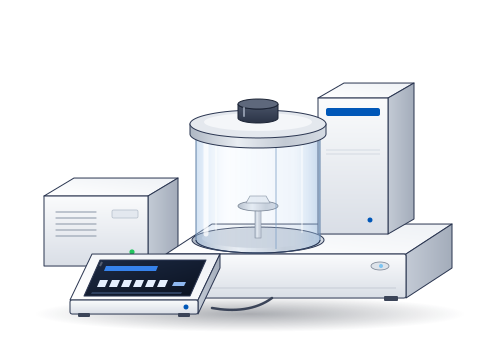
- Microbalance
- Analytical balance
Reference: Typical procedure based on CPCB Guidelines for the Measurement of Ambient Air Pollutants (Vol. I), IS 5182 (Part 23) for PM10, and US EPA 40 CFR Part 50 Appendix J (PM10) and Appendix L (PM2.5). Follow the method approved for your station.
Why this method works
An impactor or cyclone inlet removes particles larger than the cut point (10 µm or 2.5 µm aerodynamic diameter) because their inertia makes them strike a surface instead of following the air stream. The remaining particles are captured on a filter: glass-fibre or quartz filters for high-volume PM10 samplers, and 47 mm PTFE (Teflon) membrane filters for low-volume PM2.5 samplers. Filters are weighed before and after sampling after equilibrating in a room with controlled temperature and humidity, because filters and particles gain or lose water with humidity. Concentration = mass gain ÷ volume of air sampled. The flow rate must be held at the design value because the size cut of the inlet depends on it.
Instruments used

Reagents & standards
| Reagent | Grade / specification |
|---|---|
| PM2.5 filters | 47 mm PTFE membrane filters with support ring, low background, numbered |
| PM10 filters | Glass-fibre (for example 20 × 25 cm for high-volume samplers) or PTFE/quartz for low-volume samplers |
| Check weights | Calibrated working mass standards (for example 100 mg and 200 mg) for the balance |
| Inlet grease / oil | Impactor oil or grease as specified by the sampler maker (for example for a WINS impactor) |
| Consumables | Antistatic device (ionizer or polonium strip), non-serrated forceps, labelled filter cassettes and petri slides |
Preparing the sample
- 01
Inspect filters
Check each filter for pinholes, tears or loose material.
- 02
Condition
Equilibrate at controlled temperature and RH, typically at least 24 h.
- 03
Pre-weigh
Weigh with static removed; record initial mass.
- 04
Sample
Run the sampler at design flow for 24 h; record flow, time, T and P.
- 05
Transport
Return the filter in its cassette, protected and cool.
- 06
Post-weigh
Re-condition and re-weigh; mass gain ÷ air volume.
Procedure
- 1Inspect each filter against a light. Reject filters with pinholes, tears, chaff or flashing. Number each filter and its holder.
- 2Condition the filters in the weighing room. Typical conditions are a mean temperature of about 20–23 °C and a mean relative humidity of about 30–40% (PM2.5), held stable over at least 24 hours. Use the conditions in your method.
- 3Zero and check the balance with the working mass standards. Remove static from each filter and weigh it (microbalance with 1 µg readability for 47 mm PM2.5 filters; analytical balance with 0.1 mg readability for large PM10 glass-fibre filters). Weigh one or two laboratory blank filters with every batch.
- 4At the site, check the sampler flow against a calibrated flow transfer standard, clean and re-grease the impactor if needed, and install the filter cassette without touching the filter surface.
- 5Run the sampler for 24 hours (typically from 00:00 to 00:00 or as per the monitoring schedule). Record the start and end times, elapsed time, average flow rate, ambient temperature and pressure, and any flow faults.
- 6Recover the filter, inspect it, place it in its labelled holder and transport it to the lab protected from heat and vibration. Carry a field blank filter that goes to the site but is not sampled.
- 7Re-condition the exposed filter under the same conditions as before and re-weigh it. Repeat weighings should agree within the tolerance in your SOP (for example within a few µg for PM2.5 filters).
- 8Calculate the volume of air sampled and the mass concentration. Archive the filter in a refrigerator if chemical analysis (metals, ions, carbon) may follow.
Standard preparation
- 1Weigh working mass standards at the start and end of each weighing session; they must read within the tolerance of their certified values.
- 2Weigh laboratory blank filters and field blanks with each batch; a large blank mass change shows a conditioning, handling or contamination problem.
Notes for analysts
- Always state whether volumes are at actual or standard conditions; the method you follow defines which is used.
- Static charge on PTFE filters causes drifting readings. Use an antistatic device and allow readings to stabilise.
- Handle filters only with clean, non-serrated forceps, and wear powder-free gloves.
- A blocked or under-greased impactor shifts the size cut. Clean the inlet on the schedule set by the maker.
- Volatile components (ammonium nitrate, some organics) can be lost from filters in warm conditions; transport and store exposed filters cool.
Method parameters (typical)
| Sampling period | 24 hours (typically 1440 minutes ± a small allowance defined in the method) |
|---|---|
| PM2.5 low-volume flow | 16.67 L/min (1.0 m³/h) at actual conditions |
| PM10 high-volume (respirable dust sampler) flow | Typically about 1.0–1.2 m³/min, with cyclone or impactor inlet |
| PM10 low-volume flow | 16.67 L/min with a PM10 inlet |
| Filter | 47 mm PTFE (PM2.5); glass-fibre or quartz (PM10 high-volume) |
| Balance | Microbalance, 1 µg readability (47 mm filters); analytical balance, 0.1 mg (large filters) |
| Conditioning | Controlled temperature and RH, typically ≥ 24 h before each weighing |
System suitability & sequence
| Parameter | Limit |
|---|---|
| Flow check | Sampler flow within about ±4% of the transfer standard and within about ±5% of the design flow (typical criteria; see your method) |
| Balance check | Working standards within tolerance at start and end of session |
| Lab and field blanks | Mass change within the limit set in your SOP |
| Run validity | Sampling time and flow-stability criteria met; no unresolved sampler alarms |
| Collocated samplers | Precision between collocated samplers tracked over time |
Typical sequence
- 1Balance zero and check weights
- 2Laboratory blank filters
- 3Pre-weigh sample filters
- 4Field flow check and sampling (24 h)
- 5Post-weigh exposed filters and field blanks
- 6Balance check weights at end of session
Calculation with a worked example
Where
- C
- Mass concentration of PM (µg/m³)
- W₁
- Conditioned filter mass before sampling (µg)
- W₂
- Conditioned filter mass after sampling (µg)
- Q
- Average flow rate (m³/min)
- t
- Elapsed sampling time (min)
- V
- Volume of air sampled (m³), at the conditions required by your method
Given
- PM2.5: W₁
- 148.235 mg (microbalance)
- PM2.5: W₂
- 149.705 mg
- PM2.5: Q, t
- 16.67 L/min for 1440 min
- PM10 (high-volume): mass gain
- 0.1250 g on a glass-fibre filter
- PM10: Q, t
- 1.10 m³/min for 1440 min
Working
- 1
PM2.5 mass gain = 149.705 − 148.235 = 1.470 mg = 1470 µg
- 2
PM2.5 air volume = 16.67 L/min × 1440 min = 24 004.8 L = 24.005 m³
- 3PM2.5 concentration = 1470 ÷ 24.005 = 61.2 µg/m³
- 4
PM10 air volume = 1.10 × 1440 = 1584 m³
- 5PM10 concentration = 125 000 µg ÷ 1584 m³ = 78.9 µg/m³
PM2.5 = 61.2 µg/m³ (24-h); PM10 = 78.9 µg/m³ (24-h)
What result passes
- Compare 24-hour results with the National Ambient Air Quality Standards (India). As notified in NAAQS 2009, the 24-hour limits are 100 µg/m³ for PM10 and 60 µg/m³ for PM2.5 (annual 60 and 40 µg/m³); check the current notification.
- In the worked example, PM2.5 at 61.2 µg/m³ is above the 24-hour value of 60 µg/m³, while PM10 at 78.9 µg/m³ is below 100 µg/m³.
- The notification's notes state that 24-hour values are to be complied with 98% of the time in a year, so compliance is judged over the monitoring record. A single result is reported, not 'passed' or 'failed'.
Validation parameters (ICH Q2(R2))
| Parameter | Typical requirement |
|---|---|
| Precision | Collocated sampler comparisons; replicate weighings of blanks |
| Trueness | Flow-rate audits with an independent transfer standard; balance calibration with traceable weights |
| Detection limit | From the variability of laboratory and field blank filters |
| Comparability | Against a reference or equivalent method sampler where required |
Run this method in LimsPulse: specifications and STPs under version control, results calculated and checked against limits, and a signed Certificate of Analysis.