pH and Turbidity of Drinking Water
Two quick physical tests run on almost every drinking-water sample. pH tells you whether water is corrosive or scale-forming and whether chlorination will work well. Turbidity tells you how cloudy the water is, which affects both appearance and disinfection.
- Environmental & water
- Potentiometric pH measurement with a glass electrode; nephelometric turbidity at 90°
- pH meter
- Turbidity meter
- Multiparameter meter
Reference: Typical method based on APHA Standard Methods 4500-H⁺ B (electrometric pH) and 2130 B (nephelometric turbidity), and the corresponding parts of the IS 3025 series. Follow your lab SOP for the exact procedure.
Why this method works
pH: a glass electrode develops a potential that changes by about 59 mV per pH unit at 25 °C; the meter, calibrated with buffers, converts the potential to pH. Turbidity: a beam of light passes through the sample and a detector at 90° measures the light scattered by suspended particles. The scattered signal is compared with formazin (or equivalent) standards and reported in nephelometric turbidity units (NTU).
Instruments used
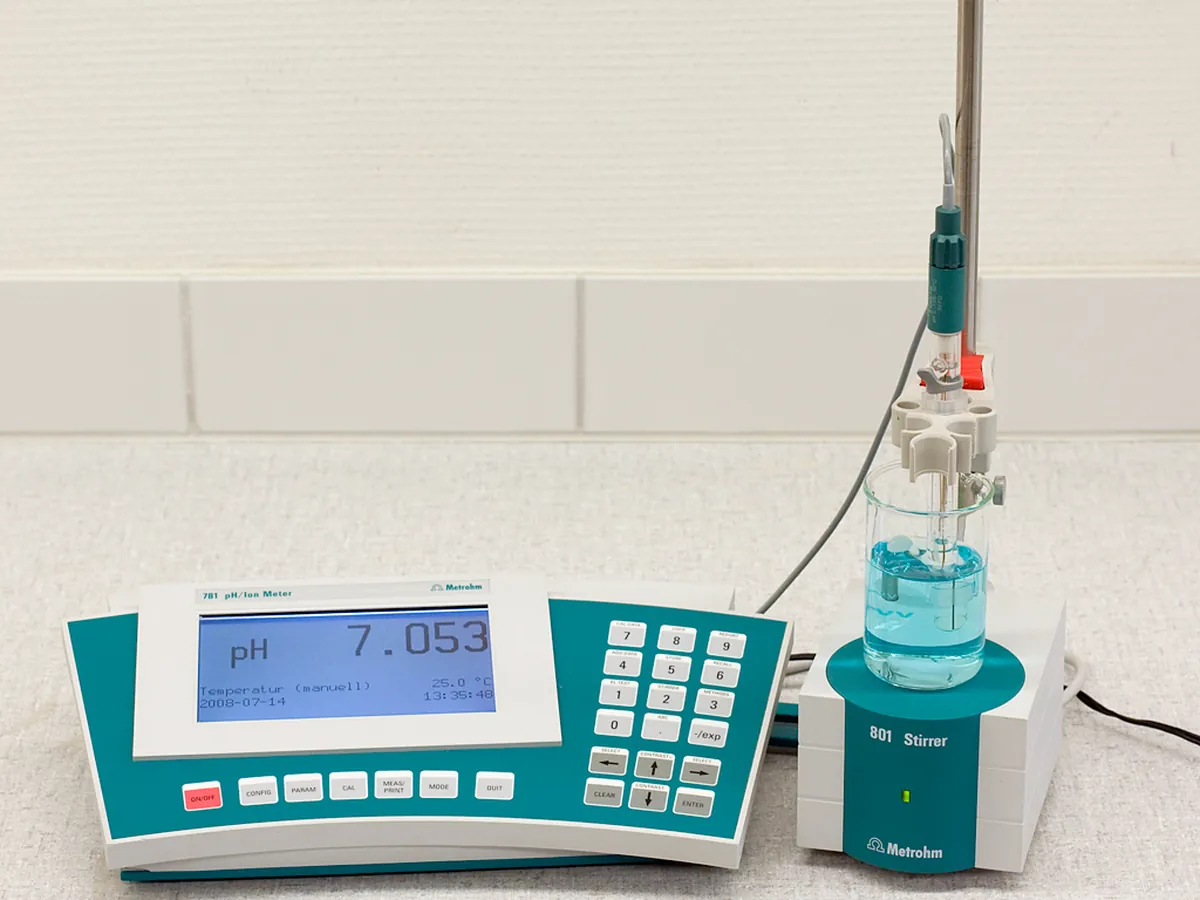

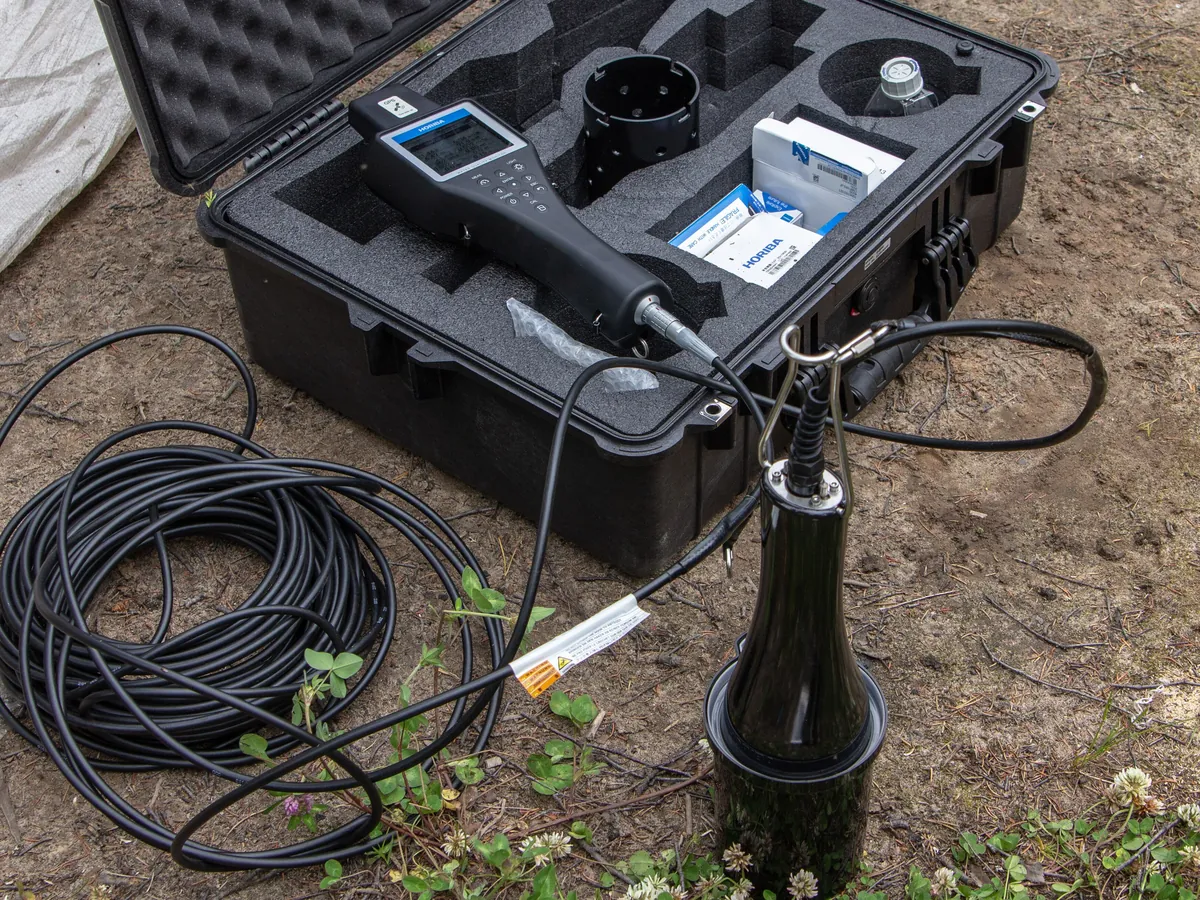
Reagents & standards
| Reagent | Grade / specification |
|---|---|
| pH buffers | pH 4.01, 7.00 and 9.21 (or 10.01), traceable, within expiry |
| Turbidity standards | Formazin stock (4000 NTU) diluted fresh, or stabilised formazin / polymer secondary standards |
| Turbidity-free water | Lab water filtered through a 0.2 µm membrane |
Preparing the sample
- 01
Collect
Clean glass or plastic bottle, fill without air gap.
- 02
Measure fast
pH on site or within hours; turbidity same day.
- 03
Equilibrate
Bring to room temperature; note temperature.
- 04
Calibrate
pH buffers and turbidity standards before samples.
- 05
Read
Stable reading; duplicate; record with temperature.
Procedure
- 1Collect the sample in a clean bottle filled to the brim so that no air is trapped. Dissolved CO₂ exchange changes pH quickly, so measure pH in the field or as soon as possible in the lab.
- 2Calibrate the pH meter with at least two buffers that bracket the expected pH (for drinking water, pH 7.00 and 4.01 or 9.21). Check that the slope is within the SOP range (typically 95–105%).
- 3Rinse the electrode with distilled water and then with a portion of the sample. Immerse it in a fresh portion, stir gently and record the pH once the reading is stable. Note the temperature.
- 4For turbidity, calibrate or verify the turbidimeter with formazin standards that cover the working range (for example 0.5, 1, 5 and 10 NTU, or as per the manufacturer).
- 5Mix the sample gently by inverting (do not shake hard — air bubbles read as turbidity). Fill a clean, scratch-free cell, wipe the outside with a lint-free tissue and read.
- 6Measure in duplicate. Report pH to 0.1 unit and turbidity to the resolution appropriate for the range (for example 0.1 NTU below 10 NTU).
Standard preparation
- 1pH: use fresh buffer portions for each calibration; never pour used buffer back into the bottle.
- 2Turbidity: prepare formazin dilutions fresh from the stock on the day of use, using turbidity-free water, or use stabilised secondary standards checked against formazin.
Notes for analysts
- Low-ionic-strength waters (for example RO product water) give drifting pH readings; allow more time or use an electrode designed for pure water.
- Bubbles, fingerprints and scratched cells all add false turbidity. Index-matched cells and silicone oil on the outside help.
- Very turbid samples above the instrument range must be diluted with turbidity-free water and the result multiplied by the dilution factor.
Method parameters (typical)
| pH calibration | Two or three buffers bracketing the sample pH |
|---|---|
| pH electrode slope | Typically 95–105% of theoretical (as per SOP) |
| Temperature | Record; use automatic temperature compensation |
| Turbidity method | Nephelometric, 90° detection, tungsten (APHA 2130) or 860 nm LED (ISO 7027) source |
| Turbidity reporting | NTU (or FNU for ISO 7027 instruments) |
System suitability & sequence
| Parameter | Limit |
|---|---|
| pH check buffer | Reads within ±0.05 pH of its stated value after calibration (or as per SOP) |
| Turbidity verification standard | Within ±10% of the assigned value (or as per SOP) |
| Duplicate pH | Agree within 0.1 pH unit |
Typical sequence
- 1pH calibration and check buffer
- 2Turbidity calibration / verification
- 3Sample duplicate readings
- 4Check buffer / standard at end of batch
What result passes
- pH: 6.5–8.5 as per IS 10500:2012 (no relaxation); check the current edition.
- Turbidity: acceptable limit 1 NTU, permissible limit 5 NTU in the absence of an alternative source, as per IS 10500:2012; check the current edition.
- WHO guidance stresses that turbidity should ideally be below 1 NTU (and much lower for effective disinfection); pH has no health-based guideline value.
Validation parameters (ICH Q2(R2))
| Parameter | Typical requirement |
|---|---|
| pH accuracy | Certified buffer read as an unknown |
| Turbidity linearity | Formazin standards across the reporting range |
| Precision | Duplicate measurements on real samples |
Run this method in LimsPulse: specifications and STPs under version control, results calculated and checked against limits, and a signed Certificate of Analysis.