Moisture in Food by Air-Oven Drying
A weighed sample is dried in an air oven at a set temperature and time (or to constant mass). The loss in mass is reported as moisture, and the remainder as total solids.
- Food & beverage
- Gravimetric, air-oven drying
- Hot air oven
- Analytical balance
Reference: Typical method based on AOAC 925.10 (flour, 130 °C) and the FSSAI Manual of Methods of Analysis of Foods. Use the temperature and time stated for your food type.
Why this method works
Heating drives off water from the food. The mass lost on drying, as a percentage of the original sample mass, is taken as the moisture content. The result is empirical: it includes other volatile substances and depends on temperature, time, sample size and particle size. Foods rich in sugar or prone to decomposition are dried at lower temperature, often in a vacuum oven, because they can lose mass by browning reactions as well as by losing water.
Instruments used
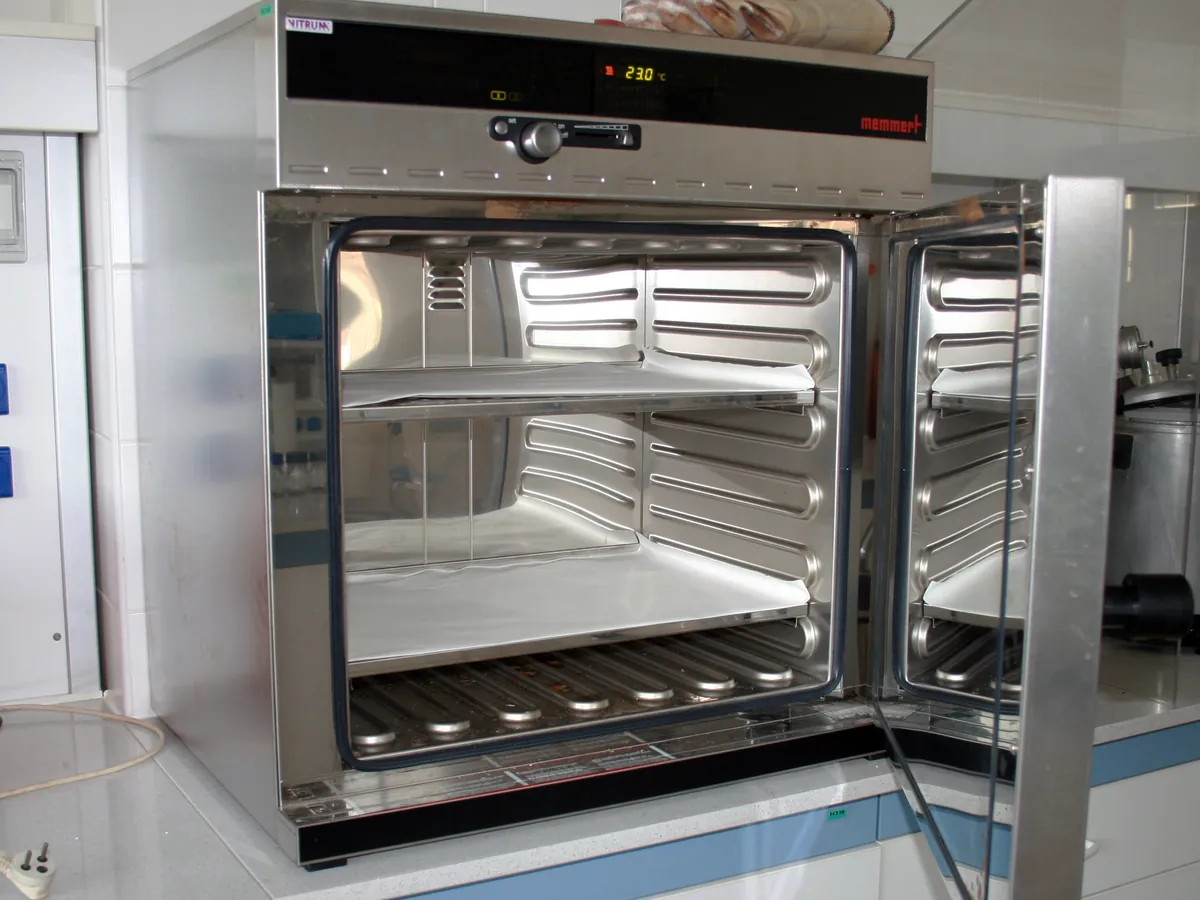

Preparing the sample
- 01
Homogenise
Grind or mix the sample so a small portion represents the whole.
- 02
Prepare dish
Dry an aluminium dish with lid, cool in a desiccator and weigh (W1).
- 03
Weigh sample
Add about 2–5 g of sample and weigh (W2).
- 04
Dry
Dry with the lid off at the method temperature for the set time.
- 05
Cool & weigh
Close the lid, cool in a desiccator and weigh (W3).
Procedure
- 1Grind dry samples to pass a 1 mm sieve (or as the method says) and mix well. Work quickly to avoid gaining or losing moisture.
- 2Dry a flat aluminium dish with its lid at the test temperature for about 1 h, cool in a desiccator for 30–45 min and weigh (W1).
- 3Spread about 2–5 g of sample evenly in the dish and weigh (W2).
- 4Place the dish in the preheated oven with the lid underneath or beside it. For flour, AOAC 925.10 uses 130 °C for 1 h; many foods are dried at about 105 °C to constant mass.
- 5Cover, transfer to a desiccator, cool to room temperature and weigh (W3).
- 6If drying to constant mass, repeat drying for 30–60 min periods until successive weighings agree within the limit in your SOP.
- 7Analyse in duplicate.
Notes for analysts
- Oven drying measures loss of all volatiles, not only water. Karl Fischer titration measures water only.
- High-sugar foods (honey, jams, dried fruit) caramelise at 105 °C. Use a vacuum oven at about 70 °C or the method for that product.
- Liquid and wet samples are pre-dried on a water bath, often mixed with sand to increase surface area.
- Keep the dried sample for ash or fat determination if the method allows; it saves a separate drying step.
Method parameters (typical)
| Oven temperature | 130 ± 3 °C for flour (1 h) or about 105 °C for many foods (to constant mass), as per method |
|---|---|
| Sample mass | About 2–5 g |
| Dish | Flat aluminium dish with tight lid, about 50–60 mm diameter |
| Cooling | Desiccator with active desiccant, to room temperature |
| Replicates | Duplicate |
System suitability & sequence
| Parameter | Limit |
|---|---|
| Oven temperature | Within the calibrated range at the shelf used |
| Duplicate agreement | Typically within 0.2% absolute moisture, or the method repeatability limit |
Typical sequence
- 1Dry and weigh dishes
- 2Weigh duplicate samples
- 3Dry in oven
- 4Cool and weigh
- 5Repeat drying if constant mass is required
Calculation with a worked example
Where
- W1
- Mass of empty dried dish with lid (g)
- W2
- Mass of dish + sample before drying (g)
- W3
- Mass of dish + sample after drying (g)
Given
- Prep 1: W1 / W2 / W3
- 32.4518 g / 37.4632 g / 36.8547 g
- Prep 2: W1 / W2 / W3
- 32.8806 g / 37.8701 g / 37.2689 g
Working
- 1Prep 1: sample = 37.4632 − 32.4518 = 5.0114 g; loss = 37.4632 − 36.8547 = 0.6085 g; moisture = 0.6085 ÷ 5.0114 × 100 = 12.14%
- 2Prep 2: sample = 4.9895 g; loss = 0.6012 g; moisture = 0.6012 ÷ 4.9895 × 100 = 12.05%
- 3Mean = (12.14 + 12.05) ÷ 2 = 12.10%; total solids = 100 − 12.10 = 87.90%
Moisture = 12.1% (total solids 87.9%), mean of duplicates
Try it with your numbersWhat result passes
- Compare with the product specification or legal standard (for example, wheat flour is commonly limited to about 14% moisture; check the current FSSAI or Codex standard for your product).
Validation parameters (ICH Q2(R2))
| Parameter | Typical requirement |
|---|---|
| Accuracy | Checked with a reference material or by comparison with Karl Fischer for selected matrices |
| Precision | Repeatability within the method limit for duplicates |
| Robustness | Effect of drying time, temperature and sample mass |
Run this method in LimsPulse: specifications and STPs under version control, results calculated and checked against limits, and a signed Certificate of Analysis.