Iodine value (Wijs)
The oil reacts in the dark with a known excess of iodine monochloride (Wijs reagent). Unreacted ICl is converted to iodine with potassium iodide and titrated with sodium thiosulphate. The difference from a blank gives the iodine value: the grams of iodine taken up by 100 g of oil.
- Chemicals & materials
- Back titration (iodometric)
- Burette & glassware
- Analytical balance
Reference: Typical method based on ISO 3961, AOCS Cd 1d-92 and IS 548 (Part 1) (Wijs method).
Why this method works
Iodine monochloride adds across carbon–carbon double bonds in fatty acid chains. The more double bonds, the more ICl is used up. After the reaction time, the excess ICl reacts with KI to release iodine (ICl + KI → KCl + I₂), which is titrated with sodium thiosulphate using starch. The blank minus sample titre equals the halogen absorbed, expressed as iodine. 12.69 is the equivalent mass of iodine (126.9 g/mol) divided by 10 to give g per 100 g.
Instruments used
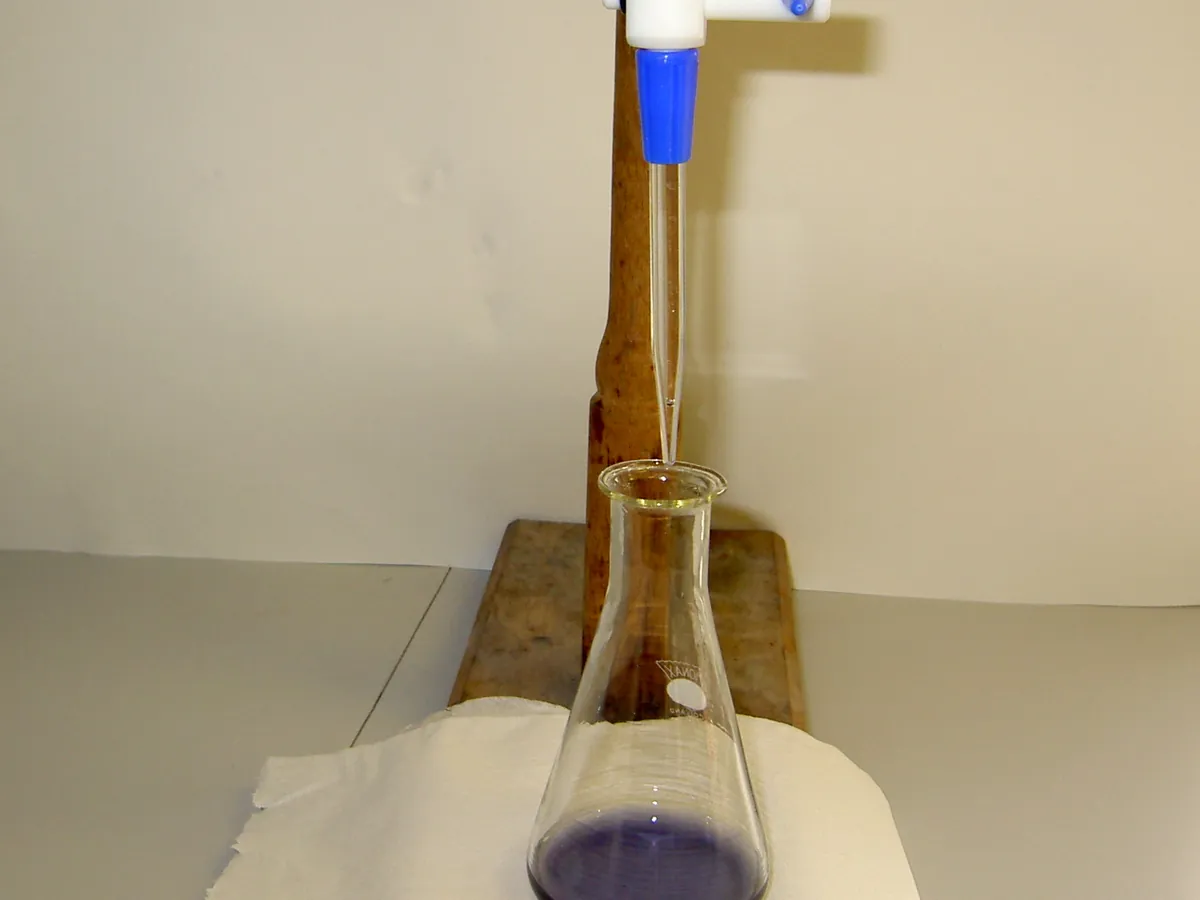

Reagents & standards
| Reagent | Grade / specification |
|---|---|
| Wijs reagent | Iodine monochloride in glacial acetic acid (commercially available) |
| Solvent | Cyclohexane and glacial acetic acid 1:1 (older methods used carbon tetrachloride or chloroform) |
| Potassium iodide | 10% (100 g/L) solution, free of iodate |
| Titrant | 0.1 N sodium thiosulphate, standardised |
| Indicator | Starch solution, about 1% |
Preparing the sample
- 01
Weigh
Weigh oil into a dry iodine flask; mass depends on the expected IV.
- 02
Dissolve
Add solvent and swirl to dissolve.
- 03
React
Add exactly 25 mL Wijs reagent, stopper, swirl and keep in the dark.
- 04
Add KI
Add KI solution and water to release iodine from the excess ICl.
- 05
Titrate
Titrate with thiosulphate, adding starch near the end point.
Procedure
- 1Choose sample mass from the expected IV using the method table (for example about 0.13–0.25 g for oils with IV around 100–150). The excess ICl should be roughly 50–60% of the amount added.
- 2Weigh the sample accurately (to 0.1 mg) into a dry 500 mL iodine flask.
- 3Add about 20 mL of solvent and dissolve.
- 4Add exactly 25 mL of Wijs reagent from a pipette, stopper, swirl and store in the dark: typically 1 h for IV below about 150 and 2 h for higher IV, as the method states.
- 5Prepare two blanks the same way without sample.
- 6After the reaction time, add 20 mL of 10% KI and 150 mL of water.
- 7Titrate with 0.1 N sodium thiosulphate until the yellow colour almost disappears, add starch and continue until the blue colour just disappears after vigorous shaking.
Standard preparation
- 1Standardise sodium thiosulphate against potassium dichromate or potassium iodate and record its normality.
Notes for analysts
- IV is a quick identity and quality check: a low IV in a sunflower oil may show blending with palm oil; a falling IV during frying shows oxidation.
- Keep the reaction strictly in the dark and time it; light and long reaction times give high results.
- Iodine value can also be calculated from the fatty acid composition by GC (AOCS Cd 1c-85), which avoids halogenated reagents.
Method parameters (typical)
| Wijs reagent volume | 25.0 mL, delivered by pipette |
|---|---|
| Reaction | In the dark at about 20–25 °C, typically 1 h (IV < 150) or 2 h (IV ≥ 150) |
| Titrant | 0.1 N sodium thiosulphate |
| Blanks | Two blanks per batch |
System suitability & sequence
| Parameter | Limit |
|---|---|
| Blank titres | The two blanks agree closely (for example within 0.1 mL) |
| Excess reagent | Sample titre at least about half the blank titre (excess ICl about 50–60%) |
Typical sequence
- 1Standardise thiosulphate
- 2Prepare blanks and samples
- 3React in the dark
- 4Add KI and water
- 5Titrate blanks and samples
Calculation with a worked example
Where
- B
- Thiosulphate used for the blank (mL)
- S
- Thiosulphate used for the sample (mL)
- N
- Normality of sodium thiosulphate
- W
- Mass of sample (g)
- 12.69
- Equivalent mass of iodine (126.9) ÷ 10
Given
- Sample mass (W)
- 0.2050 g sunflower oil
- Blank titre (B)
- 47.60 mL
- Sample titre (S)
- 26.40 mL
- Thiosulphate normality (N)
- 0.1002
Working
- 1
B − S = 47.60 − 26.40 = 21.20 mL
- 2IV = 12.69 × 21.20 × 0.1002 ÷ 0.2050
- 3= 26.957 ÷ 0.2050 = 131.5 g I₂/100 g
- 4Excess check: 26.40 ÷ 47.60 = 55% of reagent left, within the 50–60% target
Iodine value = 131.5 g I₂/100 g
What result passes
- Compare with the identity range for the oil. Typical published ranges: coconut about 6–11, palm about 50–55, olive about 75–94, groundnut about 86–107, sunflower about 118–141, soybean about 124–139 g I₂/100 g. Use the current Codex (CXS 210), FSSAI or customer ranges.
Validation parameters (ICH Q2(R2))
| Parameter | Typical requirement |
|---|---|
| Precision | Repeatability within the method's published limits |
| Accuracy | Analysis of a reference oil of known IV |
Run this method in LimsPulse: specifications and STPs under version control, results calculated and checked against limits, and a signed Certificate of Analysis.