Dissolved Oxygen by Winkler Titration (Azide Modification)
Oxygen in a full, stoppered BOD bottle is fixed on site with manganese sulphate and alkaline iodide-azide. After acidification, the iodine released, which is equivalent to the oxygen present, is titrated with standard sodium thiosulphate using starch indicator.
- Environmental & water
- Iodometric titration with sodium thiosulphate and starch indicator
- Burette & glassware
- Analytical balance
Reference: Typical method based on APHA Standard Methods 4500-O C (azide modification), IS 3025 (Part 38) and ISO 5813.
Why this method works
Manganese(II) hydroxide forms in alkaline solution and is oxidised by dissolved oxygen to a brown manganese(III/IV) precipitate. When the solution is acidified, the oxidised manganese releases iodine from iodide in an amount equivalent to the original oxygen. The iodine is titrated with thiosulphate. Sodium azide destroys nitrite, which would otherwise also release iodine and give high results. One mole of O₂ is equivalent to four moles of thiosulphate.
Instruments used
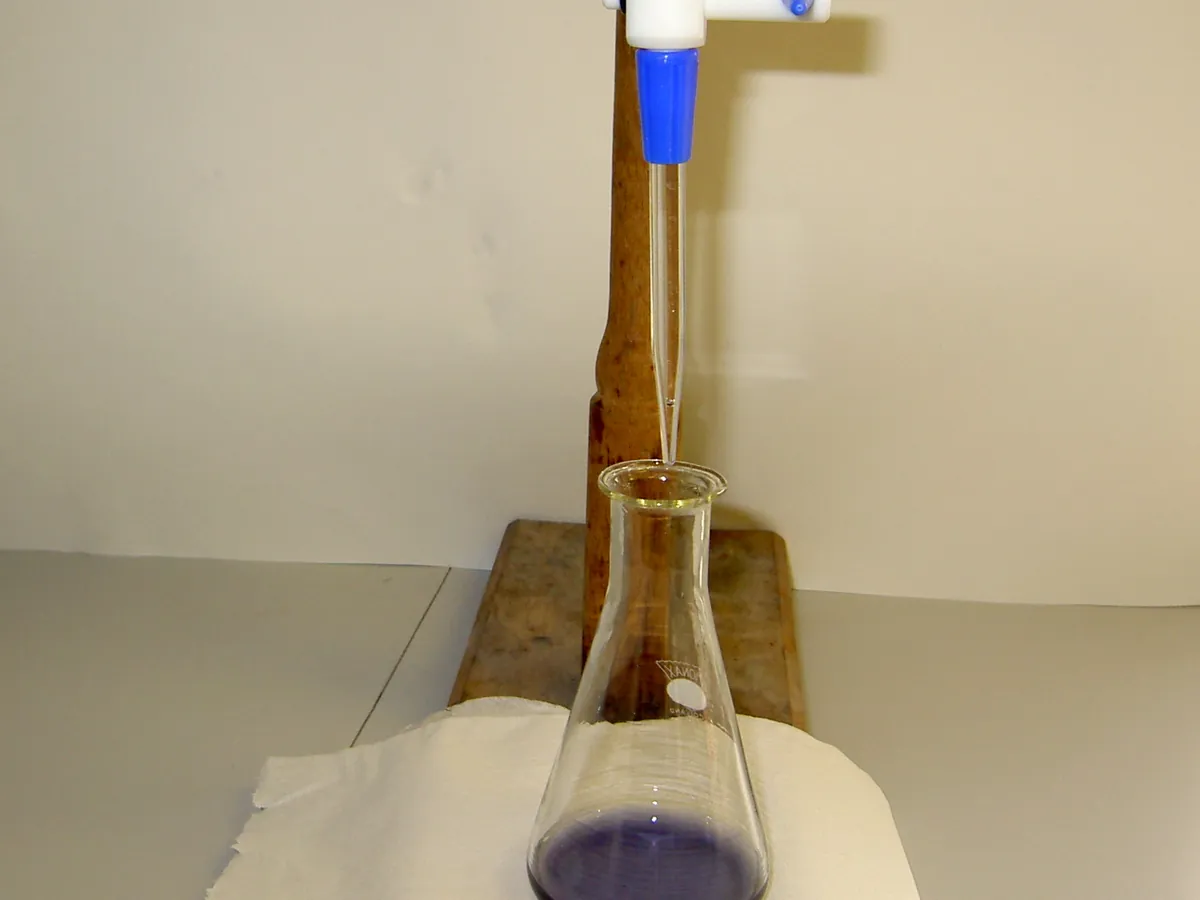

Reagents & standards
| Reagent | Grade / specification |
|---|---|
| Manganese sulphate solution | MnSO₄·4H₂O (or the monohydrate equivalent) in water |
| Alkali-iodide-azide reagent | Sodium hydroxide, sodium (or potassium) iodide and sodium azide in water |
| Sulphuric acid | Concentrated H₂SO₄ |
| Starch indicator | Freshly prepared or stabilised starch solution |
| Sodium thiosulphate titrant | About 0.025 M Na₂S₂O₃·5H₂O, standardised |
| Primary standard | Potassium bi-iodate (about 0.0021 M) or potassium dichromate, for thiosulphate standardisation |
Preparing the sample
- 01
Collect
Fill a 300 mL BOD bottle without trapping air, letting it overflow.
- 02
Fix
Add 2 mL MnSO₄ and 2 mL alkali-iodide-azide below the surface; stopper and mix.
- 03
Settle
Let the brown floc settle, mix again and settle.
- 04
Acidify
Add 2 mL concentrated H₂SO₄; stopper and mix until the floc dissolves.
- 05
Titrate
Titrate 203 mL with 0.025 M thiosulphate to pale straw.
- 06
Endpoint
Add starch and titrate until the blue colour just disappears.
Procedure
- 1Fill a 300 mL BOD bottle from the sample using a tube reaching the bottom, letting it overflow two to three bottle volumes and avoiding air bubbles.
- 2Immediately add 2 mL of manganese sulphate solution and then 2 mL of alkali-iodide-azide reagent, with the pipette tip below the liquid surface.
- 3Stopper carefully to exclude air bubbles and mix by inverting several times. A brown precipitate shows oxygen is present (a white precipitate means almost no oxygen).
- 4Let the precipitate settle to about half the bottle volume, mix again and let it settle once more.
- 5Add 2 mL of concentrated H₂SO₄ down the neck, stopper and mix until the precipitate has fully dissolved. The solution turns yellow to brown from iodine. The sample can now be held in the dark for a few hours if needed.
- 6Measure 203 mL of the solution (equivalent to 200 mL of original sample after correcting for the 4 mL of reagents added) into a conical flask.
- 7Titrate with standardised 0.025 M thiosulphate until pale straw yellow. Add 1–2 mL of starch and continue until the blue colour just disappears.
- 8Record the titre and the thiosulphate molarity.
Standard preparation
- 1Thiosulphate standardisation: dissolve about 2 g KI in 100–150 mL water, add 1 mL of 6 N H₂SO₄ (or a few drops of concentrated acid) and 20.00 mL of standard potassium bi-iodate solution, dilute to about 200 mL and titrate the released iodine with thiosulphate using starch near the end. Calculate the exact molarity.
- 2Many labs prepare thiosulphate so that 1 mL is equivalent to 1 mg/L DO when 200 mL of sample is titrated (exactly 0.025 M).
Notes for analysts
- The Winkler method is the reference method used to check DO meters and probes.
- Sodium azide is highly toxic; never acidify the azide reagent on its own, because it releases toxic hydrazoic acid.
- For activated sludge or highly coloured samples, a DO probe is often more practical; use the copper sulphate–sulphamic acid flocculation modification for activated sludge if titration is required.
Method parameters (typical)
| Sample bottle | 300 mL BOD bottle with ground-glass stopper |
|---|---|
| Reagent additions | 2 mL MnSO₄ + 2 mL alkali-iodide-azide + 2 mL conc. H₂SO₄ |
| Volume titrated | 203 mL (equivalent to 200 mL original sample) |
| Titrant | Sodium thiosulphate about 0.025 M |
| Indicator | Starch; endpoint is first disappearance of blue colour |
System suitability & sequence
| Parameter | Limit |
|---|---|
| Thiosulphate standardisation | Duplicate titrations agree within about 0.05 mL, or as per your SOP |
| Duplicate samples | Typically agree within about 0.1–0.2 mg/L |
| Reagent blank | No blue colour with starch when reagents are added to water in reverse order (checks for oxidising impurities) |
Typical sequence
- 1Standardise thiosulphate
- 2Duplicate sample bottles
- 3Air-saturated water check (optional, against solubility tables)
Calculation with a worked example
Where
- V_t
- Volume of thiosulphate used (mL)
- M
- Molarity of thiosulphate (mol/L)
- 8000
- Equivalent weight of oxygen (8 g/eq) × 1000 mL/L, in mg
- V_titrated
- Volume of treated sample titrated (mL)
- V_bottle
- Volume of the BOD bottle (mL)
- V_reagents
- Volume of MnSO₄ and alkali-iodide-azide added (mL), which displace sample
Given
- V_titrated
- 203 mL
- V_bottle
- 300 mL
- V_reagents
- 4 mL
- M (thiosulphate)
- 0.0248 M
- V_t
- 7.85 mL
Working
- 1V_eff = 203 × (300 − 4) ÷ 300 = 203 × 296 ÷ 300 = 200.29 mL
- 2
V_t × M × 8000 = 7.85 × 0.0248 × 8000 = 1557.44
- 3DO = 1557.44 ÷ 200.29 = 7.78 mg/L
- 4Check: with exactly 0.025 M thiosulphate and 200 mL equivalent, 1 mL titrant ≈ 1 mg/L DO, so 7.85 mL × (0.0248 ÷ 0.025) ≈ 7.79 mg/L, which agrees.
Dissolved oxygen = 7.78 mg/L
What result passes
- Report DO to 0.1 mg/L. Compare with the requirement for the water body or process (for example, treated effluent or receiving water criteria in your consent).
- Results are invalid if air was trapped in the bottle or the sample was not fixed promptly.
Validation parameters (ICH Q2(R2))
| Parameter | Typical requirement |
|---|---|
| Accuracy | Check against air-saturated water at known temperature and pressure using oxygen solubility tables |
| Precision | Duplicate bottles; typical standard deviation about 0.02–0.05 mg/L in clean water |
| Interferences | Nitrite (removed by azide), ferrous and ferric iron (potassium fluoride modification), suspended solids and strong oxidants or reductants |
Run this method in LimsPulse: specifications and STPs under version control, results calculated and checked against limits, and a signed Certificate of Analysis.