Specific Gravity and Water Absorption of Coarse Aggregate
A soaked sample is weighed in water, then surface-dried to the saturated surface-dry (SSD) condition and weighed in air, and finally oven-dried and weighed. These three masses give the specific gravities and the water absorption.
- Construction materials
- Gravimetric — weighing in water and in air (wire basket method)
- Analytical balance
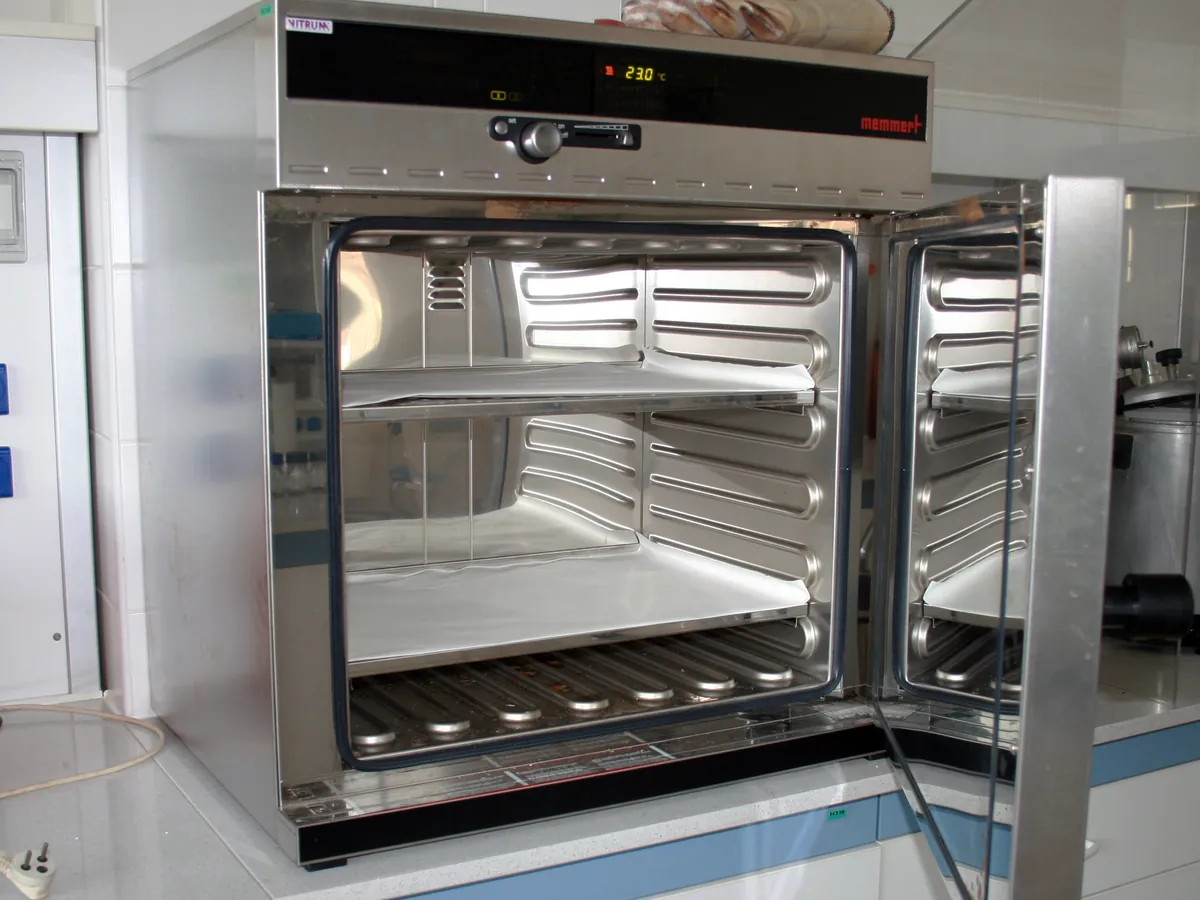
- Hot air oven
Reference: Typical method based on IS 2386 (Part 3) and ASTM C127. Always follow the current editions and your approved SOP.
Why this method works
By Archimedes' principle, the loss in mass of an object weighed under water equals the mass of water it displaces, which gives its volume. Aggregate particles have pores. In the SSD condition the pores are full of water but the surface is dry, so the particle neither takes water from nor gives water to a concrete mix. Comparing the oven-dry, SSD and in-water masses separates the volume of solid, the volume of water-permeable pores and the water those pores hold. Mix designs use specific gravity to convert masses to volumes, and absorption to correct the mixing water.
Instruments used

Reagents & standards
| Reagent | Grade / specification |
|---|---|
| Water | Clean water at 22–32 °C (or as the standard states) |
| Wire basket | Basket of about 6.3 mm mesh (or perforated container) hung from the balance into a water tank |
| Absorbent cloths | Two dry, soft cloths for surface-drying |
Preparing the sample
- 01
Wash
Wash about 2 kg of aggregate retained on 10 mm to remove dust.
- 02
Soak
Soak in water in the basket for 24 ± ½ h.
- 03
Weigh in water
Weigh basket + aggregate in water (A1), then empty basket (A2).
- 04
Surface-dry
Roll in cloths to SSD and weigh in air (B).
- 05
Oven-dry
Dry at 100–110 °C for 24 h, cool and weigh (C).
- 06
Calculate
Work out specific gravities and absorption.
Procedure
- 1Take about 2 kg of aggregate retained on the 10 mm sieve (more for larger sizes). Wash it thoroughly to remove dust and fine particles.
- 2Place it in the wire basket and immerse it in water at 22–32 °C, with at least about 50 mm of water above the top of the basket.
- 3Remove trapped air by lifting the basket about 25 mm and dropping it about 25 times at a rate of about one drop per second. Leave it to soak for 24 ± ½ hours.
- 4Jolt the basket again and weigh it with the aggregate while suspended in water at 22–32 °C (A1).
- 5Remove the basket and aggregate, let them drain, and tip the aggregate onto a dry cloth. Return the empty basket to the water, jolt it and weigh it in water (A2).
- 6Gently roll and pat the aggregate in dry cloths until all visible surface water is gone but the surface still looks slightly damp (SSD). Spread it out and do not let it dry beyond this. Weigh it in air (B).
- 7Dry the aggregate in the oven at 100–110 °C for 24 ± ½ hours, cool it in an airtight container and weigh it (C).
Standard preparation
- 1Check the balance with standard weights and confirm the below-balance weighing hook or cradle is set up correctly.
- 2Record the water temperature; keep it within the range in the standard.
Notes for analysts
- Concrete mix designs normally use the SSD specific gravity, because aggregate in a well-designed mix is treated as being in the SSD state.
- Over-drying the surface during the SSD step lowers B and so lowers both the SSD specific gravity and the absorption.
- Fine aggregate (sand) uses a pycnometer or flask method, with a cone-and-tamper test to judge SSD. See IS 2386 Part 3 or ASTM C128.
Method parameters (typical)
| Sample | About 2 kg retained on 10 mm (more for larger nominal sizes) |
|---|---|
| Soaking | 24 ± ½ hours in water at 22–32 °C |
| Air removal | About 25 jolts of about 25 mm before and after soaking |
| Drying | 100–110 °C for 24 ± ½ hours |
| Balance | Capacity at least 3 kg, readable to 0.5 g or better, with below-balance weighing |
| Replicates | 2 tests; report the mean |
System suitability & sequence
| Parameter | Limit |
|---|---|
| SSD condition | No visible water film, no dry patches; judged consistently by a trained analyst |
| Duplicate agreement | Specific gravity results typically agree within about 0.02; absorption within the limit in your SOP |
Typical sequence
- 1Wash and soak the sample
- 2Weigh in water (A1) and empty basket (A2)
- 3Surface-dry and weigh in air (B)
- 4Oven-dry and weigh (C)
- 5Calculate; repeat on a second portion
Calculation with a worked example
Where
- A1
- Mass of basket + saturated aggregate in water (g)
- A2
- Mass of empty basket in water (g)
- A
- Mass of saturated aggregate in water = A1 − A2 (g)
- B
- Mass of saturated surface-dry aggregate in air (g)
- C
- Mass of oven-dry aggregate in air (g)
Given
- A1 (basket + aggregate in water)
- 2105.0 g
- A2 (basket in water)
- 850.0 g
- B (SSD in air)
- 2010.0 g
- C (oven-dry)
- 1990.0 g
Working
- 1
A = 2105.0 − 850.0 = 1255.0 g
- 2
B − A = 2010.0 − 1255.0 = 755.0 g (equivalent to the volume of the particles, including pores, in cm³)
- 3Specific gravity (oven-dry) = 1990.0 ÷ 755.0 = 2.636 → 2.64
- 4Specific gravity (SSD) = 2010.0 ÷ 755.0 = 2.662 → 2.66
- 5Apparent specific gravity = 1990.0 ÷ (1990.0 − 1255.0) = 1990.0 ÷ 735.0 = 2.707 → 2.71
- 6Water absorption = (2010.0 − 1990.0) ÷ 1990.0 × 100 = 1.01%
Specific gravity 2.64 (oven-dry), 2.66 (SSD), apparent 2.71; water absorption 1.0%.
What result passes
- Report the values for use in mix design. Most natural aggregates typically have a specific gravity of about 2.5–3.0.
- Water absorption of sound aggregates is typically below about 2%; many specifications (for example some road specifications) set a maximum around 2%. Use the limit in the project specification.
- The apparent specific gravity is always the highest of the three, and the oven-dry value the lowest. If not, check the masses.
Validation parameters (ICH Q2(R2))
| Parameter | Typical requirement |
|---|---|
| Approach | Standard method; competence shown by duplicate agreement and proficiency testing |
| Repeatability | Duplicate specific gravity results typically within about 0.02 |
| Critical step | Consistent judgement of the SSD condition; train and compare analysts |
Run this method in LimsPulse: specifications and STPs under version control, results calculated and checked against limits, and a signed Certificate of Analysis.