BSC · Calibration procedure
HEPA filter integrity
Challenges the supply and exhaust HEPA filters of the cabinet with an aerosol (PAO/DOP) and scans the downstream side with a photometer to find leaks in the filter media or seals.
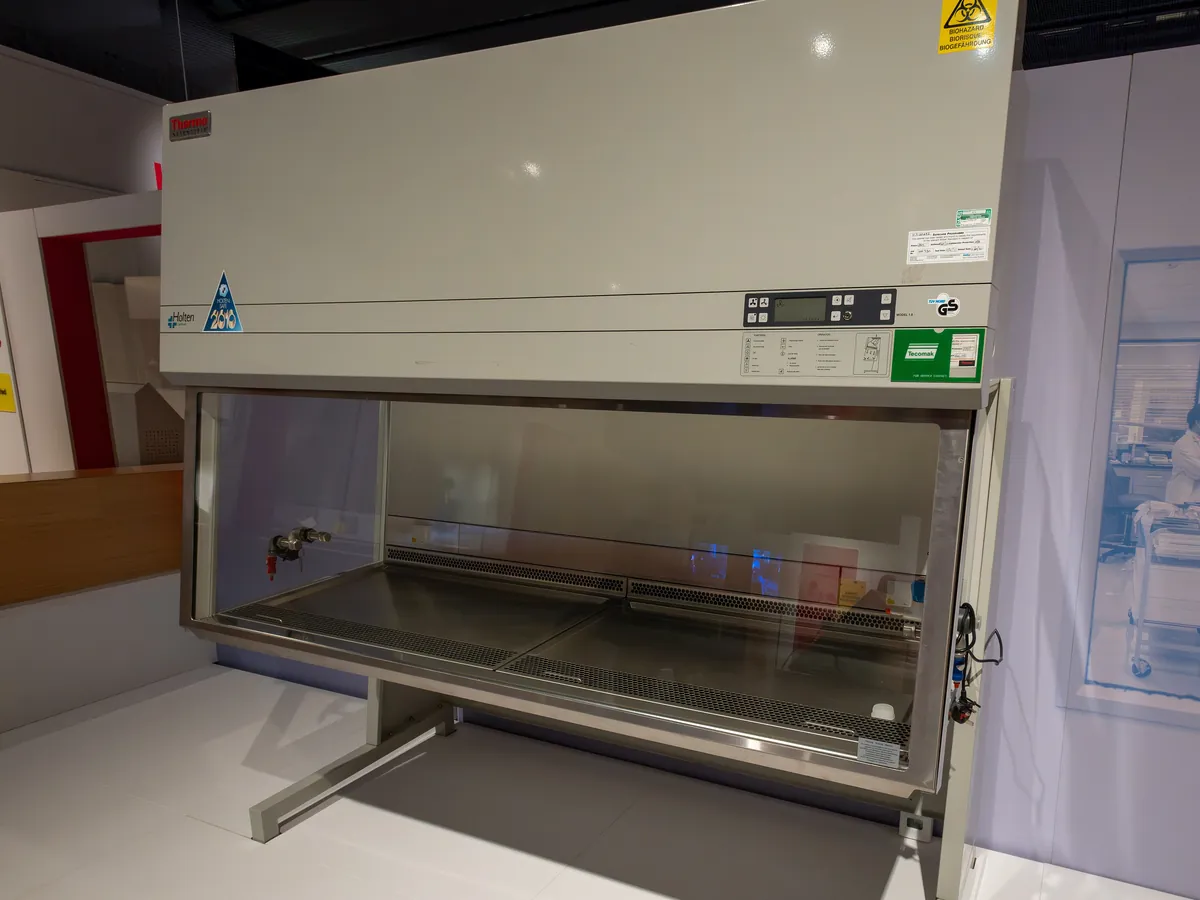
PURPOSE
Why this is checked
A leak in the supply filter lets unfiltered air onto the work, and a leak in the exhaust filter lets microorganisms escape into the room. Filter integrity is therefore tested on both filters at each certification.
Frequency
At installation, then typically every 12 months (some sites every 6 months), and after filter change, relocation or major repair, as defined in your SOP.
Learn how the BSC worksYOU WILL NEED
Standards & tools
- Aerosol generator (PAO or equivalent oil aerosol)
- Calibrated aerosol photometer with scanning probe
- Alternatively, a discrete particle counter method where the standard allows it
BEFORE YOU START
Prerequisites
- Inflow and downflow velocities within limits
- Cabinet decontaminated if the filter housing must be opened
- Upstream sample port accessible
PROCEDURE
Step by step
- 1Introduce the aerosol into the cabinet (typically at the work surface or into the plenum, as per the manufacturer) and measure the upstream concentration; set it as 100% on the photometer.
- 2Supply filter: scan the whole downstream face and its perimeter with the probe about 2–3 cm from the filter, in overlapping strokes at no more than about 5 cm/s.
- 3Exhaust filter: scan the downstream face if accessible; if it cannot be scanned (e.g. ducted), take a single-point reading downstream as the standard allows.
- 4Hold the probe still on any point above the limit to confirm and mark it.
- 5Recheck the upstream concentration at the end and record the maximum penetration for each filter.
RECORD
Example observation table
| Filter / zone | Upstream (µg/L) | Max. downstream (% of upstream) | Result |
|---|---|---|---|
| Supply filter, left third | 15.0 | 0.004 | Pass |
| Supply filter, centre third | 15.0 | 0.008 | Pass |
| Supply filter, right third | 15.0 | 0.003 | Pass |
| Supply filter perimeter seal | 15.0 | 0.002 | Pass |
| Exhaust filter (scan) | 15.0 | 0.002 | Pass |
CALCULATION
How to calculate the result
Penetration (%) = Downstream concentration ÷ Upstream concentration × 100
- Upstream = 15.0 µg/L; highest downstream reading on the supply filter centre = 0.0012 µg/L
- Penetration = 0.0012 ÷ 15.0 × 100 = 0.008%
- Not more than the typical scan limit of 0.01%: Pass
ACCEPTANCE CRITERIA
Pass if
- Scanned filters: no point with penetration above 0.01% of upstream concentration (typical criterion in NSF/ANSI 49 and common SOPs).
- Filters that cannot be scanned: typically not more than 0.005% at a single downstream point (NSF/ANSI 49 approach), or as defined in your SOP.
- Upstream concentration within the range required by the procedure at start and end.
IF IT FAILS
What to do
- Stop using the cabinet.
- Repair a small face leak with approved sealant if the manufacturer allows and the repaired area is within limits; otherwise decontaminate and replace the filter.
- Reseat or replace the gasket for seal leaks.
- Repeat integrity, velocity and smoke tests before release.
MORE
Other BSC calibrations
In LimsPulse · Calibration Management
LimsPulse schedules this calibration, records the result against limits, and blocks the instrument everywhere if it fails or goes overdue.