Water Content of Lubricating Oils by Coulometric Karl Fischer
Water is one of the most damaging contaminants in a lubricant. It causes rust, speeds up oxidation, depletes additives and weakens the oil film. Coulometric KF measures water accurately from a few mg/kg to a few per cent, so it is the standard test for new oil acceptance and for in-service oil condition monitoring.
- Petroleum, oil & gas
- Coulometric Karl Fischer titration — direct injection, or KF oven with gas transfer for difficult oils
- KF titrator (coulometric)
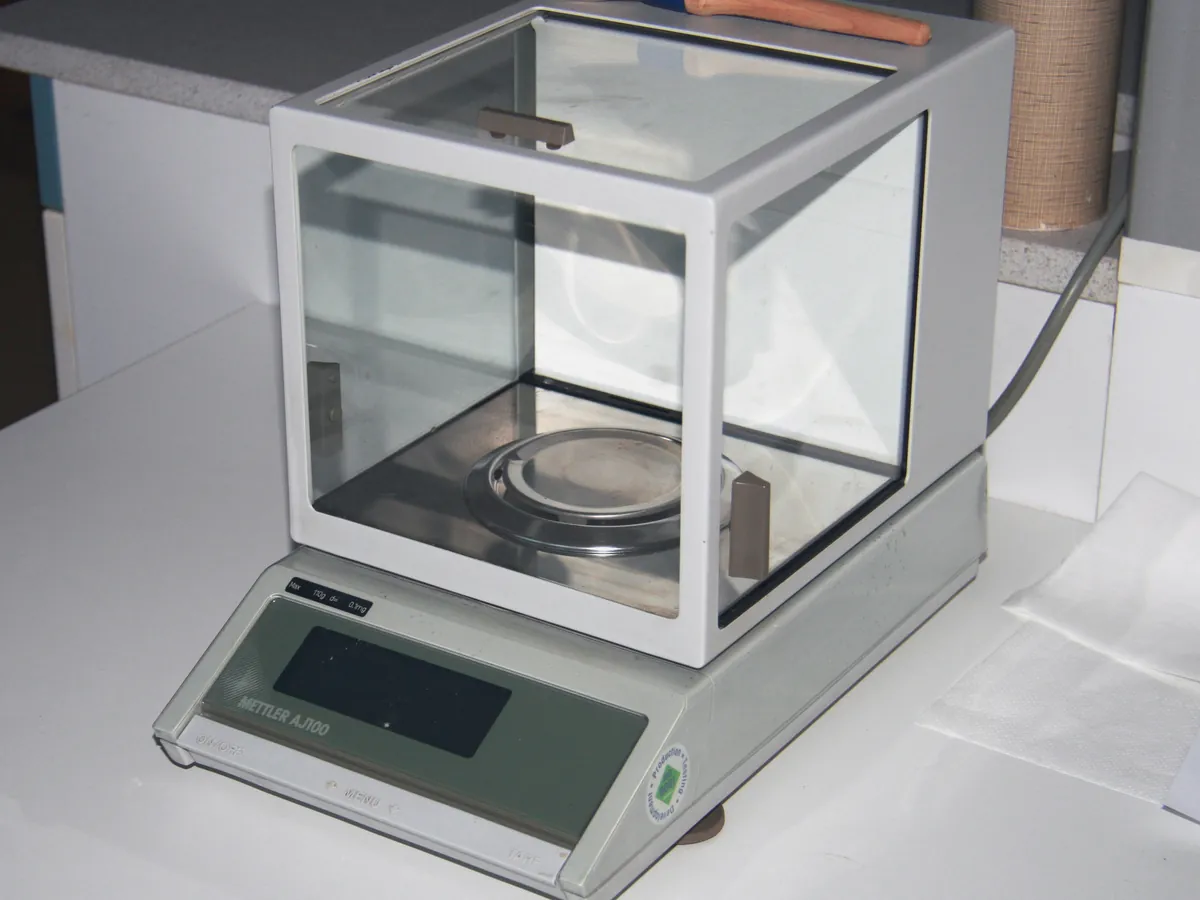
- Analytical balance
Reference: Typical method based on ASTM D6304 (coulometric KF for petroleum products, lubricating oils and additives). ASTM D4377 (volumetric KF) is used mainly for crude oils. Follow your lab SOP and the current editions.
Why this method works
In the Karl Fischer reaction, iodine reacts with water in the presence of sulphur dioxide, a base and an alcohol, one mole of iodine for each mole of water. In the coulometric method the iodine is generated electrically at the generator electrode from iodide in the anolyte. By Faraday's law, 10.71 coulombs of charge produce enough iodine to react with 1 mg of water, so the instrument counts the charge and reports micrograms of water directly — no titre is needed. A double platinum indicator electrode detects the first excess of iodine as the end point. Dividing the water found (µg) by the sample mass (g) gives µg/g, which is the same as mg/kg.
Instruments used

Reagents & standards
| Reagent | Grade / specification |
|---|---|
| Anolyte | Coulometric KF anolyte suitable for oils (often containing a solubiliser such as chloroform, xylene or a long-chain alcohol) |
| Catholyte | Matching catholyte, if the cell has a diaphragm |
| Water standard | Certified water standard (for example 0.1 or 1.0 mg/g), or certified water-in-oil standard |
| Syringes | Clean, dry glass or plastic syringes with long needles; dedicated to oils |
Preparing the sample
- 01
Condition cell
Let the drift settle to a low, stable value.
- 02
Check standard
Inject a water standard; recovery within limits.
- 03
Mix sample
Shake the bottle thoroughly; water settles.
- 04
Weigh in
Weigh syringe before and after injection.
- 05
Titrate
Instrument reports µg water at end point.
- 06
Calculate
mg/kg = µg water ÷ sample mass (g).
Procedure
- 1Switch on the cell and allow it to titrate residual moisture until the drift is low and stable (the target is set in the SOP, for example below about 10 µg/min).
- 2Verify the cell with a certified water standard. The recovery must be within the SOP limit (typically 97–103% for a 1 mg/g standard, or as defined).
- 3Shake the sample bottle vigorously for the time the SOP requires — free water and water-in-oil emulsions settle quickly. Sample from the middle of the bottle immediately after mixing.
- 4Rinse the syringe with the sample, then draw up a portion sized for the expected water (for example about 1–2 g for in-service oils, more for very dry new oils). Wipe the needle and weigh the full syringe.
- 5Inject the sample below the surface of the anolyte through the septum, without touching the electrodes, and re-weigh the syringe. The difference is the sample mass.
- 6Enter the mass and start the titration. The instrument subtracts drift and reports micrograms of water.
- 7If the oil contains additives that react with KF reagents (some sulphur-, amine- or ketone-containing additives can give falsely high results), use the KF oven: heat the oil in a sealed vial (for example 120–160 °C) and carry the released water into the cell with dry gas.
- 8Replace the anolyte when it becomes saturated with oil (slow titration, phase separation) or when its water capacity is reached.
Standard preparation
- 1Use a certified water standard within expiry; inject by mass, not volume.
- 2For oil matrices, a certified water-in-oil standard is a good check of the whole procedure, including sample handling.
Notes for analysts
- The Lab Explorer 'karl-fischer-water' calculator is for the volumetric method (titre × volume); coulometric results need no titre, so the calculation here is simply µg ÷ g.
- Crackle tests and FTIR screens are quick indicators but are not quantitative replacements for KF.
- Free water in a sample bottle is easy to miss — always mix well and sample immediately.
- Water in fuels (for example diesel) is tested in the same way; check the fuel specification for the limit.
Method parameters (typical)
| Drift before analysis | Low and stable (for example < 10 µg/min, as per SOP) |
|---|---|
| Sample size | Chosen to give roughly 100–2000 µg water per injection (for example 1–5 g) |
| Typical range | About 10 mg/kg up to a few per cent water (check current D6304 scope) |
| Oven temperature (if used) | Typically 120–160 °C for oils; set by validation |
| Reporting | mg/kg (ppm m/m) to the nearest whole number; % m/m for wet samples |
System suitability & sequence
| Parameter | Limit |
|---|---|
| Water standard recovery | Within SOP limits (typically 97–103%) |
| Duplicate injections | Agree within method repeatability |
| Drift | Stable and below the SOP limit before each injection |
Typical sequence
- 1Cell conditioning (drift)
- 2Water standard
- 3Samples in duplicate
- 4Water standard at end of batch or every 10 samples
Calculation with a worked example
Where
- W
- Water found by the coulometer, drift corrected (µg)
- m
- Sample mass injected = syringe mass before − after (g)
Given
- Syringe + sample before injection
- 10.4521 g
- Syringe after injection
- 8.4398 g
- Water found (W)
- 412.6 µg
Working
- 1
m = 10.4521 − 8.4398 = 2.0123 g
- 2Water = 412.6 ÷ 2.0123 = 205.04 µg/g = 205.04 mg/kg
- 3As % m/m: 205.04 ÷ 10 000 = 0.0205%
Water content = 205 mg/kg (0.021% m/m)
What result passes
- New oil: compare with the product specification or supplier certificate (often well below 200–500 mg/kg for many industrial oils; check the grade).
- In-service oil: compare with OEM or condition-monitoring limits. Many programmes alert at a few hundred mg/kg for turbine and hydraulic oils, and lower for transformer oils — set limits in your SOP.
Validation parameters (ICH Q2(R2))
| Parameter | Typical requirement |
|---|---|
| Accuracy | Recovery of certified water standards and water-in-oil reference materials |
| Precision | Repeatability on a control oil charted over time |
| Specificity | Compare direct injection with the oven method for additive-containing oils |
Run this method in LimsPulse: specifications and STPs under version control, results calculated and checked against limits, and a signed Certificate of Analysis.