Firmness and Spreadability of Creams (Texture Analyser)
A 90° male cone is pushed into the product packed in a matching female cone. The peak force is reported as firmness and the area under the force–distance curve as work of shear (spreadability). The negative force on withdrawal shows adhesiveness.
- Cosmetics & personal care
- Texture analysis — cone spreadability (or back extrusion)
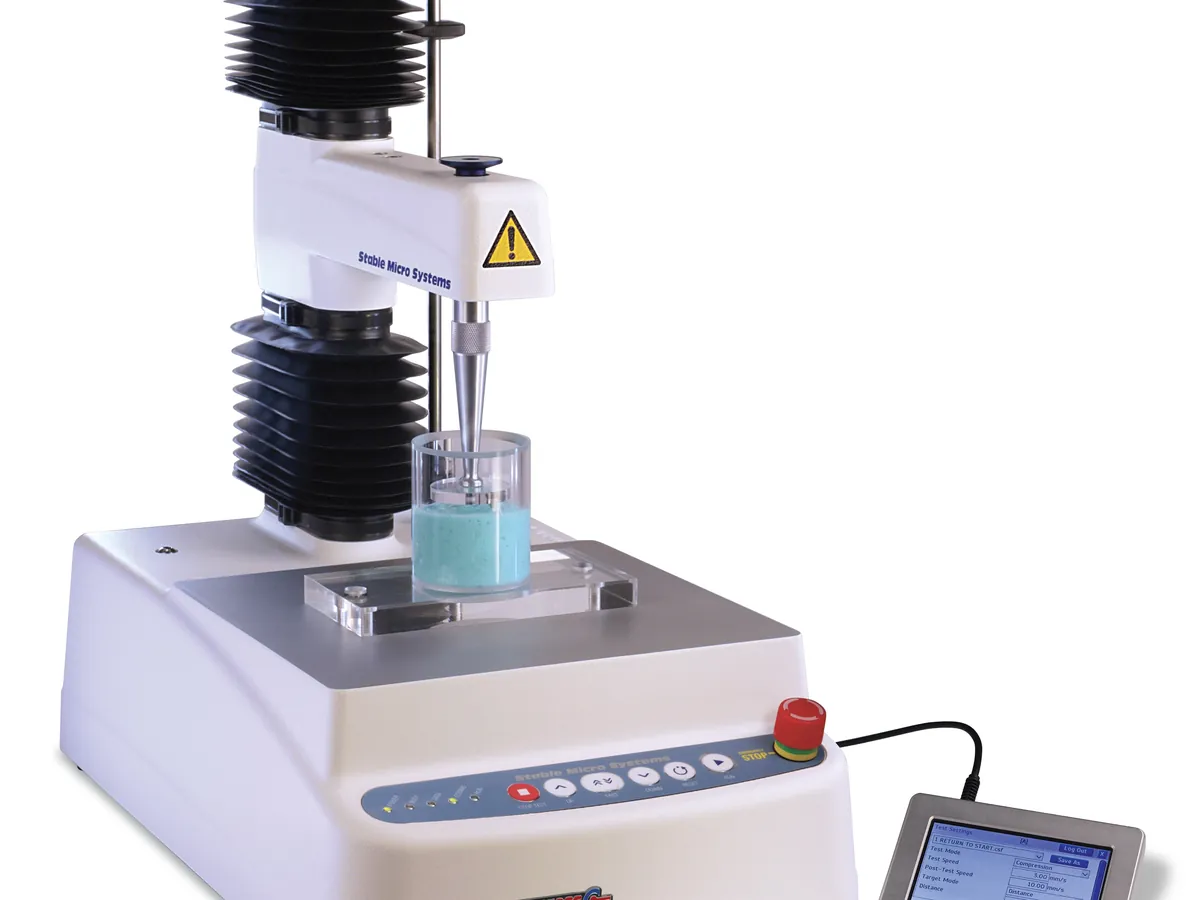
- Texture analyser
Reference: Typical in-house method based on texture analyser application notes for cosmetic creams (matched male and female cone spreadability rig). Test settings are product-specific.
Why this method works
As the male cone descends, the product is squeezed outward between the two cone surfaces, much like spreading a cream between fingers. A firm product resists strongly and gives a high peak force and large area. A soft, easily spread product gives low values. When the cone withdraws, the product pulls back on it, giving a negative peak whose size relates to stickiness. Because all values depend on geometry, speed and temperature, they are compared only within the same method.
Instruments used
Preparing the sample
- 01
Condition
Hold samples at 25 °C for at least several hours.
- 02
Fill cone
Pack the female cone with product, avoiding air pockets.
- 03
Level
Scrape the surface flat with a spatula.
- 04
Rest
Leave for a fixed recovery time before testing.
- 05
Test
Run the spreadability programme and repeat on fresh fills.
Procedure
- 1Run the force calibration and height calibration on the texture analyser.
- 2Condition the product in its container at 25 ± 1 °C for a fixed time (for example 4 h or overnight).
- 3Pack the female cone with a spatula, pressing to remove air pockets. Scrape off excess to leave a flat surface.
- 4Leave for the set recovery time (for example 15 minutes).
- 5Fit the female cone in its holder, centred under the male cone. Calibrate the probe height so the male cone stops a set gap above the bottom.
- 6Run the test: pre-test speed 1 mm/s, trigger 5 g, test speed 3 mm/s to the set depth (for example 23 mm), post-test speed 10 mm/s.
- 7Repeat with five fresh fills. Report the mean and %RSD for firmness, work of shear and adhesiveness.
Notes for analysts
- Filling technique is the biggest source of variation. Train analysts on the same method and record rest times.
- Back extrusion (a disc pushed into a cup of product) is a good alternative for lotions that flow too much for the cone rig.
- In stability studies, compare firmness at each pull point with the initial value; a large drop can show emulsion breakdown.
Method parameters (typical)
| Fixture | Matched 90° male and female cones (spreadability rig) |
|---|---|
| Load cell | 5 kg (or chosen so peak force is well within range) |
| Speeds | Pre-test 1 mm/s; test 3 mm/s; post-test 10 mm/s (typical) |
| Trigger force | 5 g |
| Temperature | 25 ± 1 °C |
| Replicates | 5 fills |
System suitability & sequence
| Parameter | Limit |
|---|---|
| Force calibration | Passed on the day of use |
| Replicate precision | %RSD of firmness typically ≤ 5–10% (set during method development) |
Typical sequence
- 1Force and height calibration
- 2Control product (if used)
- 3Sample replicates 1–5
- 4Control product at end
Calculation with a worked example
Where
- Fᵢ
- Peak force of replicate i (N)
- n
- Number of replicates
- s
- Sample standard deviation (N)
Given
- Peak forces (N)
- 2.84, 2.91, 2.78, 2.95, 2.87
Working
- 1Mean = (2.84 + 2.91 + 2.78 + 2.95 + 2.87) ÷ 5 = 14.35 ÷ 5 = 2.870 N
- 2
s = 0.0652 N
- 3%RSD = 0.0652 ÷ 2.870 × 100 = 2.27%
Firmness = 2.87 N (%RSD 2.3%, n = 5)
Try it with your numbersWhat result passes
- Within the product specification set from development and pilot batches (for example 2.4–3.4 N firmness), and replicate %RSD within the method limit.
Validation parameters (ICH Q2(R2))
| Parameter | Typical requirement |
|---|---|
| Precision | Repeatability (same analyst) and intermediate precision (different analysts, days) |
| Robustness | Effect of rest time, filling technique and temperature |
| Relevance | Correlation with sensory panel scores for firmness and spreadability where claims are made |
Run this method in LimsPulse: specifications and STPs under version control, results calculated and checked against limits, and a signed Certificate of Analysis.