Melting Range by the Capillary Method (Paracetamol, illustrative)
Measures the temperature range over which a finely powdered, dried sample packed in a capillary melts when heated slowly. Used as an identity and purity test for crystalline raw materials.
- Capillary melting point apparatus
- Melting point apparatus
Reference: Typical capillary procedure in the style of USP <741> Class Ia and Ph. Eur. 2.2.14. Use the drying conditions, rate and limits given in your monograph or specification.
Why this method works
A pure crystalline solid melts sharply at a characteristic temperature. Impurities lower the melting point and widen the range. The sample is packed into a standard capillary, placed in a block already a few degrees below the expected point, and heated at about 1 °C per minute. The temperature at which the column collapses or first shows liquid, and the temperature at which it becomes completely clear, define the melting range.
Instruments used
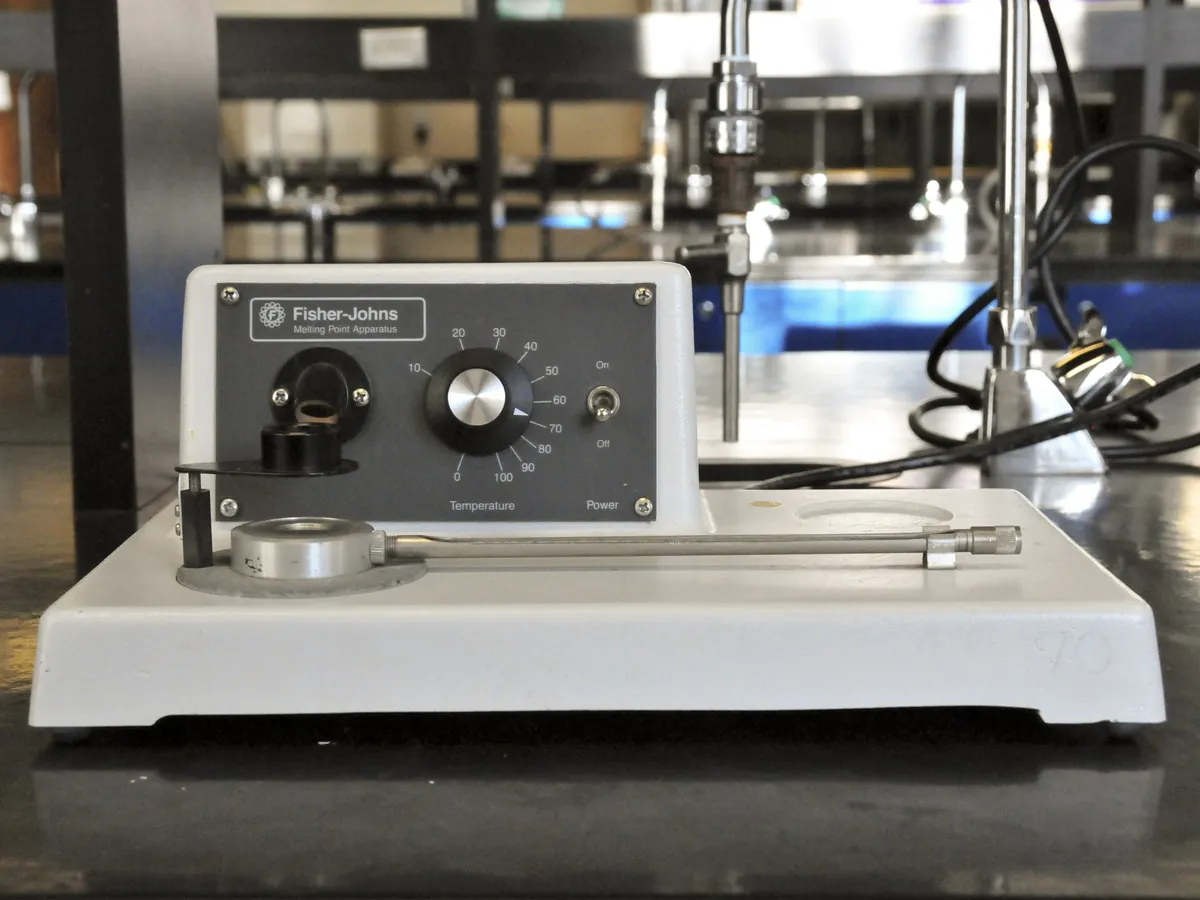
Reagents & standards
| Reagent | Grade / specification |
|---|---|
| Melting point reference standards | Certified standards bracketing the expected melting point, for calibration and system checks |
| Capillary tubes | Glass, closed at one end, about 1 mm internal diameter, as specified in the pharmacopoeia |
| Desiccant | For drying the sample, if the monograph requires (for example silica gel) |
Preparing the sample
- 01
Dry
Dry the sample as the monograph states.
- 02
Powder
Grind to a fine powder.
- 03
Pack
Fill a capillary to about 3 mm and pack tightly.
- 04
Pre-heat
Bring the block to about 5–10 °C below the expected point.
- 05
Ramp
Insert and heat at about 1 °C/min.
- 06
Read
Record the start and end of melting.
Procedure
- 1Unless the monograph says otherwise, dry the sample (for example in a desiccator over silica gel for 24 hours).
- 2Grind a small amount to a fine powder.
- 3Fill a capillary with the powder and pack it by tapping or dropping it through a glass tube until the packed column is about 3 mm high.
- 4Heat the block to about 5–10 °C below the expected melting point and let it stabilise.
- 5Insert the capillary and heat at 1 ± 0.5 °C per minute.
- 6Record the temperature at which the column collapses against the wall or liquid first appears (start), and the temperature at which the sample becomes completely liquid (clear point).
- 7Repeat with a second capillary.
Standard preparation
- 1Before testing, check the apparatus with a melting point reference standard whose certified value is close to the expected melting point, under the same conditions.
Notes for analysts
- This is a compendial test; labs normally verify it (show it works in their hands) rather than fully validate it.
- Heating too fast gives falsely high results.
- If the substance melts with decomposition, follow the monograph's instructions for the start temperature and how to read the point.
- A mixed melting point (sample + reference standard 1 : 1) that is not depressed supports identity.
Method parameters (typical)
| Start temperature | About 5–10 °C below the expected melting point (check your chapter and SOP) |
|---|---|
| Heating rate | 1 ± 0.5 °C/min (typical) |
| Column height | About 3 mm, tightly packed |
| Capillary | Pharmacopoeial glass capillary, about 1 mm internal diameter |
| Detection | Visual or automatic (light transmission), with video record |
| Replicates | At least duplicate capillaries |
System suitability & sequence
| Parameter | Limit |
|---|---|
| Reference standard check | Standard close to the expected point melts within its certified tolerance |
| Duplicate agreement | As defined in your SOP (for example within 0.5 °C) |
Typical sequence
- 1Reference standard check
- 2Sample capillary 1
- 3Sample capillary 2
What result passes
- The melting range lies within the limits of the monograph or specification. For example, paracetamol is commonly specified to melt between about 168 °C and 172 °C; check your current monograph.
- Example result: start 169.2 °C, clear point 170.6 °C. Melting range 169.2–170.6 °C, which complies with 168–172 °C.
Validation parameters (ICH Q2(R2))
| Parameter | Typical requirement |
|---|---|
| Specificity | Mixed melting point with the reference standard can support identity |
| Precision | Repeatability of duplicate capillaries within the SOP limit |
| Accuracy | Demonstrated through calibration with certified reference standards |
Run this method in LimsPulse: specifications and STPs under version control, results calculated and checked against limits, and a signed Certificate of Analysis.