In Vitro SPF and UVA Protection of Sunscreens
A measured amount of sunscreen is spread evenly on roughened PMMA plates. UV transmittance is measured from 290 to 400 nm. SPF is calculated by weighting transmittance with the erythemal action spectrum and a reference sun spectrum; UVA-PF uses a UVA action spectrum after a controlled UV pre-irradiation; critical wavelength comes from the absorbance curve.
- Cosmetics & personal care
- UV transmittance of a product film on PMMA plates (290–400 nm)
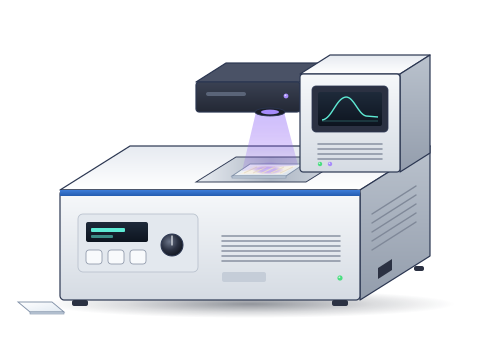
- SPF analyser
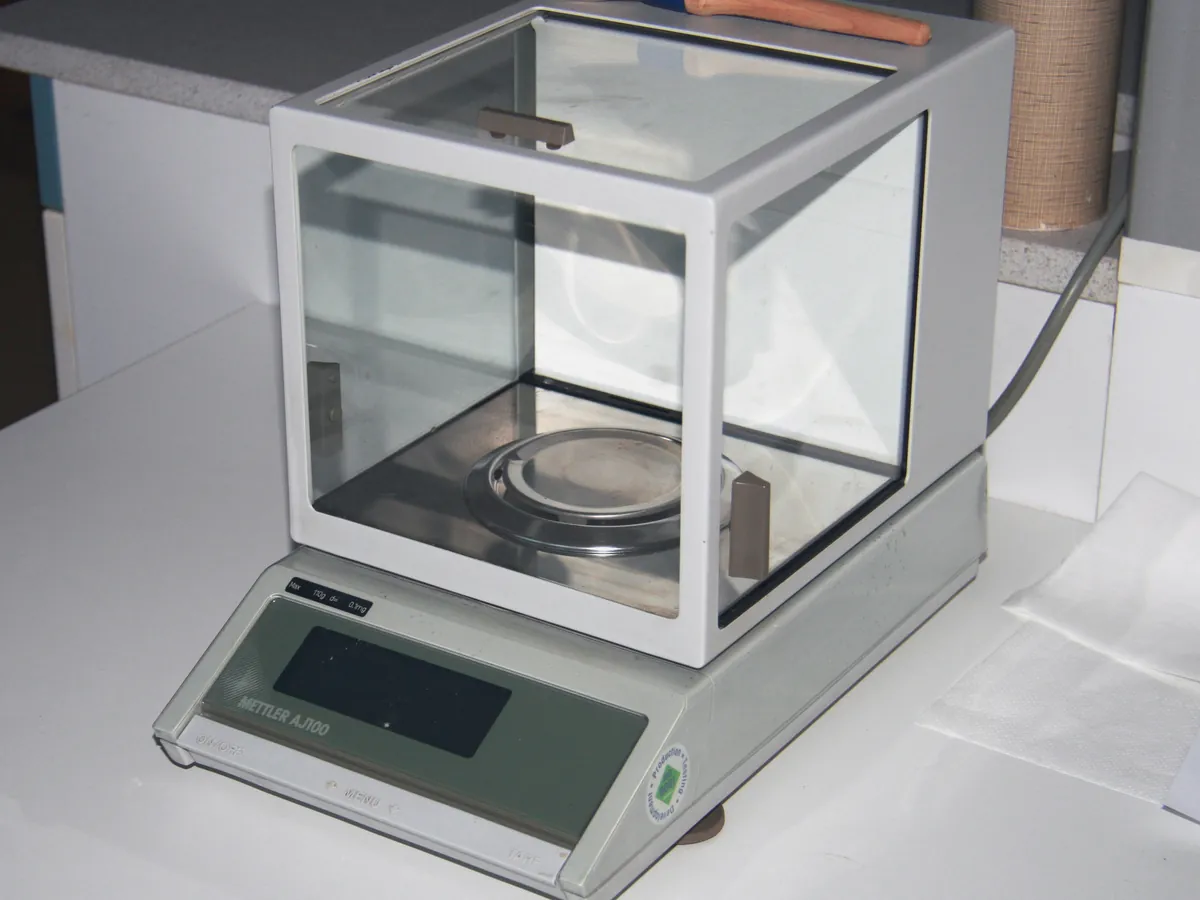
- Analytical balance
Reference: Typical procedure based on ISO 24443 (in vitro UVA protection) and the principles of ISO 23675 (in vitro SPF). The in vivo test ISO 24444 remains the reference for the SPF stated on labels in many markets; check what your regulator accepts.
Why this method works
Sunburn is caused mainly by UVB, with some contribution from UVA. Each wavelength's ability to cause sunburn is described by the erythemal action spectrum E(λ), and the amount of each wavelength in sunlight by a reference solar spectrum S(λ). A sunscreen film lets through a fraction T(λ) of the light. The sunburn-weighted dose without the film is the sum of E(λ)·S(λ); with the film it is the sum of E(λ)·S(λ)·T(λ). SPF is the ratio of the two: if the film cuts the weighted dose to one-twentieth, SPF is 20. UVA-PF is calculated the same way with the persistent pigment darkening (PPD) action spectrum and a UVA source spectrum from 320 to 400 nm. In ISO 24443 the measured curve is first adjusted (scaled) so that its calculated SPF matches the product's labelled in vivo SPF, then the plate is irradiated with a dose proportional to the initial UVA-PF to include photostability, and UVA-PF is calculated from the final spectrum. The critical wavelength is the wavelength at which the area under the absorbance curve from 290 nm reaches 90% of the total area to 400 nm.
Instruments used
Reagents & standards
| Reagent | Grade / specification |
|---|---|
| PMMA plates | Moulded (and, for some methods, sandblasted) plates with certified surface roughness |
| Blank | Glycerine (or the substance stated in the method) for the reference plate |
| Reference sunscreen | Reference product of known value specified by the standard |
Preparing the sample
- 01
Condition
Bring product and plates to room temperature.
- 02
Weigh dose
Apply product as small dots at the specified dose, e.g. about 1.3 mg/cm².
- 03
Spread
Spread evenly over the full plate within a fixed time.
- 04
Settle
Leave in the dark for the specified drying time.
- 05
Scan
Measure transmittance at several spots per plate, 290–400 nm.
- 06
Irradiate & rescan
For UVA-PF, expose to the calculated UV dose and scan again.
Procedure
- 1Verify the instrument and run the blank plate to set 100% transmittance.
- 2Weigh the product onto a fresh PMMA plate at the dose given in the method (for ISO 24443 typically about 1.3 mg/cm² on moulded plates), placing it as many small dots over the surface.
- 3Spread quickly and evenly with a pre-saturated gloved finger or automated spreader: light strokes first, then firmer pressure, for the time in the method.
- 4Leave the film to settle in the dark at room temperature (typically 15–30 minutes).
- 5Measure transmittance from 290 to 400 nm in 1 nm steps at several positions on each plate. Use at least three plates (more if variability is high).
- 6For UVA-PF, calculate the pre-irradiation UVA-PF, expose the plates to the dose the standard specifies from a calibrated solar simulator, and rescan.
- 7Run the reference sunscreen in the same series and check it falls in its expected range.
Standard preparation
- 1Prepare reference sunscreen plates exactly as for samples. The result must fall within the range stated in the method before sample results are accepted.
Notes for analysts
- The worked example is a deliberately simplified four-band version to show the logic of the calculation; it is not a real spectral calculation.
- Film application is the largest source of error. Weigh the dose accurately and keep spreading identical between plates and analysts.
- ISO 24444 (in vivo SPF) is mentioned only as the reference method; this page does not describe human testing.
- Spray products are usually collected into a container first and then applied to plates like a lotion, unless a specific spray method is used.
Method parameters (typical)
| Wavelength range | 290–400 nm (UVA-PF calculated over 320–400 nm) |
|---|---|
| Step | 1 nm |
| Application dose | About 1.3 mg/cm² on moulded PMMA (ISO 24443); as specified in other methods |
| Plates | At least 3 per product; several spots per plate |
| Drying | 15–30 min in the dark at room temperature |
| Weighting spectra | Erythemal action spectrum (SPF); PPD action spectrum (UVA-PF); standard reference sun / UVA source spectra |
System suitability & sequence
| Parameter | Limit |
|---|---|
| Instrument verification | Wavelength and transmittance verification in date |
| Reference sunscreen | Within the range stated in the method |
| Plate variability | Coefficient of variation or confidence interval within the method limit |
Typical sequence
- 1Blank plate
- 2Reference sunscreen plates
- 3Sample plates (≥ 3)
- 4UV irradiation (for UVA-PF)
- 5Rescan
- 6Calculation and review
Calculation with a worked example
Where
- E(λ)
- Erythemal action spectrum (sunburn effectiveness at each wavelength)
- S(λ)
- Reference solar spectral irradiance
- T(λ)
- Measured transmittance of the product film (fraction)
- w(λ)
- Normalised sunburn weight of each band (all weights add up to 1)
Given
- Simplified 4-band example (illustrative only)
- Real calculations use 1 nm steps from 290 to 400 nm with tabulated spectra
- 290–300 nm
- w = 0.20, T = 0.02
- 300–310 nm
- w = 0.45, T = 0.03
- 310–320 nm
- w = 0.25, T = 0.06
- 320–400 nm
- w = 0.10, T = 0.20
Working
- 1
Weighted transmitted dose = 0.20 × 0.02 + 0.45 × 0.03 + 0.25 × 0.06 + 0.10 × 0.20
- 2
= 0.0040 + 0.0135 + 0.0150 + 0.0200 = 0.0525
- 3SPF = 1 ÷ 0.0525 = 19.0
- 4
Absorbance in each band = −log₁₀ T: 1.70, 1.52, 1.22 and 0.70 — the film absorbs most strongly in UVB
Illustrative in vitro SPF ≈ 19. Note that the weakly protected UVA band still contributes the largest share (0.0200) of the transmitted sunburn dose.
What result passes
- UVA protection: in the EU, Commission Recommendation 2006/647/EC expects UVA-PF to be at least one-third of the labelled SPF and a critical wavelength of at least 370 nm for a UVA claim.
- Broad-spectrum claims in the US rely on a critical wavelength of at least 370 nm.
- In vitro SPF results used for screening or batch consistency are compared with the product's development data; label SPF must be supported by the method your regulator accepts (traditionally in vivo ISO 24444).
Validation parameters (ICH Q2(R2))
| Parameter | Typical requirement |
|---|---|
| Precision | Plate-to-plate and day-to-day variability with the reference sunscreen |
| Accuracy | Agreement of reference sunscreen with its stated range; for ISO 23675, agreement with in vivo data as described in the standard |
| Robustness | Effect of application dose, spreading time, drying time and plate lot |
Run this method in LimsPulse: specifications and STPs under version control, results calculated and checked against limits, and a signed Certificate of Analysis.