Jar tester · Calibration procedure
Paddle speed check
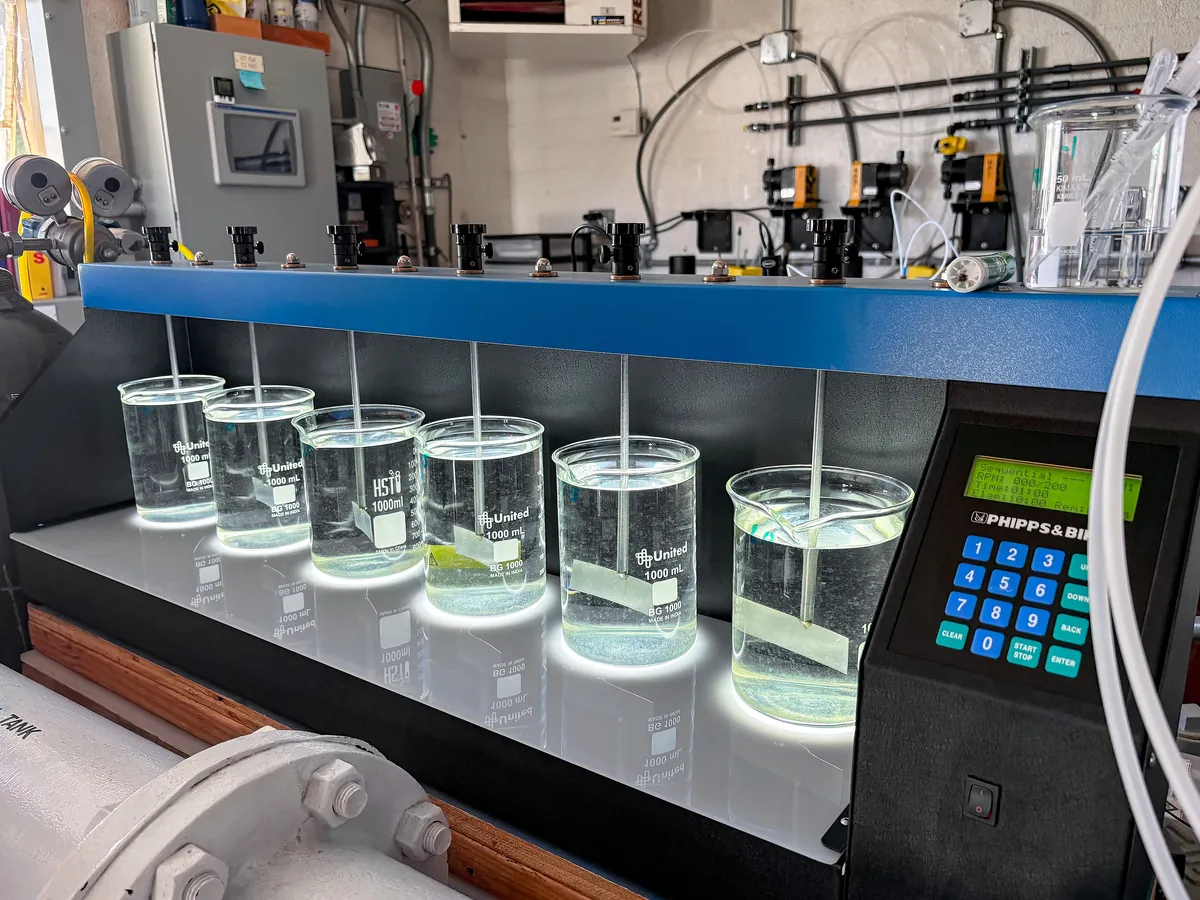
Verifies with a calibrated tachometer that each paddle turns at the set speed across the rapid- and slow-mix range.
PURPOSE
Why this is checked
Mixing intensity controls how coagulant spreads and how flocs grow. If paddles turn faster or slower than set, or differ from one another, jar results are not comparable or do not represent the plant.
Frequency
Typically six-monthly or annually and after repair, as defined in your SOP.
Learn how the Jar tester worksYOU WILL NEED
Standards & tools
- Calibrated optical (non-contact) or contact tachometer, traceable to national standards
- Reflective tape for optical tachometers
- Calibrated stopwatch for timer verification
BEFORE YOU START
Prerequisites
- Jars filled with water to the normal working volume (load affects speed on some units)
- Paddles straight and set at the same depth
PROCEDURE
Step by step
- 1Attach a small piece of reflective tape to each paddle shaft.
- 2Set the apparatus to the first test speed (for example 20 rpm) and let it run for a minute.
- 3Measure the speed of each paddle with the tachometer and record it.
- 4Repeat at other set points covering the range used (for example 40, 100, 200 and 300 rpm).
- 5Check the timer against a stopwatch over a set period.
- 6Calculate the deviation from set speed for each paddle.
RECORD
Example observation table
| Set speed (rpm) | Measured, paddle 1 (rpm) | Deviation (rpm) | Deviation (%) |
|---|---|---|---|
| 20 | 20.4 | +0.4 | +2.0 |
| 40 | 39.6 | −0.4 | −1.0 |
| 100 | 101.2 | +1.2 | +1.2 |
| 200 | 198.5 | −1.5 | −0.75 |
| 300 | 302.4 | +2.4 | +0.8 |
CALCULATION
How to calculate the result
Formula
Deviation (rpm) = measured − set; Deviation (%) = (measured − set) ÷ set × 100
Worked example
- 1At 20 rpm: 20.4 − 20 = +0.4 rpm; 0.4 ÷ 20 × 100 = +2.0%
- 2At 300 rpm: 302.4 − 300 = +2.4 rpm; 2.4 ÷ 300 × 100 = +0.8%
ACCEPTANCE CRITERIA
Pass if
- Each paddle typically within ±2 rpm or ±5% of the set speed, whichever is larger, as defined in your SOP
- All paddles within the same tolerance of each other
- Timer within about ±1% over the checked period
IF IT FAILS
What to do
- Label the apparatus and do not use it for dose optimisation.
- Check belts, couplings and paddle alignment; repeat the check.
- Have the motor or controller serviced, then repeat the check before use.
In LimsPulse · Calibration Management
LimsPulse schedules this calibration, records the result against limits, and blocks the instrument everywhere if it fails or goes overdue.