DO meter · Calibration procedure
Air and zero calibration
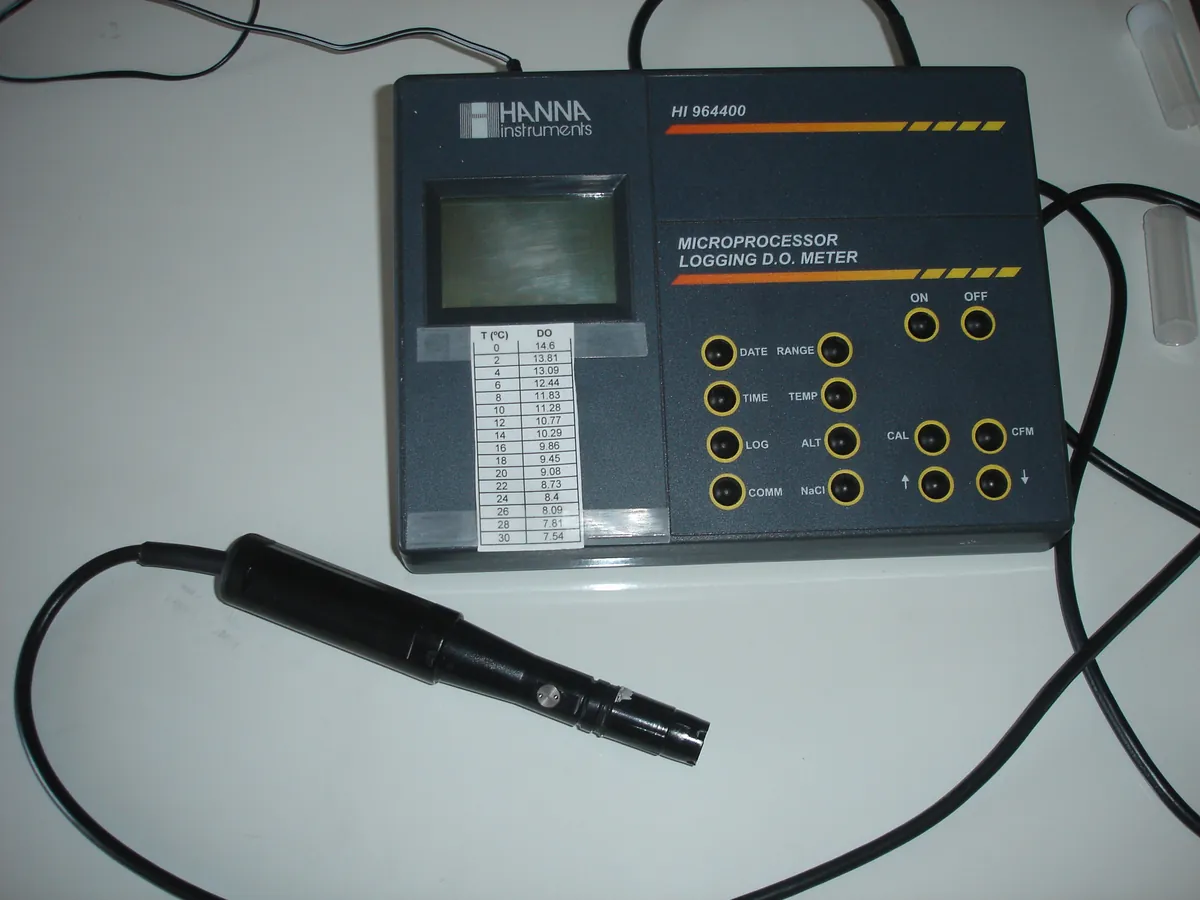
Sets the DO sensor's 100% point in water-saturated air and its 0% point in oxygen-free solution, then checks the reading in air-saturated water against the solubility table.
PURPOSE
Why this is checked
DO sensors drift as membranes, electrolyte or sensor caps age. A two-point calibration fixes the slope and zero; the check in air-saturated water confirms the meter reads true mg/L at the actual temperature and pressure.
Frequency
Air calibration typically daily or before use; zero calibration weekly or monthly, or as defined in your SOP.
Learn how the DO meter worksYOU WILL NEED
Standards & tools
- Water-saturated air (calibration sleeve or bottle with a little water)
- Zero-oxygen solution, for example freshly prepared sodium sulphite solution (about 2% w/v in water, sometimes with a trace of cobalt salt as catalyst)
- Calibrated barometer (or the meter's built-in barometer) and reference thermometer
- Oxygen solubility table (for example from ISO 5814)
BEFORE YOU START
Prerequisites
- Membrane or sensor cap in good condition; electrolyte filled (electrochemical sensors)
- Probe polarised for the time stated by the supplier
- Probe and calibration vessel at a stable temperature
PROCEDURE
Step by step
- 1Place the probe in the calibration sleeve with water-saturated air, out of direct sun and draughts.
- 2Enter or confirm the barometric pressure and set salinity to zero for fresh water.
- 3When the reading is stable, accept the 100% (air) calibration.
- 4Rinse the probe and place it in the zero-oxygen solution; when stable, accept the zero calibration.
- 5Rinse the probe thoroughly with purified water.
- 6Check: measure air-saturated water (water stirred or aerated until saturated) and compare with the theoretical value from the solubility table corrected for pressure.
RECORD
Example observation table
| Check | Condition | Expected | Reading | Difference |
|---|---|---|---|---|
| Zero | Sodium sulphite solution | 0.00 mg/L | 0.03 mg/L | +0.03 mg/L |
| Air-saturated water | 25.0 °C, 985 hPa | 8.03 mg/L | 8.01 mg/L | −0.02 mg/L |
CALCULATION
How to calculate the result
Expected DO (mg/L) = DO at saturation from the table (at 1013.25 hPa) × (Barometric pressure ÷ 1013.25 hPa)
- Saturation DO in fresh water at 25 °C and 1013.25 hPa ≈ 8.26 mg/L (from the solubility table)
- Barometric pressure = 985 hPa
- Expected = 8.26 × 985 ÷ 1013.25 = 8.03 mg/L
- Reading 8.01 mg/L → difference −0.02 mg/L
ACCEPTANCE CRITERIA
Pass if
- Zero reading typically not more than about 0.1 mg/L.
- Air-saturated water reading typically within ±0.2 mg/L (or about ±2% saturation) of the expected value, or the limits in your SOP.
- Sensor slope or calibration value within the range given by the supplier.
IF IT FAILS
What to do
- Check pressure and salinity settings and that the probe is fully polarised.
- Replace the membrane and electrolyte, or the sensor cap, and recalibrate.
- Prepare fresh zero solution.
- Label the meter out of calibration if it still fails.
In LimsPulse · Calibration Management
LimsPulse schedules this calibration, records the result against limits, and blocks the instrument everywhere if it fails or goes overdue.